Showing posts with label DMZ. Show all posts

Sunday, September 28, 2014

Korean DMZ Veterans 1954 to 1991


At the link is a 3 minute video of photos of Freedom Bridge and the DMZ.  I think I have stood in every location around the bridge from which each photo was taken.  To all my good friends and brothers who have stood guard at Freedom Bridge and patrolled the DMZ in those years:  Keep up the Fire and Stands Alone.

Thanks to Thomas Lucken for putting this together and posting it.

Korean DMZ Veterans 1954 to 1991


Published on Sep 27, 2014
This is dedicated to all those who served on the Korea DMZ from 1954 to 1991. We did a duty, most never knew about or will never understand! More then a few of our brothers gave it all and the 

Thursday, August 21, 2014

Ground Game: Tunnels in Gaza, Korean Peninsula

Ground Game: Tunnels in Gaza, Korean Peninsula


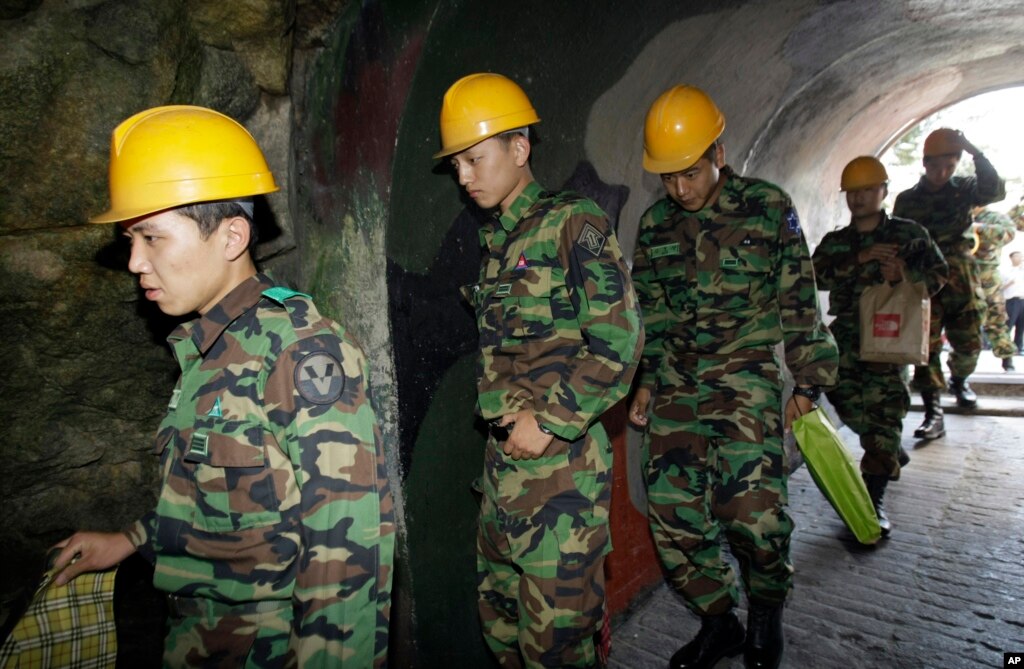
An Israeli army officer shows journalists a tunnel allegedly used by Palestinian militants for cross-border attacks from Gaza into Israel, July 25, 2014.
August 21, 2014 1:52 PM
The Palestinian militant group Hamas may have drawn global attention for using tunnels in its latest war with Israel, but the Gaza Strip isn’t the only place where digging has factored into an ongoing conflict.
Just look east to the divided Korean Peninsula.
North Korea is suspected of having as many as 20 cross-border attack tunnels under the Demilitarized Zone, or DMZ, some South Korean and U.S. security analysts say.
South Korean officials base their suspicions on testimony from North Korean defectors, some of whom claimed to have built the passages, say analysts such as Go Myong-Hyun, a researcher at the Asian Institute for Policy Studies in Seoul.
korea mapkorea map
South Korean forces and their U.S. allies have found only four infiltration tunnels – three in the 1970s, one in 1990. But the South Korean Defense Ministry continues to be on the alert for more.
"We don’t ignore even the smallest signs of a possible tunnel because these tunnels could determine the outcome of a war and our country’s survival," it told The New York Times in a faxed statement in 2012.  
Meanwhile, at least one South Korean company, the Panmunjom Travel Center, offers a specialized DMZ tour that includes an “infiltration tunnel” visit.
For decades, some South Korean individuals have looked for cross-border tunnels, too – but critics accuse them of using unscientific methods and wasting money and effort.
But there’s no disputing the tunnels that both Hamas and North Korea have built, in their own territories, for defensive purposes.
Other similarities can be found between the North Korean tunnels and those in Hamas-run Gaza, as well as between the forces trying to locate them. But, there are significant differences, too.
Going on offense
Both Hamas and Pyongyang have built cross-border tunnels in pursuit of the same military objective: to sneak their fighters behind enemy lines and hurt enemy morale.
In the current Israel-Hamas conflict, Israeli forces staged a ground offensive against Gaza militants from July 17 to August 5, destroying 32 tunnels, 14 of which crossed into Israel. Militants used the tunnels to ambush and kill 11 Israeli soldiers on Israeli territory.
Gaza StripGaza Strip
Hamas has described the tunnels as strategic weapons in its decades-long fight against Israel. Gaza, the world’s most heavily-militarized zone, shares a border running 59 kilometers, or nearly 37 miles, with the Jewish state.
Israeli authorities have accused Hamas of plotting to use the tunnels to kill civilians in small Israeli communities near the Gaza border.
As for North Korea, its founder and supreme leader, Kim Il Sung, had called for tunneling under the DMZ, which stretches approximately four kilometers or 2.5 miles wide and 240 kilometers or 150 miles long.
The tunnels were intended to give North Korea the capability to send thousands of soldiers to exit points several kilometers south of the DMZ, behind South Korea’s front-line combat posts, said David Maxwell, a retired U.S. Army Special Forces colonel who served in South Korea. 
"If North Korean infiltrators were dressed in South Korean uniforms, and also attacked U.S. forces near the DMZ, that would have a devastating effect on the trust between the U.S. troops and their South Korean allies," said Maxwell, now an analyst at Georgetown University’s Center for Security Studies in Washington.
Maxwell said such guerrilla tactics have long been a part of North Korean military doctrine.
Tunnels as defense
The U.S. and Israeli militaries suspect Pyongyang and Hamas have built many more tunnels for a different purpose: protecting their military assets from aerial assault.
South Korean soldiers visit the 2nd Underground Tunnel, found in 1975 near the city of Cheorwon, on Sept. 18, 2008.
In 2012, Brig. Gen. Neil H. Tolley, then-commander of all U.S. special operations forces in South Korea, said at a special-ops industry conference that North Korea had hidden its military infrastructure in an underground network. He estimated the network includes 20 subterranean air bases,National Defense magazine reported.
Reports from North Korean defectors and satellite imagery indicate Pyongyang has built thousands of tunnels into mountains and hillsides to house artillery, ammunition and medical supplies, said Maxwell, the Georgetown security analyst.
(Continued at the link below)

Friday, June 20, 2014

Obama to Overrule Military on Landmines?

Interesting timing on this.  

As an aside, I wonder if the north Koreans will get rid of the land mines on their side of the DMZ (some of which were emplaced to keep north Koreans from trying to defect to the South.  I remember being on the DMZ in the 1980's on Christmas on a rice patty dike across from Propaganda Village seeing north Korean anti-personnel mines detonate on the north Korean fence line.

And then of course this will not solve the problem of the massive numbers of land mines (and other ordnance) in and around the DMZ that were left over from the 1950-1953 and have been displaced due to flooding over the years.  It used to be quite common to find all kinds of ordnance piled on the side of the road next to rice fields while conducting training around the DMZ.  The farmers would find them in their fields and put them on the side of the road when US forces were in the area training because they knew they would get EOD to dispose of them.

June 20, 2014

Obama to Overrule Military on Landmines?

By Dustin Walker
http://www.realcleardefense.com/articles/2014/06/20/obama_to_overrule_military_on_landmines_107281-full.html?print=1
The Obama administration may be moving closer to banning landmines that U.S. military officials have said are critical to deterring aggression from North Korea.
The Wall Street Journal reports that President Obama is set next week to approve the Ottawa Treaty, an international treaty banning landmines, and position the Department of Defense to comply with the treaty.
However, a congressional source tells RealClearDefense that the timing of such an announcement is unclear and may be put off in the face of potential criticism from Congress, concerns from the South Korean government, and lingering reservations at the Pentagon.
The Ottawa Treaty officially closed for signature on March 1, 1999. But that doesn't prevent President Obama from symbolically signing and aligning U.S. practices with the treaty, effectively acceding to it. 
Yet one of the biggest potential sources of opposition to the treaty may be some of President Obama’s top military advisers who have defended the use of landmines as essential to fulfilling U.S. national defense needs.
Chairman of the Joint Chiefs Martin Dempsey testified before Congress in March of this year that he had rendered his military advice that landmines are “an important tool in the arsenal of the armed forces of the United States.” Dempsey emphasized that U.S. landmines can be set for specific times and are designed to self-destruct, thus posing less of a danger to civilians during and after conflicts.
Less than a month later, General Curtis Scaparrotti, the current commander U.S. commander in Korea, testified before Congress that landmines “are a critical element in the defense of the Republic of Korea and our interest there. And they're a critical element of our contingency plans, as well.”
A recent 30-page Joint Staff assessment detailed the dangers of a landmine ban with special concern for U.S. defense of South Korea, according to sources briefed on the report. However, the assessment remains classified.
The Ottawa Treaty aims to eliminate anti-personnel landmines, and has contributed to a dramatic decline in related casualties. Between 1999 and 2011, the number of reported new landmine casualties dropped by more than half, from 8,807 to 4,286. Most casualties occur in just a few countries – Afghanistan, Colombia, and Cambodia had the worst records during that twelve year period.
161 countries are currently parties to the treaty. In addition to the United States, non-signatories include China, Russia, North Korea, South Korea, Israel, India, and Pakistan.
Treaty advocates say landmines are of questionable military value in the modern age. “While in the past they may have protected borders and slowed advancing troops, now most armies are mobile and can get through a minefield in less than 30 minutes,” says the International Campaign to Ban Landmines. “Modern motion detection equipment, night detection technology and strategically placed guns can protect military installations, borders and other areas better than landmines.” Regardless, landmine opponents say the humanitarian costs of landmines far outweigh any conceivable military utility.
Opponents of signing the Ottawa Treaty say that it fails to distinguish between “dumb” and “smart” mines. Dumb mines, also called persistent mines, cannot self-destruct or self-deactivate. As a result, they can remain a danger to civilian populations decades after wars end.
In 2011, the United States completely ended the use of persistent landmines, completing a process started under the Bush administration in 2004 to remove all such mines from service.
But the United States has maintained the right to use smart mines designed to self-destruct – typically after a period of four hours, 48 hours, or 15 days. If the self-destruct mechanism fails, the landmine’s battery will go dead within 90 days, disarming the explosive.
Despite these advances in technology, smart anti-personnel mines are banned under the Ottawa Treaty.
report by the National Research Council concluded that “the current inventory of self-destructing and self-deactivating U.S. [anti-personnel landmines] is militarily advantageous and safe. They achieve desired military objectives without endangering U.S. warfighters or noncombatants more than other weapons of war.” The report also pointed out that many alternatives that are compliant with the Ottawa Treaty “may be less humane than present U.S. self-destructing and self-deactivating landmines.”
In the past, the Department of Defense has reported to the Government Accountability Office that smart mines have a 99.99-percent self-destruct reliability rate.
Security and stability on the Korean Peninsula has loomed over the consideration of the Ottawa Treaty under the last three presidential administrations.
Millions of devices were deployed by both sides during the Korean War. In the decades after the war’s end, South Korea has refused to sign the Ottawa Treaty and has continued to lay new landmines along the demilitarized zone (DMZ) to deter North Korea’s million-man army from launching an invasion. In total, over one million landmines remain deployed by both sides along the DMZ.
The U.S. currently has a variety of mines stockpiled for a potential contingency in Korea, where 25,000 American troops are currently stationed. However, the U.S. does not maintain minefields anywhere in the world, including Korea.
During the Ottawa Treaty’s negotiation, the Clinton administration sought unsuccessfully to include an exception for landmines deployed in the DMZ between North and South Korea. This failure, combined with the lack of treaty-compliant alternatives to anti-personnel landmines, led President Clinton to leave the treaty unsigned when he left office.
The Bush administration defended the “valid and essential” role of landmines in military operations. In particular, administration policy emphasized the distinction between smart and dumb mines. Smart mines would allow the U.S. to address the humanitarian problems associated with landmines, while preserving needed military capability, the administration argued.
After conducting its own policy review, the Obama administration agreed with Bush administration and decided not to sign the treaty. “This administration undertook a policy review and we decided our landmine policy remains in effect,” State Department spokesman Ian Kelly said in November 2009. “We made our policy review and we determined that we would not be able to meet our national defense needs nor our security commitments to our friends and allies if we sign this convention.”
But in 2010, the Obama administration decided under intense political pressure to revisit the issue with a comprehensive review. The state of that review is unclear.
RealClearDefense reached out to the White House for clarification late last night, but had not received a response at the time this report was published.  
So what has changed that makes the signing the treaty a good idea now?
Not much, according to General Dempsey. At a March hearing before the House Armed Services Committee, Rep. Randy Forbes (R-VA) asked the chairman of the joint chiefs if “anything changed between 2009 and today that would render our use of those mines any less important than it was in 2009.” Dempsey responded, “My military judgment is actually [that] the tensions on the peninsula have increased.”
This has some on Capitol Hill concerned.
“President Clinton, President Bush, President Obama back in 2009, our allies in Northeast Asia, our senior military leaders in the Pentagon, and U.S. Forces Korea have all opposed signing this treaty,” one congressional source said. “If the White House is going to move ahead and comply with its provisions, they first need to explain just what has changed on the Korean Peninsula and along the DMZ in the last five years that suddenly makes removing these mines a good idea.”
Congressional opposition is already building to signing the Ottawa Treaty. During an appearance on Fox Business yesterday, Rep. Buck McKeon (R-CA), chairman of the House Armed Services Committee pledged support for the efforts of Rep. Forbes, who plans to introduce an amendment to the defense appropriations bill under consideration in the House that would prohibit funding to implement the convention. The amendment’s passage could set up a major partisan debate during the conference process on the appropriations measure. 

Dustin Walker is the Editor of RealClearDefense.

Monday, January 6, 2014

U.S. to deploy mechanized infantry battalion to S. Korea

A double edged sword here.  USFK is undoing years of decline of US combat capabilities but the rotational force presence concerns the Koreans.  There is a lot going on with the alliance right now that needs to be worked out from the special measures agreement to the transformation of the CFC (e.g., OPCON transfer) to preparing for regime collapse while maintaining the necessary strong deterrence and defense capabilities.  With US fiscal challenges the Koreans worry about the easy decision to not rotate forces in order to save money.  One of the ways to potentially alleviate those fears and strengthen interoperability might be to return US forces to rotations on the DMZ conducting actual combat patrols integrated with the frontline ROK forces.
V/R
Dave

   The U.S. Army will deploy a mechanized infantry battalion made up of advanced battle tanks to South Korea to bolster defense on the peninsula as part of a rotational force, a military source said Tuesday.

   The battalion armed with M1A2 battle tanks and M2A3 armored infantry fighting vehicles will depart their base on Thursday to join the U.S. Army's 2nd Infantry Division stationed in South Korea, the source said, asking for anonymity.

   About 800 American service members will serve in North Gyeonggi Province, just south of the demilitarized zone separating the two Koreas, for nine months as part of planned enhancements to American forces in the country, he said.

   The latest deployment shows the U.S. commitment to the military rebalancing to the Asia-Pacific region amid rising tensions in the strategically important region.

   It also comes at a time when South Korean and U.S. forces have been beefing up their vigilance against potential political instability in North Korea following the execution of young leader Kim Jong-un's once-powerful uncle, Jang Song-thaek.

   Last September, a U.S. Army attack reconnaissance squadron returned to Camp Humphreys in Pyeongtaek, south of Seoul, after missions in Iraq with 30 OH-58D Kiowa Warrior helicopters.

   In April 2013, a U.S. chemical battalion was also redeployed to Camp Stanley in Euijeongbu, just north of Seoul, nine years after it withdrew from the peninsula in 2003.

   About 28,500 American service members are stationed in South Korea to help deter aggression from North Korea.

   By Kim Eun-jung
   SEOUL, Jan. 7 (Yonhap)
   ejkim@yna.co.kr
(END)

Friday, November 15, 2013

A trip to the DMZ (and a T-shirt to prove it): Korea divided on a solution

The key excerpt (and Hahm Chaibong can always be counted on to make provocative remarks):

There’s a sense of abandonment in a nation that has historically suffered when the world turned its back. Hahm Chaibong, president of the Asian Institute of Policy Studies, notes insecurity across the region. China and Japan are in an ongoing dispute over the East China Sea“not a very comforting scene for us”while the US is “preoccupied”. Japan has its hands full trying to rebuild its economy; China is “rather nonchalant” about North Korea’s nuclear ambitions. ”For us, we seem to find ourselves in a very similar situation again,” Hahm Chaibong told Crikey from the institute’s palatial study centre in the middle of Seoul.
There are still more than 28,000 American troops stationed on the Korean peninsula. But the symbolism of a transfer of control in the DMZ from the United Nations (a force always led by an American general) back to South Korea in 2015 has many nervous. It’s already been delayed from 2012, and theSouth Korean government has pleaded for even more time. A taskforce will report next year on how ready the South is to take control.
Hahm Chaibong said: ”Why are we battling with a system that has stood us in such good stead for such a long time? Are we not sending the wrong signal again? Any sense of weakening of US commitment to the region, to the Korean peninsulawhy are we tinkering with this command structure?
“Secretary Kerry is not interested in Asia, doesn’t know about Asia … What we see now is this rapid diminution of American interest in the region. It’s part of the leadership there.”
So if the North is off the leash and the South is on its own, what should the Park government do? Hahm Chaibong’s view is chilling: South Korea should nuke up, too. Nobody serious in government will talk about it, but hardliners like Hahm Chaibong are lobbying. “I think we should start seriously talking about it so people know we’re serious about it,” he said.
He cites an unsourced figure of 70% support among Koreans to nuclearise its munitions; others Crikey spoke to didn’t believe it was nearly that high. A government official who asked not to be named rejects the notion out of hand and insists diplomatic options aren’t exhausted. The official was more confident that the attitude of the Chinese is changing. “Momentum is growing,” the official said.
“It’s a taboo subject as far as the government is concerned, but they’re fully aware this debate is taking place,” Hahm Chaibong said of the nuclear option. “But it’s only to show the extent to which we’re going to go to change the status quo, which is the world leaving North Korea to develop its nuclear weapons.” That, Crikey points out, is a scary thought. “I’m trying to scare you,” he snapped back. “I’m seriously trying to scare people, especially the Chinese.

A trip to the DMZ (and a T-shirt to prove it): Korea divided on a solution
JASON WHITTAKER | NOV 15, 2013 12:49PM | EMAIL | PRINT

Opinions in South Korea are sharply divided on what to do about its nuclear neighbour. Crikey visited the no-man’s-land between still-warring nations to examine whether diplomacy is still an option.
Description: http://media.crikey.com.au/wp-content/uploads/2013/11/20131023-IMG_1807.jpg
“WELCOME TO THE JSA!” It’s the exclamation mark combined with the scrolling LED sign that encapsulate the deadly farce. Some 160,000 tourists annually visit the Joint Security Area, the gateway between North and South Korea that almost never opens, one of the most dangerous places on earth and conversely among the safest.


Similarly, the South Koreans Crikey met on a recent study tour. This is a nation still at war, alert if not alarmed. Everyone wants to talk about the “reunification issue”and opinions are sharply divided on a solutionbut it’s front of mind like traffic for Sydneysiders and coffee for Melburnians: conversation without urgency.
The bus winds through the landmine-filled countryside of the 4-kilometre-wide Demilitarised Zone, across booby-trapped bridges, from the JSA to the border. In the hills of the North we’re pointed to Kijong-dong, a sound-stage of a town built for show with barely any residents that the military tour guide only refers to as “Propaganda Village”. But the matching town on the South, Daeseong-dong, is as much of a sham: it’s a tax haven for farmers who are allowed to dodge compulsory military service as an incentive to keep them there.
What you quickly learn is there’s plenty of propaganda on both sides.
At least the South isn’t executing its own citizens. A local newspaper reported this week that 80 people had been executed by the Kim Jong-un regimefor watching foreign films. At the border, we’re warned against sudden movement and venturing too far from the guards (handsome men with clenched fists in dark sunnies, apparently chosen for their looks). The logistics are risiblethe main negotiation hut straddling the invisible border is locked on the North side and filled with South Korean guards for our visit; it’s reversed when tourists visit from the Northbut nobody is laughing.
North Korea is changingbut not fast enough for its neighbour. Kim Jong-un has banished the seven generals who carried his father’s coffin, and a regime that for decades put the military first is now interested in economic development. Tourism has opened up, and more industrial parks are popping up on satellite images.
“[Kim Jong-un] spent two-and-a-half years in Switzerland as a boy in boarding school,” Young Hie Kim, the editor-at-large and diplomatic correspondent for South Korean national daily JoongAng Ilbo, explained toCrikey. “There, unlike many North Koreans, he has come to realise what democracy is, what a democratic way of life is, and how well-to-do the outside world is, even South Korea. So in his mind, even when his father was still alive, I think he thought that the economy is our way. So as soon as he had a chance he is shifting from military-first to economy-first.
“But he has no money.” And that’s the key. If the regime wants foreign investment it will have to agree to resume talks. And under centre-Right President Park Geun-hye, the South Korea line is firm: there’s no negotiation while nuclear programs remain in place.
The fear of many in South Korea is that the United States is losing interest. Young Hie Kim believes while secretary of state Hillary Clinton was focused on south-east Asia, her replacement, John Kerry, is more interested in the Middle East, while President Barack Obama is distracted by domestic issues. The much-heralded “Asia pivot” has made another deviation, according to Young Hie Kim.
Description: http://media.crikey.com.au/wp-content/uploads/2013/11/20131023-IMG_1775.jpg
There’s a sense of abandonment in a nation that has historically suffered when the world turned its back. Hahm Chaibong, president of the Asian Institute of Policy Studies, notes insecurity across the region. China and Japan are in an ongoing dispute over the East China Sea“not a very comforting scene for us”while the US is “preoccupied”. Japan has its hands full trying to rebuild its economy; China is “rather nonchalant” about North Korea’s nuclear ambitions. ”For us, we seem to find ourselves in a very similar situation again,” Hahm Chaibong told Crikey from the institute’s palatial study centre in the middle of Seoul.
(Continued at the link below)

Monday, July 22, 2013

Changing The Korean Tour: Unit deployments would replace individual duty

This is probably the reason the ROK Military has leaked information about the delay in OPCON transfer  They are worried about the long term US commitment of forces on the Peninsula.

As I have proposed before, this could work if these rotational forces conducted a tour patrolling the DMZ integrated with ROK forces during their rotation.  The amount of training required to conduct DMZ patrols would sustain small unit combat readiness and the deployment on the DMZ would demonstrate sustained commitment to the alliance, enhance ROK-US interoperability, provide mission focus for the rotational units, and send a powerful message of the strength of the ROK-US Alliance to the north.  If we go to a rotational scheme we really need to put US forces back on the DMZ (and not simply in a US sector but as I said integrated with ROK forces throughout the entire DMZ - and I would also recommend rotating US Marines with the 6th ROK Marine Brigade in the Northwest Island as well.)
V/R
Dave
Army Times

July 29, 2013
Pg. 20
Cover story

Changing The Korean Tour

Unit deployments would replace individual duty
By Michelle Tan and Lance M. Bacon

One-year individual tours to South Korea may soon be replaced by deployments of trained and equipped combat units that will go for upwards of nine months at a time.

The Army is studying a plan that would rotate units in and out of South Korea — a plan that had the full support of Lt. Gen. Frank Wiercinski, who relinquished command of U.S. Army Pacific on July 2.
The idea of moving to rotational forces, as opposed to individual replacements, has been in the works for at least two years. No official decision has been announced and talks with the Korean government are ongoing, but many defense analysts say the writing is on the wall.

“Think about the increase in the level of preparedness and the training state those units are in,” Wiercinski said. “It’s amazingly higher [and] now that makes them even more of a potent force on the ground.

“It’s a game-changer,” he added. “It makes great sense. Tank crews, aircrews, machine-gun crews, squads, platoons — if you’re constantly rotating key people in and out, you’re never fully trained to the best you can possibly be.”

The June 25 announcement of a massive brigade combat team reorganization by Army Chief of Staff Gen. Ray Odierno would appear to support this idea. He named 10 BCTs that will be inactivated and said one more would be cut. His speech left out one critical word found in his prepared statement: “overseas.”

To cut an overseas BCT significantly narrows the field.

Two are based in Europe: The 2nd Cavalry Regiment in Vilseck, Germany, and the 173rd Airborne Brigade Combat Team out of Vicenza, Italy. The other is the 2nd Infantry Division’s 1st Armored Brigade Combat Team in South Korea.

The Army has cut two BCTs from Europe in recent years as it continues to beef up its Pacific presence. Odierno has long hinted that a honed rotational force on the Korea Peninsula would exponentially increase combat capabilities in the region.

Such a commitment would mark a significant change to the way the Army has done business for years, and the practice would increase the readiness of units stationed in one of the most volatile parts of the world.

The Army has about 19,000 soldiers stationed in South Korea, including the 2nd Infantry Division headquarters and the division’s 1st BCT. Other major units include the 19th Expeditionary Sustainment Command, the 1st Signal Brigade, the 35th Air Defense Artillery Brigade, the 65th Medical Brigade, the 501st Military Intelligence Brigade and Eighth Army.

The Army has been consolidating its forces in South Korea with a huge project to build up facilities at Camp Humphreys. U.S. Forces Korea broke ground July18 on a $324 million operations command center at the installation, according to Stars and Stripes.

Wiercinski said the volatility on the Korean Peninsula has kept him up at night.

“This is a 29-year-old five-star general without a lot of diplomatic or international experience but with potentially dangerous weapons,” he said of North Korean leader Kim Jong-un. “We need to be prepared for that. We need to be absolutely focused.”

That’s why officials at U.S. Army Pacific “fully support” moving to a rotational model, something the Army couldn’t do while it was committed in Iraq and Afghanistan, Wiercinski said.

“We certainly couldn’t do it during the last 11 years, but we’re out of Iraq and we’re pulling back from Afghanistan, and now the forces are available for us to consider this possibility,” he said. “[This] has the potential to be incredibly powerful. Now your force on the peninsula is truly ready to fight tonight.”

Who might go

The Hawaii-based 25th Infantry Division will be responsible for the Pacific theater for the foreseeable future. The Army has dedicated 79,000 troops there and has raised the commanding general’s profile by changing the billet to a four-star one; it had been a three-star billet for many years. Roughly 7,300 soldiers are scheduled to conduct 230 activities in 20 countries in fiscal 2014 — most with a close eye on North Korea.

And while the 25th Infantry Division does not have armored BCTs — the type of BCT now in South Korea — the Army’s BCT reorganization plan announced in June will leave the service with 12 armored BCTs in places such as Fort Hood and Fort Bliss in Texas, Fort Riley, Kan., and Fort Carson, Colo.
The rotational model has strong support in the rank and file because it will enhance readiness. Most soldiers take three months to get in the groove after reporting to the peninsula, and many get a short-timer’s attitude when they are three months from leaving. That leaves six good months of service.
The constant ebb and flow of soldiers makes consistency hard to find.

“Because of the sheer number of first-termers [assigned to South Korea], every three months you’re qualifying tank crews,” said one officer with extensive experience on the peninsula. “There is constant turmoil trying to keep crews together on different weapons systems.”

In the rotational model, a fully trained and equipped unit is ready and able to provide defense, humanitarian assistance and participate in multinational exercises from start to finish. And such deployments are nothing new to Pacific soldiers. More than 150,000 deployed to Iraq and Afghanistan since 2001.

But now the spotlight is on their backyard.

And the BCT reorganization optimizes the Army’s power projection. New and improved BCTs will have about 4,500 soldiers, an increase of about 1,000. This will enable a third maneuver battalion, as well as additional engineer and fires capabilities.

Specifically, engineer battalions will have gap-crossing and breaching capabilities while fires capability will go from a 2-by-8-gun fires battalion to a 3-by-6.

The changes follow “extensive modeling and analysis” that used 34 separate vignettes and 6,500 simulated battles that ranged from seven to 72 hours in length, said Col. Karl Konzelman of Army Operations and Plans’ Force Management Division. Extensive interviews were conducted with every division commander, dozens of combat BCT commanders and numerous battalion commanders and senior enlisted leaders.

The final result is more tooth and less tail. The Army will lose three battalions while greatly enhancing the 95 that remain.

It will also cut 12 headquarters. The reorganization puts more combat power at the tip of the spear, and then sharpens the tip, he said.

But that is not true of the BCTs stationed outside the continental U.S. They will stay at two maneuver battalions for now, mostly as a way to save on military construction costs, officials said.

That means a less capable BCT will take point in the world’s most dangerous place unless something changes.

Konzelman was quick to point out that a decision on the final BCT cut has not been made.
And while it seems the logical approach for many defense leaders and analysts, there are a couple of wild cards that could come into play.

One idea that has been floated in congressional and defense circles would keep the 1st Armored Brigade Combat Team in South Korea while rotating other units throughout the theater.

After all, the Army has invested a ton of money modernizing that BCT in recent years:
*It has M1A2 SEP Abrams tanks and M2/M3A3 Bradley Fighting Vehicles.

*The 2nd Combat Aviation Brigade has transitioned to UH-60L Black Hawks.

*The division took possession of 70 mine-resistant, ambush-protected vehicles. The 35th Air Defense Artillery Brigade is completing the Patriot Recapitalization Program.

“The Army Equipping Guidance 2013 Through 2016,” published June 20, seems to allude to such a scenario.

“Given recurring tensions in Korea, it is critical we keep units there ready to fight, prepare units for rotation to Korea, and balance new fieldings with training schedules,” it reads.
And it is not the first to make such allusions.

New defense strategy

Senior defense leaders on Jan. 26, 2012, unveiled a new defense strategy in light of pending budget cuts.

Then-Defense Secretary Leon Panetta assured “an adaptable and battle-tested Army” would remain the nation’s force for decisive action, capable of defeating any adversary on land.
“We will have a significant land force presence in places like Korea and in the Middle East … and we will also emphasize a rotational presence” to establish partnerships and training in other countries, he said.

But this “best of both worlds” scenario begs the question: Where would you put the deployed force? The Land Partnership Plan is relocating forces from north of Seoul to Camp Humphreys, which is busting at the seams.

It is not clear what would happen to the 3,400 South Korean Army augmentees assigned to U.S. units.
And there always is the question of cost.

Money would be saved by cutting the Korean BCT. While precise estimates aren’t available, an Army analysis of the reduction of two European BCTs estimated a savings of $2 billion over 10 years.
Not everyone will be happy with such savings — especially the 6,659 soldiers who receive a $300 monthly bonus for extending their Korean tours. Some are accompanied tours, which would continue, but many are unaccompanied soldiers who volunteered for a second year.

“People talk about the cost of basing a BCT in Korea, but rotating forces there would not be cheap either,” said one congressional staffer. “And you would have to ask where those units would be and what they would be doing. There are a number of U.S. military forces from all branches positioned throughout the region. But that place is a hot spot. If something goes down, you need to have a force that is ready to respond at a moment’s notice.”

South Korea by the numbers

19,000 -- U.S. Army soldiers in South Korea
79,000 -- U.S. Army soldiers in Pacific theater
1 -- U.S. Army brigade combat team now in South Korea

4 -- Stars worn by the general who leads the U.S. force in the Pacific.

Friday, February 15, 2013

Why Are We Still on the DMZ?


Well actually we are not really on the DMZ.  Or more accurately we do not have US forces regularly patrolling the DMZ as we did up until the early 1990's, except perhaps in the vicinity of the Joint Security Area at Panmunjom (but even there I think ROK forces now have complete responsibility).  That said I would argue against Mr. Buchanan and I would recommend that we actually return US forces to patrolling the DMZ, working with the ROK forces throughout the entire DMZ.  There are a number of reasons to do this, e.g, mission focus for US combat forces (and the training preparation for the mission is some of the best small unit training that can be done), demonstrations of increased Alliance commitment, and combined interoperability.  
V/R
Dave

Why Are We Still on the DMZ?
February 15, 2013


North Korea has just pulled off an impressive dual feat — the successful test both of an intercontinental ballistic missile and an atom bomb in the 6-kiloton range.

Pyongyang's ruler, 30-year-old Kim Jong Un, said the tests are aimed at the United States. So it would seem. One does not build an ICBM to hit Seoul, 30 miles away.

Experts believe North Korea is still far from having the capability to marry a nuclear warhead to a missile that could hit the West Coast. But this seems to be Kim's goal.

Why is he obsessed with a nation half a world away?

America has never recognized his, his father's or his grandfather's regime. We have led the U.N. Security Council in imposing sanctions. We have 28,000 troops in the South and a defense treaty that will bring us into any war with the North from day one, and a U.S. general would assume overall command of U.S. and Republic of Korea troops.

We are South Korea's defense shield and deterrent against the North.

And while America cannot abdicate her responsibility and role in this crisis, we should be asking ourselves: Why is this our crisis in 2013?

President Eisenhower ended the Korean War 60 years ago. The Chinese armies in Korea went home. Twenty years ago, the Soviet Union collapsed, Russia abandoned communism and ceased to arm the North, and Mao's China gave up world revolution for state capitalism.

Epochal events. Yet U.S. troops still sit on the DMZ, just as their grandfathers did when this writer was still in high school.
(Continued at the link below)
http://cnsnews.com/blog/patrick-j-buchanan/why-are-we-still-dmz

Monday, January 28, 2013

Along Korea's DMZ, Lone Forward-Deployed US Division Stays Prepared


Again, Mr Herman misses the significance of 2015.  It is not the transfer of wartime OPCON (we know that the Military Committee exercises operational control of the ROK/US Combined Forces Command so both Korea and the US have joint operational control over the combined force so the OPCON transfer is really a red herring), it is the dissolution of the ROK/US Combined Forces Command that is going to occur in 2015.

But as an aside, although the article notes that 2ID has been patrolling close to the DMZ since 1965, it would be really good if it were to return to patrolling the actual DMZ.
V/R
Dave

Along Korea's DMZ, Lone Forward-Deployed US Division Stays Prepared


M1-A2SEP Abrams tanks participating in a platoon qualifying exercise near the DMZ. (Photo: VOA / Steve Herman)

January 28, 2013
POCHEON, SOUTH KOREA — At a time of rising tensions on the Korean peninsula, a quartet of U.S. Army “Abrams” M1-A2SEP tanks rolls onto the frozen ground of the Rodriguez Live Fire Range near the DMZ during one of the coldest days of the winter.

The tanks and their crews, from Dragon Company of the 1st Battalion’s 72nd Armor Regiment (1-72 AR), are a small but lethal component of the U.S. Army's 2nd Infantry Division stationed close to the tense border separating North and South Korea.


The division has the unenviable task of holding off - until reinforcements arrive - a much larger enemy force, should there be an invasion similar to the one that began the Korean War in 1950.

The tankers' advanced qualification exercise (known as a gunnery table XII) not only involves the crews inside the 70-ton 1,500-horsepower vehicles, but 400 other support personnel scattered across the range, including those in an observation tower and a large heated tent that serves as the battalion tactical operations center.  
(Continued at the link below)

Giving Tuesday Recommendations

  Dear Friends,  I do not normally do this (except I did this last year and for the last few years now, too) and I certainly do not mean to ...