Showing posts with label Gaza. Show all posts

Thursday, August 21, 2014

Ground Game: Tunnels in Gaza, Korean Peninsula

Ground Game: Tunnels in Gaza, Korean Peninsula


An Israeli army officer shows journalists a tunnel allegedly used by Palestinian militants for cross-border attacks from Gaza into Israel, July 25, 2014.
August 21, 2014 1:52 PM
The Palestinian militant group Hamas may have drawn global attention for using tunnels in its latest war with Israel, but the Gaza Strip isn’t the only place where digging has factored into an ongoing conflict.
Just look east to the divided Korean Peninsula.
North Korea is suspected of having as many as 20 cross-border attack tunnels under the Demilitarized Zone, or DMZ, some South Korean and U.S. security analysts say.
South Korean officials base their suspicions on testimony from North Korean defectors, some of whom claimed to have built the passages, say analysts such as Go Myong-Hyun, a researcher at the Asian Institute for Policy Studies in Seoul.
korea mapkorea map
South Korean forces and their U.S. allies have found only four infiltration tunnels – three in the 1970s, one in 1990. But the South Korean Defense Ministry continues to be on the alert for more.
"We don’t ignore even the smallest signs of a possible tunnel because these tunnels could determine the outcome of a war and our country’s survival," it told The New York Times in a faxed statement in 2012.  
Meanwhile, at least one South Korean company, the Panmunjom Travel Center, offers a specialized DMZ tour that includes an “infiltration tunnel” visit.
For decades, some South Korean individuals have looked for cross-border tunnels, too – but critics accuse them of using unscientific methods and wasting money and effort.
But there’s no disputing the tunnels that both Hamas and North Korea have built, in their own territories, for defensive purposes.
Other similarities can be found between the North Korean tunnels and those in Hamas-run Gaza, as well as between the forces trying to locate them. But, there are significant differences, too.
Going on offense
Both Hamas and Pyongyang have built cross-border tunnels in pursuit of the same military objective: to sneak their fighters behind enemy lines and hurt enemy morale.
In the current Israel-Hamas conflict, Israeli forces staged a ground offensive against Gaza militants from July 17 to August 5, destroying 32 tunnels, 14 of which crossed into Israel. Militants used the tunnels to ambush and kill 11 Israeli soldiers on Israeli territory.
Gaza StripGaza Strip
Hamas has described the tunnels as strategic weapons in its decades-long fight against Israel. Gaza, the world’s most heavily-militarized zone, shares a border running 59 kilometers, or nearly 37 miles, with the Jewish state.
Israeli authorities have accused Hamas of plotting to use the tunnels to kill civilians in small Israeli communities near the Gaza border.
As for North Korea, its founder and supreme leader, Kim Il Sung, had called for tunneling under the DMZ, which stretches approximately four kilometers or 2.5 miles wide and 240 kilometers or 150 miles long.
The tunnels were intended to give North Korea the capability to send thousands of soldiers to exit points several kilometers south of the DMZ, behind South Korea’s front-line combat posts, said David Maxwell, a retired U.S. Army Special Forces colonel who served in South Korea. 
"If North Korean infiltrators were dressed in South Korean uniforms, and also attacked U.S. forces near the DMZ, that would have a devastating effect on the trust between the U.S. troops and their South Korean allies," said Maxwell, now an analyst at Georgetown University’s Center for Security Studies in Washington.
Maxwell said such guerrilla tactics have long been a part of North Korean military doctrine.
Tunnels as defense
The U.S. and Israeli militaries suspect Pyongyang and Hamas have built many more tunnels for a different purpose: protecting their military assets from aerial assault.
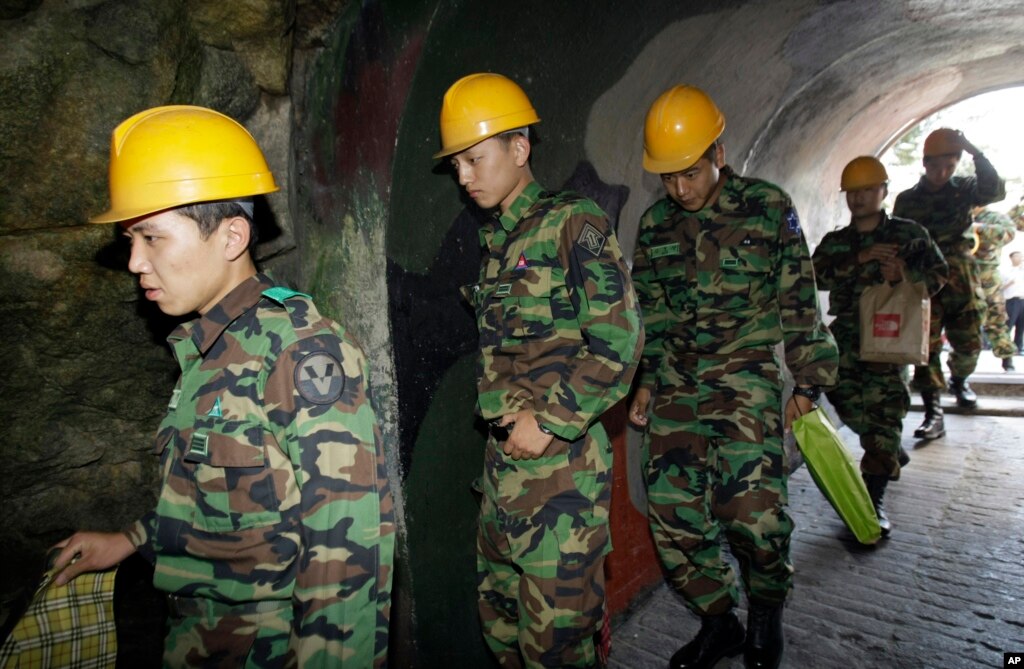
South Korean soldiers visit the 2nd Underground Tunnel, found in 1975 near the city of Cheorwon, on Sept. 18, 2008.
In 2012, Brig. Gen. Neil H. Tolley, then-commander of all U.S. special operations forces in South Korea, said at a special-ops industry conference that North Korea had hidden its military infrastructure in an underground network. He estimated the network includes 20 subterranean air bases,National Defense magazine reported.
Reports from North Korean defectors and satellite imagery indicate Pyongyang has built thousands of tunnels into mountains and hillsides to house artillery, ammunition and medical supplies, said Maxwell, the Georgetown security analyst.
(Continued at the link below)

Wednesday, July 16, 2014

Four Young Boys Killed Playing on Gaza Beach

I saw the IDF spokesman's tweet before I saw this NY Times article.  I wonder how many other militaries and government organizations could have a response to the public as quickly as the IDF spokesman.  Or more specifically how many Lieutenant Colonel military public affairs officers could get something out as rapidly as LTC Peter Lerner  (or stated another way how many senior leaders in organizations trust their spokesman to allow such rapid responses without multiple rewrites through the staffing process in the vain attempt to make sure someone does not say something wrong - of course that is not fair as there are many senior leaders who do.  So to put it another way, how many organizations are willing to give up the conventional staffing process to allow information to flow with speed where it will do more potential good than harm (good information now is usually better than perfect information too late).

Retweeted by Blogs of War
The #IDF has commenced an investigation on the beach incident. The reported civilian causalities from this strike are a tragic outcome.

Photo
Civilians rushed to help after explosions hit a beach where children were playing in Gaza City. Four Palestinian boys died. CreditTyler Hicks/The New York Times
GAZA CITY — Four young Palestinian boys were killed Wednesday when two explosions hit a jetty and beach where they were playing at the fishing port of Gaza City, and witnesses and officials here said the cause was an Israeli naval or aerial attack. The port area had been considered relatively safe from the intense Israeli bombing campaign of the past nine days.
The Israel Defense Forces, which has been hitting Gaza with bombs and missiles to counter rockets fired into Israel by Hamas and other militant groups, said it was investigating what killed the boys. All were cousins in an extended family of fishermen who kept their boats at the port.
The first explosion left a small shack burning on the jetty. Several boys could be seen fleeing along the beach. About 30 seconds later came the second blast, and when the dust cleared, three figures lay motionless on the sand. One had most of a leg blown off, his body charred; a few yards away lay a smaller one with curly hair.

Men came running and scooped up the bodies. A fourth was found in the charred ruins of the shack on the jetty. A grown man, wounded, called for help from inside an outdoor beach cafe, and he too was carried away.
Photo
The two explosions were about 30 seconds apart. CreditTyler Hicks/The New York Times
Israel’s military says it has taken extensive precautions to avoid killing civilians. According to a running count kept by United Nations officials, of the more than 200 Palestinians killed so far, about 75 percent have been civilians. One Israeli has been killed.
Hamas and other militants have fired more than 1,000 rockets into Israel since simmering hostilities erupted into military confrontation on July 8. Most of the Gaza rockets have fallen in open ground in Israel or been destroyed by Israel’s Iron Dome interception system. Israel has struck houses, offices and farmland with airstrikes, missiles from Apache helicopters and shelling from naval boats.
(Continued at the link below)

Interesting tweet from the IDF spokesman

This seems like an example of good strategic communications.  A calm response to a potentially tragic event (if as reported).  Obviously it will not sooth Hamas or Israeli opponents but it seems to me that this is a good example of how to communicate bad news to the public.  It is not defensive, it acknowledges the possibility of the tragedy but it implies the need for patience while an investigation is conducted and it says that Israel is taking the incident seriously.  There is a lot of information packed into this little tweet.

 Retweeted by Blogs of War
The #IDF has commenced an investigation on the beach incident. The reported civilian causalities from this strike are a tragic outcome.

Giving Tuesday Recommendations

  Dear Friends,  I do not normally do this (except I did this last year and for the last few years now, too) and I certainly do not mean to ...