Showing posts with label President Park. Show all posts

Friday, October 16, 2015

Video: Statesmen's Forum: with the Honorable Park Geun-hye President of the Republic of Korea

48 minute video of President Park's address and 4 question Q&A.

The video is at the links below.  Her remarks are provided in English via simultaneous translation and the Q&A is sequential translation.


Video: Statesmen's Forum: with the Honorable Park Geun-hye President of the Republic of Korea

  • Oct 15, 2015
    Duration: 00:48:33
    DOWNLOAD VIDEO (RIGHT-CLICK AND SAVE)
    Agenda
    3:30 p.m. Registration
    5:00 p.m. Welcoming Remarks
    By
    Dr. Victor Cha 
    Senior Advisor and Korea Chair, Center for Strategic and International Studies and Director of Asian Studies, Georgetown University
    Introductory Remarks
    By
    Dr. John J. Hamre 
    President and CEO, Pritzker Chair, and Director, Brzezinski Institute on Geostrategy, Center for Strategic and International Studies
    Keynote Address
    By
    The Honorable Park Geun-hye 
    President of the Republic of Korea
    Dialogue
    Moderated by
    Dr. John J. Hamre 
    CSIS
    Closing Remarks
    Dr. John J. Hamre 
    CSIS
    5:50 p.m. Adjournment
    6:00 p.m. Hors d’oeuvers Reception
    Regions

Thursday, January 1, 2015

Park calls for military readiness amid tensions with N. Korea

Although there are some who find this unhelpful in terms of engagement with north Korea and would in fact advocate stopping alliance exercises in order to bring north Korea to the negotiating table and believe that canceling alliance exercises would change north Korean behavior.

However, I think we should understand (and fortunately President Park does) that trustpolitik and the Dresden initiative rest on the foundation of a strong ROK/US alliance because only that can guarantee the security of the Korean peninsula.  We cannot bet on north Korean words and agreements because since 1992 and the ARNE (as well as going back to 1950 when the north called for talks at Kaesong about a month before June 25, 1950) the north's actions have always been counter to their words and agreements.

A strong military provide President Park the flexibility to execute a broad range of policies that include engagement and negotiation.

Park calls for military readiness amid tensions with N. Korea

khclose

Published : 2015-01-01 09:24
Updated : 2015-01-01 09:24
President Park Geun-hye called on the military Thursday to maintain its readiness, saying robust security is a must to lay the groundwork for potential unification with North Korea.
  
"We should end the history of division by putting an end to the Cold War on the Korean Peninsula," Park said in a New Year's message to the country's 650,000-strong military.
  
The Korean Peninsula was divided into the capitalistic South and communist North after its liberation from Japan's 1910-45 colonial rule.
  
The comments came three days after South Korea proposed that the two rival Koreas hold ministerial talks in January to discuss such bilateral issues as the reunion of families separated by the war.
  
Still, it remains unclear whether North Korea will accept South Korea's offer.
  
She also expressed hope that the military will receive public trust and love by establishing a new military culture, remarks apparently aimed at boosting morale in the military.
  
South Korea's military came under fire last year over a series of deaths blamed on a deep-rooted culture of abuse and bullying in barracks.
  
In June, an Army sergeant who had been bullied by his comrades went on a shooting rampage near the border with North Korea, killing five people and wounding seven others.
  
All able-bodied South Korean men must carry out compulsory military service for about two years in a country facing North Korea across the heavily fortified border. (Yonhap)

Tuesday, September 23, 2014

U.S. lawmakers express support for Park's policy on unification

Maybe we can get the US government to develop a policy and more importantly a strategy to support the ROK in pursuit of unification.  Since our policy of strategic patience has become one of strategic paralysis, maybe a shift to a strategy based on support ROK unification would be more effective (certainly it would in the long run).

U.S. lawmakers express support for Park's policy on unification

2014/09/23 03:52
By Chang Jae-soon
WASHINGTON, Sept. 22 (Yonhap) -- A group of U.S. lawmakers sent a letter to South Korean President Park Geun-hye on Monday, praising and supporting her handling of North Korea and efforts to seek unification with the communist nation.
The letter, co-signed by 14 members of the House of Representatives led by Gerry Connolly (D-VA) and Mike Kelly (R-PA), was timed with Park's arrival in New York to attend the U.N. General Assembly, where she plans to deliver a keynote speech about unification.
The lawmakers said that last month's visit to South Korea by Pope Francis "not only highlighted but confirmed the important leadership role that Korea is actively playing in the Asia-Pacific region." They called the South a "key U.S. ally, indispensable partner and friend."

   "We applaud your strong leadership and conviction especially in light of the continued acts of destabilization by North Korea," the letter said. "We support your efforts to maintain a firm and consistent posture against any threats and provocations by North Korea, while also seeking avenues for peaceful dialogue with the North for the eventual reunification."

   The lawmakers also expressed support for Park's vision for unification, known as the "Dresden" declaration, as well as her initiatives at increased reunions of families separated by the 1950-53 Korean War, targeted humanitarian assistance and promotion of educational and cultural exchange programs.
The "Dresden" declaration was so named because Park unveiled it in a speech in the former East German city earlier this year. It calls for gradually expanding economic and other exchanges and cooperation between the two sides so as to lay the groundwork for unification.
The congressmen noted and congratulated Park on the establishment of a presidential committee on unification.
Recalling Park's speech before a joint session of the U.S. Congress last year, they said Park's Korean Peninsula trust process is an important policy priority. They also expressed support for her vision to create a peace park in the Demilitarized Zone.
"Madam President, we reiterate our support for your initiative for peace and cooperation in Northeast Asia as well as your goals and vision outlined in your Dresden Address," they said. "May we one day see a reunified Korea free of tyranny, oppression and suffering, and we look forward to partnering with you in the U.S. Congress to realize this important and shared objective."

   Connolly is co-chairman of the Congressional Caucus on Korea and a senior member of the House Foreign Affairs Committee. The lawmaker, who is known as a champion of the U.S.-Korea alliance, also played a role in the House passage of the North Korea sanctions bill in July.
The 12 other congressmen are Charles B. Rangel (D-NY), Trent Franks (R-AZ), Madeleine Bordallo (D-GU), Chris Gibson (R-NY), Bill Pascrell (D-NJ), Tom Reed (R-NY), Michael Honda (D-CA), Luke Messer (R-IN), Mario Diaz-Balart (R-FL), Billy Long (R-MO), Doug Collins (R-GA) and Loretta Sanchez (D-CA).
(END)

Monday, April 28, 2014

Challengers to DPRK Will Never Be Pardoned: CPRK Spokesman

Here is the English translation of the north Korean statements insulting Presidents Park and Obama.  It is hard to believe that there is anyone who could take the regime seriously or that there are still those who think that something like the Sunshine Policy would ever work.  I would really like to read how the north Korean apologists explain and justify statements such as these (I am sure they will say that this is just propaganda).

Challengers to DPRK Will Never Be Pardoned: CPRK Spokesman

Pyongyang, April 27 (KCNA) -- The spokesman for the Committee for the Peaceful Reunification of Korea released a statement on Sunday assailing U.S. President Obama's tour of south Korea from April 25 to 26.

The statement said: Due to the tragedy of sinking of a ferry the whole land of south Korea looks like a mourner's house. Had Obama have even an iota of ethics and morality, he should have postponed or shelved his trip. The American master and his servant staged the farce of insulting, threatening and blackmailing the DPRK during the former's criminal tour of south Korea utterly indifferent to the sorrow of south Koreans. This was entirely to serve the purpose of collusion and conspiracy in their campaign against the DPRK.

What Park did before Obama this time reminds one of an indiscreet girl who earnestly begs a gangster to beat someone or a capricious whore who asks her fancy man to do harm to other person while providing sex to him.

Through her ugly behavior Park answered with a war the question put by the DPRK if she wants peaceful reunification based on the inter-Korean reconciliation or a war through the confrontation of the social systems, and fully revealed that her policy of "confidence- building process" is just the same policy of confrontation as that pursued by traitor Lee Myung Bak. She, at the same time, declared before the whole world her intention to drive the situation to the worst catastrophe through the confrontation with the DPRK to the last in utter disregard of the north-south relations.

She fully met the demands of her master for aggression, keeping mum about the nukes of the U.S. and desperately finding fault with fellow countrymen in the north over their nukes. She thus laid bare her despicable true colors as a wicked sycophant and traitor, a dirty comfort woman for the U.S. and despicable prostitute selling off the nation.

She visited together with Obama even the "south Korea-U.S. combined forces command" for the first time as a puppet chief executive and went off confrontation hysteria, crying out for "deterrence against the north" and "resolutely countering provocation from it." She even donned a dress unfit for the atmosphere of the mourner's house in the wake of the big tragedy and embarrassedly flattered Obama in a bid to please him, sparking off uproar.

The anti-DPRK charade staged by Obama and his servant became a laughing stock of world people as it was nothing but an odd burlesque rare to be found in the world.
The outcome of Obama's south Korean junket clearly proved that the DPRK was entirely just when it judged and determined that it should counter the U.S., the sworn enemy, by force only, not just talking, and should finally settle accounts with it through an all-out nuclear showdown. This, at the same time, only hardens the will and resolution of the DPRK to keep to the road chosen by it. Park's true colors and ulterior motive were brought to daylight.

There is no remedy for Park and there is nothing to expect from her as far as the inter-Korean relations are concerned as long as she remains a boss of Chongwadae.
She is steeped in sycophancy and treachery and confrontation with compatriots in the north. Her preoccupation is to realize the dream of confrontation of the social systems.
Genes remain unchanged. Needless to say, her present behavior suggests that her fate will be just the same as that of her father Park Chung Hee who met a miserable death after being forsaken by his master and public while crying out for "unification by prevailing over communism" and "unification by stamping out communism".

The DPRK will never pardon anyone who dares challenge its dignity, social system and its line of simultaneously developing the two fronts, the statement warned. 

Wednesday, January 22, 2014

Jackpot or Crackpot? Park on Korean Reunification

Dr. Foster is providing the conventional wisdom.  But his fundamental assumption must be examined:

Common sense says that the two massive initial outlays required – raising Northern incomes and rebuilding infrastructure – will constitute a prolonged and crushing fiscal burden, even if both are ultimately in part also investments: in human and physical capital respectively.

We should consider how the ROK plans to achieve reunification.   A more realistic assumption is that it is going to take a generation or more to undo the extreme damage that has been done to the north Korean people and to the physical infrastructure.  Yes it is going to be expensive and yes it is going to be hard and more importantly it is going to be necessary and the right thing to do.  The key is really the ROK plans for unification and an understanding of the realistic timelines for changing the conditions in the north.  Most importantly the plans should not assume immediate absorption but a gradual transition from two systems, to a confederal system to a unified country while working to change the economic system and developing the infrastructure.  I do agree with President Park that reunification could be a jackpot.  Think about the planned cities that the ROK has built (e.g.,New Sango city near Incheon airport).  Think of being able to conduct deliberate planning for the north to develop the right industries in the right places while exploiting (in a positive way) the natural resources of the north.  I am willing to bet that the Korean people can make reunification work.
V/R
Dave
  • January 22, 2014, 6:10 PM


Jackpot or Crackpot? Park on Korean Reunification

By Aidan Foster-Carter

Getty Images
South Korean President Park Geun-hye speaks during a press conference at the Presidential Office on January 6, 2014 in Seoul. Ms. Park outlined her policy plans for the new year.
The demure Park Geun-hye rarely startles. Yet South Korea’s president did just that on Jan. 6.
In her first press conference after almost a year as president, Ms. Park raised eyebrows by calling Korean unification a “jackpot”. The usual fear of vast costs has it wrong, she argued. Rather, this will be “a chance for the economy to make a huge leap.”
She didn’t elaborate, but cited Jim Rogers in support. The US.. investment guru reiterated his own bullishness on a joint Korean future on Jan. 14: “… South Korea’s capital and technical skills, and North Korea’s labor and natural resources, [can] make Korea grow exponentially.”
Park’s jackpot talk gained her rare praise from the South Korean liberal opposition. Democratic Party leader Kim Han-gil said he was “glad [she] helped break the common misconception that reunification is a cost.” But Kim added a crucial condition: “Only a gradual and peaceful reunification is a blessing. Reunification by absorption [after] a sudden change in North Korea could be a catastrophe.” Or to be more technical, reunification will be path-dependent.
All this taps into a long-running debate. Conventional wisdom views Korean reunification by whatsoever means as hugely expensive. A year ago Seoul’s Ministry of Strategy and Finance  put the cost at 7% of GDP for a decade, or $80 billion annually. Other estimates run much higher. Four years ago in The Wall Street Journal, Peter Beck reckoned $2 to $5 trillion, over 30 years.
Common sense says that the two massive initial outlays required – raising Northern incomes and rebuilding infrastructure – will constitute a prolonged and crushing fiscal burden, even if both are ultimately in part also investments: in human and physical capital respectively.
The obvious real-life precedent supports this. By 2009 German reunification had cost $1.9 trillion, even though the initial West-East GDP gap was far less than in Korea. South Korea’s central bank puts South Korea’s GDP in 2012 as 38 times the North’s, or 19:1 per capita.
Yet Park can cite Goldman Sachs on her side. A 2009 research paper predicted that by 2050 a unified Korea could have the world’s eighth largest GDP, overtaking Germany and Japan. Its author, Kwon Goo-hoon, posits China and Hong Kong as a better model than Germany.
Contrarianism is always welcome, but two big questions arise. Kwon’s premise “assume(s) a peaceful and gradual economic integration between North and South Korea”. That’s like the one about the scientists stranded on a desert island with only an old-style can of baked beans. The physicist can’t open it, but the economist has the answer: “Let us assume a can-opener.”
(Continued at the link below)

Thursday, September 5, 2013

S Korea raises possible Syria-N Korea weapons link

I think it is very interesting that despite the policy of "trustpolitik" that South Korea has no qualms about calling north Korea on the carpet for its support to a regime nearly (but not quite) as brutal as its own.  The ROK is not going to coddle the north even as it negotiates on Kaesong, reunions, and tourism, even as it offers potential infrastructure development and humanitarian aid.   I think President Park knows how to deal with north Korea. I think we can learn some lessons from her.
V/R
Dave
 
TITLE: S Korea raises possible Syria-N Korea weapons link
POSTED: 05 Sep 2013 4:42 PMURL: http://www.channelnewsasia.com/news/asiapacific/s-korea-raises-possible/803090.html
South Korea's defence ministry on Thursday called for fresh attention to North Korean chemical weapons, suggesting such arms might have been traded between Pyongyang and Syria.
 
SEOUL: South Korea's defence ministry on Thursday called for fresh attention to North Korean chemical weapons, suggesting such arms might have been traded between Pyongyang and Syria.

The warning comes amid international outrage over the Syrian regime's alleged use of chemical weapons against its own people.

"We believe there has been a chemical weapons connection between North Korea and Syria," Defence Ministry spokesman Kim Min-Seok told reporters.

Any link between North Korea and the attacks in Syria could further isolate Pyongyang, which is prohibited from international sales of its weapons under UN sanctions for conducting nuclear and missile tests.

Suspicions over chemical weapons trade between Pyongyang and Damascus have been raised in the past.

Concerns have grown since South Korea intercepted a North Korean shipment of protective gear on a vessel sailing near the southern port of Busan in 2009, Kim said.
Later that year Greece also seized almost 14,000 suits that provide protection from chemical weapons on a North Korean ship they believed was headed to Syria.
"Protective gear related to chemical weapons was traded," Kim said, declining to disclose details.

Japan's Sankei Shimbun newspaper reported last month that North Korea tried to export gas masks to Syria this spring.

Acting on the tip from the United States, Turkey intercepted a vessel carrying rifles, pistols, ammunition and gas masks, it said.

The North is believed to have up to 5,000 tonnes of chemical weapons deliverable by artillery or missile, Kim said.
(Continued at the link below)

Wednesday, August 7, 2013

North Korea blinks minutes after South threatens closure of factory park

President Park may be giving us all a lesson in how to deal with north Korea that we should all know by now.  You have to be tough and you cannot back down.  And do not be afraid to call the north's bluff.  The north has much more to lose in every scenario.  I also think her "paradoxical" trustpolitik policy provides the foundation from which to operate because it allows her to engage with the north because she is able to deal from a position a military strength (as long as the ROK/US Alliance holds).
V/R
Dave

North Korea blinks minutes after South threatens closure of factory park

Photo
6:13am EDT
SEOUL (Reuters) - Impoverished North Korea said on Wednesday it was reopening the troubled Kaesong industrial zone jointly run with the wealthy South just minutes after Seoul signalled its willingness to let it close for good.

The North's Committee for the Peaceful Reunification of Korea, which handles Pyongyang's ties with Seoul, proposed talks aimed at normalising the project and said the safety of South Koreans visiting the factory park would be guaranteed.

The committee was "prompted by its desire to bring about a new phase of reconciliation, cooperation, peace, reunification and prosperity by normalizing operation in the Kaesong zone", it said in unusually conciliatory remarks.

The comments were carried by the North's official KCNA news agency about 90 minutes after South Korea announced steps to compensate its firms that operate factories in Kaesong for losses - a step widely seen as a move towards shutting down the rivals' last symbol of cooperation.

Reclusive North Korea, for which Kaesong has been a rare source of hard currency, and the South, one of the richest countries in the world, are technically still at war as their 1950-53 civil conflict ended not in a treaty but in a mere truce.

The decision to pay 109 South Korean small and medium-sized manufacturers from a government insurance fund came after the North went for 10 days without responding to what Seoul said was its "final offer" for talks aimed at reopening the project.

South Korea had said it would not wait forever.

The South welcomed the North's change of heart and accepted the proposal for talks to be held on August 14 in Kaesong.

"We hope that a rational solution can be found ... for the normalisation of the Kaesong industrial zone," South Korean Unification Ministry spokesman Kim Hyung-suk said.
(Continued at the link below)

Wednesday, May 15, 2013

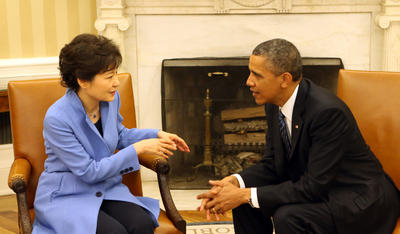
Park–Obama summit bolsters US–ROK alliance


The strength of the ROK/US Alliance is key to the outcome on the Korean Peninsula. I think it is very good that the Administration is supporting President Park's policy of "trustpolitik" with the north.  But I think the Administration missed an opportunity to support her Northeast Asia Initiative with Seoul in the lead for many issues from the environment and climate change to counterterrorism and non-proliferation.  I am sure that the Administration is sensitive to the charge that supporting initiatives with the ROK in the lead might be classified as "leading from behind." (whomever in the Administration came up with that phrase should be publicly flogged)  But in this case it would not be leading from behind, but instead supporting an ally's worthy initiative.
V/R
Dave

Park–Obama summit bolsters US–ROK alliance
May 16th, 2013
Author: Robert A. Manning, Atlantic Council
Successful summits tend to be more about symbolism than substance.

South Korean President Park Geun-hye’s summit with US President Barack Obama certainly had its share of symbolism:the first foreign trip of South Korea’s new first woman President; the 60th anniversary of the USROK alliance; and USROK messages to North Korea, Japan and China.
But President Park’s US trip rose above mere symbolism on a number of important fronts. It marked a deepening institutionalisation of the US-ROK alliance beyond defence into a larger partnership encompassing economics and global cooperation.

In her one-on-one meeting with Obama, her well-received speech to a Joint Session of the US Congress, and her interview with the Washington Post, Park outlined her approach to North Korea — one that was endorsed by Obama and in the US–ROK Joint Statement.

President Park is pursuing a different approach to Pyongyang than her predecessor, Lee Myung-bak, though they are from the same conservative political party. During Lee’s tenure, North–South ties hit new lows as confrontations such as the sinking of the ROK naval ship, Cheonan, and the shelling of Yeongpyeong Island in 2010 inflamed tensions and angered the South Korean public. Lee’s hardline policy and demand for reciprocity from the North was a shift from the previous ROK ‘Sunshine policy’, begun by Kim Dae Jung, which offered aid and cooperation to North Korea despite it being largely a one-way street.

Instead, Park wants to pursue a ‘trust-building’ process with North Korea, maintaining deterrence but keeping a window for dialogue and cooperation and humanitarian assistance, hoping to induce North Korea to comply with its previous denuclearisation obligations. This approach was explicitly supported by Obama. Park referred to a Korean saying, that ‘it takes two hands to clap’. Obama stressed that there was no distance between the United States’ and South Korea’s policies and that ‘The days when North Korea could create a crisis and elicit concessions … are over’.

President Park, according to news reports, raised the troubling issue of Japanese revision of history in her discussions with Obama and publicly in her address to the US Congress, and in an interview with the Washington Post. Park told the Post that she was ‘disappointed and frustrated at the lack of progress in relations with Japan’. She complained that ‘the Japanese have been opening past wounds and have been letting them fester, and this applies not only to Korea but also to other neighboring countries’. While she did not mention Japan by name to the US Congress, her speech did say that ‘differences from history are widening’, adding that ‘those who are blind to the past, cannot see the future’.

In regard to China’s support for North Korea, Park noted some changes in Beijing’s policy when Xi Jinping took office. She said in an interview that China could exert more influence to change North Korean behavior, but that if North Korea ‘chooses not to take the right path’ then she would ask China to rethink whether its current policy toward North Korea, ‘is sustainable’.

One little-noticed initiative from the Park visit was her call to create a new multilateral dialogue process in Northeast Asia to address the deficit of political/security cooperation. Park suggested it could start focusing on environmental issues, nuclear safety, counterterrorism and disaster relief and then build a wider agenda. She appeared to be thinking of the five parties in the now lapsed six-party talks, but added that North Korea might be invited.
(Continued at the link below)

Wednesday, May 8, 2013

Park says Korea-U.S. alliance base for reunited Korea, region


These are some important words to which I hope people are paying attention.  For those who dispute Korean unification as a strategic end state for the alliance to achieve please listen to President Park.  Alliance policymakers, strategists, and planners need to have a long term view even as they are reacting to crises and ask who with this policy, strategy, or plan contribute to the path toward Korean unification?
She specified a three-point vision for the future of the alliance for the peninsula, region and the world.  
Park said the alliance should lay the groundwork for enduring peace on the Korean Peninsula and over time, for reunification. 
Park explained that her “trustpolitik” process involved never accepting a nuclear-armed North Korea and decisive measures against any provocations, but delinking that from humanitarian aid. 
“And with the trust that gradually builds up, through exchange, through cooperation, we will cement the grounds for durable peace and eventually peaceful reunification.”
V/R
Dave

Park says Korea-U.S. alliance base for reunited Korea, region
President calls for U.S. support for trustpolitik, Northeast Asia peace initiative in address to Congress

Published : 2013-05-08 17:39
Updated : 2013-05-09 09:55


WASHINGTON -- President Park Geun-hye on Wednesday (Thursday Korea time) hailed the Korea-U.S. alliance as the linchpin of a reunified Korea, the future Northeast Asian order and the two countries’ cooperation to address insecurity and poverty around the world. 

Park also called on the U.S. to support her vision to forge a multinational mechanism for peace and cooperation in Northeast Asia.

The president delivered these messages before a joint session of the House and the Senate and during the gala dinner commemorating the 60th anniversary of Korea-U.S. alliance the night before.

“Building on the extraordinary accomplishments of the last 60 years, we determined to embark on another shared journey toward peace on the Korean Peninsula, toward cooperation in Northeast Asia, and finally, toward prosperity around the world,” Park said in her 30-minute speech, referring to the summit talks she had with President Barack Obama the day before.

She specified a three-point vision for the future of the alliance for the peninsula, region and the world. 

Park said the alliance should lay the groundwork for enduring peace on the Korean Peninsula and over time, for reunification.

Park explained that her “trustpolitik” process involved never accepting a nuclear-armed North Korea and decisive measures against any provocations, but delinking that from humanitarian aid.

“And with the trust that gradually builds up, through exchange, through cooperation, we will cement the grounds for durable peace and eventually peaceful reunification.”

At her speech to Congress, Park also called on the alliance to reach beyond the Korean Peninsula and build a mechanism for peace and cooperation.

“The initiative will serve the cause of peace and development in the region. But it will be firmly rooted in the Korea-U.S. alliance,” she said saying the dialogue could start on softer issues such as environment, disaster relief, nuclear safety and counter-terrorism. She added that North Korea could also be invited to join.
(Continued at the link below)

South Korean President Park Geun-hye answers questions


Some very interesting statements from President Park.  She does have the potential to be a very positive leader in the region.  Perhaps there is something to theory that the world would be a more peaceful place if there were more women heads of state.  I think her comments about history and emotions are very important and things that we as Americans cannot really seem to appreciate.
Who is responsible for the tensions in the region, apart from North Korea? 
I wasn’t referring to a specific country; it’s more about history. It can be said that if territory constitutes the body, history constitutes the soul. . . . Even a very small fire can be greatly inflamed, so it is imperative that we have a hard-headed and correct understanding of history. 
How dangerous are the tensions among Japan, China and other countries in the region, and what more could the United States do? 
This could be referred to as the Asian paradox. We see deepening economic interdependence in Northeast Asia uneasily coexisting with tensions deriving from various historical issues that spill over into the political and security realms. . . . Unlike Europe, this region does not have a framework for multilateral discussions, and this just simply doesn’t make sense. This is why I propose to advance the Peace and Cooperation Initiative for Northeast Asia, whereby the countries of Northeast Asia, including the United States — and this would be firmly anchored to our alliance with the United States could engage in discussions of nonpolitical issues, such as climate change, terrorism and nuclear safety. . . . We could build trust and then move on to larger issues of cooperation. This is what I proposed, and while it may not seem like much, I think the state of emotions here in the region can be quite risky and dangerous, so if we could build trust, this is a project which I wish to pursue jointly with the United States and in fact it is what I suggested to President Obama in my meeting with him today.
V/R
Dave
South Korean President Park Geun-hye answers questions
Published: May 7

South Korean President Park Geun-hye spoke with senior associate editor Lally Weymouth and other Post journalists Wednesday after her meeting with President Obama. Excerpts of the interview:

Q: Do you think China could do more to promote North Korean denuclearization?

A: After President Xi Jinping took office in China we were able to see some changes, which President Obama also referred to as positive. I believe that China can exert more influence on [North] Korea, I think they can do more. . . . In order for North Korea to change, and in order for the Korean Peninsula to enjoy greater peace, North Korea needs to choose the right path, and China should exert greater influence in inducing North Korea to do so.

You have a good relationship with the new president of China and you are going to visit China soon. China has recently distanced itself from North Korea. Is China prepared to cooperate more with your government and the United States in respect to curbing North Korea’s nuclear ambitions?

When I meet with President Xi Jinping I look forward to engaging in very candid discussions with him on issues that encompass North Korea, its nuclear weapons, as well as peace and stability in Northeast Asia. I also hope to be able to engage in candid discussions with him about whether, if North Korea decides not to become a responsible member of the international community, and chooses not to take the right path, whether this current path that it is taking is sustainable. Is there a future there?

What more could China do?

Of course, we can’t expect China to do everything, and the Chinese also say they can’t do everything. But I do believe there’s room for them to undertake more with respect to some material aspects. At the same time China has been able to achieve growth and development through reform and opening, and I think this offers a very good model for [North] Korea to follow, and so they can perhaps strengthen their persuasion of Korea in this regard.

What do you mean by material aspects?

North Korea is very heavily dependent on China.

How do you assess Korean-Japanese relations?

I remember eight years ago, when I had an interview with The Washington Post, that was also a time when the North Korean nuclear crisis was ongoing, and when the Japanese were also making comments about [disputed islands], thereby raising the temperature between Korea and Japan. Eight years later I’m very disappointed and frustrated to see that we haven’t made any progress. Japan and [South] Korea share many things in common — our shared values of democracy, freedom and a market economy — and there is a need for us to cooperate on North Korea and on economic issues as well as security issues. . . . But the Japanese have been opening past wounds and have been letting them fester, and this applies not only to Korea but also to other neighboring countries. . . . This arrests our ability to really build momentum, so I hope that Japan reflects upon itself.

How dangerous are the tensions among Japan, China and other countries in the region, and what more could the United States do?

This could be referred to as the Asian paradox. We see deepening economic interdependence in Northeast Asia uneasily coexisting with tensions deriving from various historical issues that spill over into the political and security realms. . . . Unlike Europe, this region does not have a framework for multilateral discussions, and this just simply doesn’t make sense. This is why I propose to advance the Peace and Cooperation Initiative for Northeast Asia, whereby the countries of Northeast Asia, including the United States — and this would be firmly anchored to our alliance with the United States — could engage in discussions of nonpolitical issues, such as climate change, terrorism and nuclear safety. . . . We could build trust and then move on to larger issues of cooperation. This is what I proposed, and while it may not seem like much, I think the state of emotions here in the region can be quite risky and dangerous, so if we could build trust, this is a project which I wish to pursue jointly with the United States and in fact it is what I suggested to President Obama in my meeting with him today.
Is the U.S. “rebalance” to Asia aimed at China?

The reason we see the security posture in the region being strengthened is because of what North Korea has been doing, as North Korea escalates the level of threats and provocations. . . . The basis of peace in this area is to maintain a firm deterrence posture, especially with regard to North Korea. If North Korea were to choose to become a responsible member of the international community and desist from provocations . . .I’m sure we would not need to see the strengthening of military postures in the region.
(Continued at the link below)

Wednesday, April 24, 2013

Park says to unveil 'Northeast Asia peace' initiative during visit to U.S.


The Seoul process:
 The idea, which Park dubbed the "Seoul process," calls for the United States and Asian nations to enhance cooperation, first on non-political issues such as climate change, terrorism prevention and atomic power, before expanding the trust built in such cooperation to other areas.
An interesting initiative that I hope we can support.  I think it is very important that Seoul takes the lead in the region. This can be a positive step (even though I remain completely pessimistic that any positive step like this will influence the north).
V/R
Dave

2013/04/24 20:43 KST


(2nd LD) Park says to unveil 'Northeast Asia peace' initiative during visit to U.S.
By Chang Jae-soon

SEOUL, April 24 (Yonhap) -- South Korean President Park Geun-hye said Wednesday she will unveil her vision to promote peace in Northeast Asia during a visit to the United States next month, offering an invitation for North Korea to join the trust-building process.

   The idea, which Park dubbed the "Seoul process," calls for the United States and Asian nations to enhance cooperation, first on non-political issues such as climate change, terrorism prevention and atomic power, before expanding the trust built in such cooperation to other areas.

   The initiative appears to be an expanded, Asian version of Park's "Korean Peninsula trust proces" that calls for greater exchanges and cooperation between the two Koreas so as to build trust and reduce tensions across one of the world's most heavily fortified border.

   "Asian countries have a high level of mutual economic interdependence, but they also a lot of contentious issues when it comes to security and territorial matters. We call this 'Asia paradox' and the reason I'm doing this (the initiative) is to overcome that," Park said during a meeting with dozens of managing editors of major newspapers and broadcasters, including Yonhap News Agency and its broadcasting arm, news Y.

   "I believe North Korea can get into this initiative," she added.

   Park is scheduled to visit the United States, her first overseas trip since taking office in February, for a summit with President Barack Obama on May 7. In Washington, she will also deliver a speech before a joint session of the U.S. Congress.

   Park said she expects to have in-depth discussions with Obama about how to denuclearize North Korea and ways to further strengthen the alliance between Seoul and Washington. South Korean needs closer cooperation with Washington now than at any other times, she said.
(Continued at the link below)
http://english.yonhapnews.co.kr/national/2013/04/24/94/0301000000AEN20130424013800315F.HTML

Tuesday, April 23, 2013

Park's speech to U.S. Congress to show strong alliance amid N. Korea's threats: Boehner


An interesting piece of Congressional trivia worth checking.  I have been told that the last head of state to address a joint session of Congress was President Lee thus two Korean heads of state will give back to back addresses.  I am sure if it is true that it will be perhaps coincidence (with 2012 an election year there was probably no time for another head of state to address Congress) but it is also interesting and perhaps worth highlighting to show the strength of the ROK/US Alliance.  (e.g., another action to attack the north's strategy to try to split the Alliance).
V/R
Dave

2013/04/24 05:28 KST

Park's speech to U.S. Congress to show strong alliance amid N. Korea's threats: Boehner
By Lee Chi-dong
WASHINGTON, April 23 (Yonhap) -- The upcoming speech by South Korean President Park Geun-hye in the U.S. Congress will provide a chance to demonstrate the strength of the alliance between the two nations amid North Korea's military threats, the leader of the House said.

   "It will be my honor to welcome President Park to the United States Capitol next month,”House Speaker John Boehner (R-OH) said in a statement. "Given the North Korean regime's recent provocative actions, President Park's address to Congress will serve as a vital and timely reminder that Americans and South Koreans will continue to stand shoulder to shoulder to preserve our hopes for peace and freedom."

   Park plans to address a joint session of Congress on May 8 after holding talks with President Barack Obama at the White House.

   She is scheduled to arrive in Washington on May 5 for her first overseas trip since taking office in February.

   It comes as South Korea and the U.S. mark the 60th anniversary of their alliance this year.

   U.S. Rep. Ed Royce (R-CA), chairman of the House Foreign Affairs Committee, also noted the significance of Park's planned speech.

   "America's close relationship with South Korea, forged 60 years ago during the dark days of the Korean War, remains strong and vibrant to this very day," he said in a separate statement.

   On the 60th anniversary of the armistice of the 1950-53 war, he added, "I believe it is only fitting to bestow this high honor to Northeast Asia's first elected female head of state.
(Continued at the link below)

Tuesday, April 16, 2013

Obama, South Korean President Park to meet at White House on May 7


A new potential launch date for the Musudan?  The north could try to embarrass the Alliance with such timing.
V/R
Dave

Obama, South Korean President Park to meet at White House on May 7
Mon, Apr 15 2013

WASHINGTON (Reuters) - President Barack Obama will meet with South Korean President Park Geun-hye on May 7 at the White House to discuss economic and security issues, including "countering the North Korean threat," the White House said on Monday.

"President Obama and President Park will also discuss a broad range of economic and security issues, including continued cooperation on denuclearization of the Korean peninsula and countering the North Korean threat," the White House said in a statement.

(Reporting by Roberta Rampton and Jeff Mason; Editing by Paul Simao)

Thursday, March 28, 2013

S. Korea to delink humanitarian aid from N. Korea's denuclearization actions


Some will criticize this and there will be comparisons to the Sunshine Policy.  However, I think an important difference is that President Park's policies will rest on the foundation of the strength of the ROK/US Military Alliance.

But this statement is somewhat troubling:
  "We do look at this as part of a pattern, and we respond in the way that we always have," White House press secretary Jay Carney said at a press briefing.
One of the reasons that the north is acting the way it is is because of the way the ROK/US Alliance has always responded.  The regime thinks the ROK/US  Alliance will do little to nothing in response to a provocation and that eventually the US will want to return to negotiations to restore stability in the region.  But the north would be wrong at least in the case of the ROK – the ROK military will respond decisively  to the next "kinetic" provocation that results in an attack on the ROK and I do not think that the US will provide political and economic concessions to the regime in return for a return to negotiations.  The north is miscalculating regarding the likely ROK/US response and that of course is potentially very dangerous.
V/R
Dave

S. Korea to delink humanitarian aid from N. Korea's denuclearization actions
2013-03-27 10:00
Normal FontLarge Font
   South Korea will delink humanitarian assistance to North Korea from overall diplomatic developments with Pyongyang and its denuclearization actions, in the early stages of a "trust-building" process with the North, ministry officials said Wednesday.

   Unveiling detailed diplomatic goals for the new engagement policy with North Korea proposed by President Park Geun-hye, a high-ranking ministry official also brushed aside concerns about to what extent the U.S. will support the initiative by Park to expand inter-Korean relations, saying Washington "fully understands" the new approach by Seoul.

   Park has pledged to pursue the "trust-building" policy with North Korea that calls for more engagement with the North, while, at the same time, not tolerating Pyongyang's nuclear ambitions.

   In an annual policy briefing to Park on Wednesday, the foreign ministry summarized Park's initiative as a three-step approach in which South Korea will first provide humanitarian aid to North Korea while calling for the North to keep the agreements made with the South.

   If the first-stage measure is successful in building confidence between the two Koreas, South Korea will expand inter-Korean economic cooperation without linking it to the North's nuclearization actions, the high-ranking ministry official said.

   The third-stage step is for large-scale government assistance, but it will be possible only if North Korea demonstrates its sincerity for denuclearization through actions, the official said.

   "From the start, the Korean Peninsula trust-building process does not link to North Korea's denuclearization," the official said on the condition of anonymity.

   "If confidence is built throughout the first two stages, the third stage of large-scale assistance will be linked to progress in the North's denuclearization," the official said.

   So far, the U.S. has maintained its stance that it won't return to nuclear talks with North Korea unless the North takes "irreversible steps" to denuclearize.

   However, numerous analysts have raised doubts over Washington's so-called "strategic patience" approach toward North Korea, a policy of shunning direct talks with the North until it agrees to abide by past nuclear commitments.

   Despite diplomatic efforts and international sanctions, North Korea has continued to develop its missile and nuclear programs.
(Continued at the link below)

Giving Tuesday Recommendations

  Dear Friends,  I do not normally do this (except I did this last year and for the last few years now, too) and I certainly do not mean to ...