Showing posts with label Kaesong Industrial Complex. Show all posts

Monday, January 27, 2014

How Choco Pie infiltrated North Korea's sweet tooth

We have read about this before and sure the tile and subject are humorous to some but the choco pie phenomenon is worth looking at from distribution on the black market to defiance of north Korean control to the influence of the Kaesong Industrial Complex.
V/R
Dave

How Choco Pie infiltrated North Korea's sweet tooth

By Madison Park, Frances Cha and Evelio Contreras, CNN
updated 3:18 AM EST, Mon January 27, 2014

The big prize on N. Korea's black market


STORY HIGHLIGHTS
  • Businessman describes North Korean workers at Kaesong trying Choco Pie for first time
  • Popularity of snack in North Korea shows how it could penetrate that country's society
  • South Korean workers give cup noodles instead of Choco Pie
(CNN) -- The first time the South Korean factory owner watched his North Korean employees nibble on a Choco Pie, they appeared shocked -- even overwhelmed.
He summed up their reaction to the South Korean snack in one word: "Ecstasy."
Much like what Twinkies are to Americans, South Korea's Choco Pies -- two disc-shaped, chocolate-covered cakes, sandwiching a rubbery layer of marshmallow cream -- are ubiquitous, cost less than 50 cents and are full of empty calories.
But on the other side of the Korean border, the snacks are viewed as exotic, highly prized treats, selling on North Korea's black markets for as much as $10, according to analysts. Their rising popularity in the north reveals an unexpected common ground between the two Koreas, despite their fractious relationship -- a shared sweet tooth.

Artist Jin Joo Chae creates a golden Choco Pie.
This month, an art exhibition called "The Choco Pie-ization of North Korea" opened in New York, exploring the symbolism of the treat. The high value in North Korea of the Choco Pie, something considered so widespread and mundane in South Korea, is "a sad tragic story," said the artist, Jin Jo Chae.
Chae smeared melted chocolate across the North Korean newspaper Rodung Sinmun, staining the state-run propaganda with something sweet. She used the chocolate to make a symbol of Choco Pie, written in the lettering style of Coca Cola. Her exhibit, displayed at Julie Meneret Contemporary Art gallery, also contains piles of Choco Pies as well as a gold-plated one.
"Through this Choco Pie, I found the potential from chocolate as an object that changes a society," Chae said.
The Choco Pie represents something more than just a treat.
Subversive Choco and Coke?
Despite perceptions of North Koreans as brainwashed, insulated masses, the hunger and desire for Choco Pie shows that "complete quarantine is impossible," wrote Richard Lloyd Parry in London Review of Books. Lloyd wrote that it "reveals a susceptibility to outside influence in a society commonly regarded as impenetrable." The crumbly mass of chocolate and marshmallow had taken on a subversive aspect.
Indeed, Chae, the artist behind the exhibit, says, the Choco Pie "has a power in how it works as a mind changing tool between South and North."
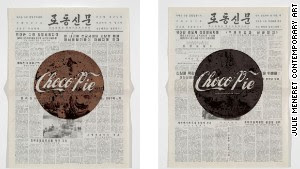
Chocolate is smeared on top of North Korean-run state newspaper Rodung Sinmun.
The South Korean factory owner, who introduced his North Korean workers to Choco Pies, washed down with a Coca Cola, said the products seemed to leave an impression on his staff.
"It was clear that the workers had gotten at least some idea of capitalism and that it wasn't all bad," he told CNN.
"They had only associated the United States with evil, and the fact that they could love something that the U.S. had produced -- specifically Coca Cola -- was an eye-opener."
Choco trade
The factory owner, who did not wish to be named, operated his business for seven years at the Kaesong Industrial Complex, one of the key symbols of cooperation between North and South Korea, and the site through which Choco Pies trickled into North Korea.
At the complex, more than 100 South Korean factory owners employ about 50,000 North Korean laborers to manufacture products like clothing and shoes. Kaesong, considered to be an important source of hard currency for North Korean leader Kim Jong Un's regime, sits just a few kilometers north of the Demilitarized Zone, which divides the two Koreas. It re-opened in September after a five-month hiatus.
(Continued at the link below)

Friday, August 23, 2013

N. Korea appears to struggle to woo Chinese investors

This may be helping to drive regime back to Kaesong.  Perhaps China is deliberately keeping its investors away (then again maybe they do not need to be kept away and they are making these decisions on their own since they have been burned by the Kim Family Regime so many times).
V/R
Dave

(Yonhap Feature) N. Korea appears to struggle to woo Chinese investors

2013/08/23 14:26
BEIJING, Aug. 23 (Yonhap) -- The only sign of activity at the North Korean trade promotion agency here in Beijing is the faintly lit banner in front, and it is hard to tell whether the office is open for business.
No one is seen at the reception desk of North Korea's Investment and Development Group building, located in a northern Beijing suburb, and its front door, though appears to be open, remains stationary for most of a weekday.
"North Koreans are still working there," said a Chinese cleaner near the building, who only gave his surname Wu.
The Beijing branch of North Korea's Investment and Development Group was believed to have launched operations early last year, but it appears certain to be a dead duck as the North's unpredictability continues to keep Chinese investors away.
Its website has not posted any statement since Jan. 23 this year, and there was no response to a phone call made on Aug. 16.

A South Korean diplomatic source in Beijing, who spoke on the condition of anonymity, said the North Korean branch has been dormant since the North's defiant launch of a long-range rocket last December.
Tensions on the Korean Peninsula soared early this year, with North Korea conducting its third nuclear test and its near-daily war threats during an annual joint military drill between South Korea and the United States.
(Continued at the link below)

Saturday, August 17, 2013

Lankov Looks to Cooperative Future for Korea

Some key assessments from Andrei:

I am under no illusions about the North Korean leadership, and that is my major difference with the left: they believe that through this policy they can change the North Korean leaders and start some gradual evolution of the government. I don’t think it’s going to happen.
…
I’m not talking about the North Korean leadership “seeing the light” and becoming mild, non-authoritarian democracy lovers. If that were to happen they would be killed. Their major reward would be a firing squad. Such exchanges make common people, especially the lower reaches of the elite, demand change, demand transformation, demand reform. 
…
No. Starting to behave better is not in their interest. If I were in their shoes, what would I do next? I would do another Cheonan; some manipulation that comes with plausible deniability, or at least where responsibility cannot be proved immediately.


Lankov Looks to Cooperative Future for Korea

[Saturday Interview: Professor Andrei Lankov]http://www.dailynk.com/english/read.php?cataId=nk02500&num=10855
By Chris Green. Interview transcription by Jason Mallet.
[2013-08-17 17:09 ]  
Facebook  Twitter  Indiegogo
▲ Professor Andrei Lankov of Kookmin University in Seoul. (ⓒNKnet)
Yesterday, Daily NK revealed Professor Andrei Lankov's positive perspective on Tuesday's agreement to restart the Kaesong Industrial Complex (KIC). As the interview revealed, Professor Lankov supports the reopening of the KIC, seeing it as a trustworthy window on the world for the information-starved North Korean people.

Today we bring you the full text of the interview, which took place at Professor Lankov's office at Kookmin University in Seoul on August 15th, a national holiday in both Koreas that commemorates the arrival of freedom from Japanese imperial rule in August 1945.
Daily NK (DNK): The Kaesong Industrial Complex is to reopen. Do you welcome the news?

Professor Lankov (L): Yes, it’s a very good thing. Frankly, I did not expect it to happen. When asked about probability I used to say, “60 to 70% it is not going to restart.” Some people whom I take very seriously even said 95%. So it’s a good thing: slightly unexpected, but very good.

DNK: Why are you so pleased about it?

L: Two reasons, maybe even three. 

First, it is a sign that relations between North and South Korea will warm. Of course, the North Koreans only want better relations with the South because they’ve got South Korean money; it’s very simple. Nevertheless, as our experience of the Sunshine Policy shows, when North and South Korea interact economically there are far fewer military clashes and serious confrontations. I’m not saying that clashes do not happen; we saw some clashes under the Sunshine Policy after all. Rather, the possibility of a clash is much lower, and the possibility of any clash escalating is quite close to zero. 

Second, North Korea has to be changed, and as the Cold War in Eastern Europe illustrates, the best way, maybe the only way, the outside world can promote change is by infusing information inside North Korea.

To this end, information that goes through official channels is usually seen as trustworthier than that which does not. In Kaesong there are 55,000 North Koreans who are exposed to the sight of South Koreans every single day. They are tall: and their skin! It clearly shows that they are not sent to do labor, that the American imperialist dogs don’t send them to work for free in the fields as a part of agricultural labor mobilization programs. When we take into account family members we are probably talking about a quarter of a million people getting this type of exposure. It’s a significant part of the North Korean population, located in a strategically very important area. 

Number three; sooner or later North Korea will start changing anyway. I don’t know whether it will come about as a result of popular revolution, regime collapse or as a result of some gradual transformation, but it will come, and when the country starts changing, one of their major obstacles will be a dramatic shortage of information about modern technology and the modern world. In Kaesong, North Koreans see how modern factories should operate, and they learn the basics, very primitive basics no doubt, but still the basics, of modern technology. It should be welcomed. Kaesong is a good start, and I just hope that late president Ro Moo Hyun’s 2007 idea of a second industrial complex will happen, too.

DNK: Do you mean the planned complex at Haeju?

L: Probably in Haeju, but as far as I understand it the final decision about location has never been made. Is it going to be implemented? Yes, eventually, and the sooner the better. 

DNK: Do you really think it will happen?

L: I’m not sure. I hope so.

DNK: That’s just a hope, though.
(Continued at the link below)http://www.dailynk.com/english/read.php?cataId=nk02500&num=10855

Wednesday, August 7, 2013

North Korea blinks minutes after South threatens closure of factory park

President Park may be giving us all a lesson in how to deal with north Korea that we should all know by now.  You have to be tough and you cannot back down.  And do not be afraid to call the north's bluff.  The north has much more to lose in every scenario.  I also think her "paradoxical" trustpolitik policy provides the foundation from which to operate because it allows her to engage with the north because she is able to deal from a position a military strength (as long as the ROK/US Alliance holds).
V/R
Dave

North Korea blinks minutes after South threatens closure of factory park

Photo
6:13am EDT
SEOUL (Reuters) - Impoverished North Korea said on Wednesday it was reopening the troubled Kaesong industrial zone jointly run with the wealthy South just minutes after Seoul signalled its willingness to let it close for good.

The North's Committee for the Peaceful Reunification of Korea, which handles Pyongyang's ties with Seoul, proposed talks aimed at normalising the project and said the safety of South Koreans visiting the factory park would be guaranteed.

The committee was "prompted by its desire to bring about a new phase of reconciliation, cooperation, peace, reunification and prosperity by normalizing operation in the Kaesong zone", it said in unusually conciliatory remarks.

The comments were carried by the North's official KCNA news agency about 90 minutes after South Korea announced steps to compensate its firms that operate factories in Kaesong for losses - a step widely seen as a move towards shutting down the rivals' last symbol of cooperation.

Reclusive North Korea, for which Kaesong has been a rare source of hard currency, and the South, one of the richest countries in the world, are technically still at war as their 1950-53 civil conflict ended not in a treaty but in a mere truce.

The decision to pay 109 South Korean small and medium-sized manufacturers from a government insurance fund came after the North went for 10 days without responding to what Seoul said was its "final offer" for talks aimed at reopening the project.

South Korea had said it would not wait forever.

The South welcomed the North's change of heart and accepted the proposal for talks to be held on August 14 in Kaesong.

"We hope that a rational solution can be found ... for the normalisation of the Kaesong industrial zone," South Korean Unification Ministry spokesman Kim Hyung-suk said.
(Continued at the link below)

Monday, July 8, 2013

South Korea's Kaesong Blunder: Seoul agrees to reopen a source of cash for North Korea's dictator.

I disagree.  I think that the ROK has the upper hand and it is the right thing to do in accordance with President Park's trustpolitik policy.  (although I am under no illusion that such engagement will prevent north Korean violent acts of provocation - those are an integral part of its blackmail diplomacy and they will not cease).  Yes it means potential money for the north; however, the bargaining chip belongs to the ROK.  If it does reopen then it will again provide some access and influence and those 53,000 workers are potentially important in support unification in the long term.  Second, when the north breaks the deal again as it likely will the ROK will retain the moral high ground.  And most importantly the ROK (and US) have held firm on the nuclear issues.  We should remember that a part of the trustpolitik policy is to not tie everything to the nuclear issue.  The ROK and President Park have the self confidence necessary to deal with the recalcitrant north because actions are supported by the strength of the ROK/US Alliance.
V/R
Dave

South Korea's Kaesong Blunder
Seoul agrees to reopen a source of cash for North Korea's dictator.

South Korea threw Pyongyang a lifeline over the weekend with an agreement to reopen the Kaesong industrial complex. Since the North closed the cross-border manufacturing zone in April, Seoul had an opportunity to let it die and compensate the companies that were led into this mess a decade ago by then President Kim Dae-jung. Instead the new administration of Park Geun-hye is repeating one of the worst mistakes of the misbegotten "Sunshine Policy" of a decade ago.
The Kim Jong Eun regime will again collect $90 million per year in wages allegedly for its workers, a sum that, believe it or not, could make a critical difference in its survival. Coming as the United Nations begins its investigation into human-rights abuses in the North, such a subsidy will be judged harshly by history.

Better yet for the North, it gets to keep Kaesong as a bargaining chip. The South's managers are potential hostages—in the past they have been prevented from leaving. And Seoul evidently believes that keeping Kaesong open is important to preserving peace between the two sides, which means the mind games will continue.
(Continued at the link below)

Tuesday, May 7, 2013

Kaesong Closure Poses Challenges for North


I do worry what will become of the workers in Kaesong, especially those that had the most interaction with South Koreans.  I do not think we can understand deeply enough the importance of information to and contact with the north Korean people.  Again, I hate to beat the dead horse but this is another indication of why we (the ROK/US Alliance) need a comprehensive PSYOP/MISO, influence campaign.  North Korea is probably one of the most important PSYOP targets and one where we can achieve the most long term effects.
V/R
Dave

  • May 6, 2013, 4:17 PM KST
Kaesong Closure Poses Challenges for North
ByAlastair Gale

A South Korean police officer stands guard on an empty road connecting the Kaesong Industrial Complex inside North Korea with the South after all South Koreans returned from the park on May 3.
After the closure of the Kaesong Industrial Complex and delivery of millions of dollars in final wage and tax payments to North Korea on Friday, several questions remain about the fate of the plant and the people who worked there.

Setting aside North Korea’s claim that it isn’t worried about the lost income, Pyongyang’s biggest headache is what to do with the 53,000 or so workers who have lost their jobs. The shutdown has effectively tossed one in six people in Kaesong–North Korea’s third-largest city–out of work.

Reassigning that number of people to new jobs presents a major logistical challenge, coupled with the potential risks to the regime of the spread of information about the capitalist system at the facility. Daily NK, a website based in Seoul that specializes in news about North Korea and is partially staffed by defectors, reported Monday that the workers have been sent to a wide range of other workplaces in the adjoining region to Kaesong.

The former Kaesong workers are also being given lectures and special study sessions to tackle the problematic ideas they have been exposed to, according to the report. By spreading the workers over a large area, North Korea likely hopes to dilute the politically toxic message they may bring.

The South Korean companies that operated at the Kaesong plant still have machinery and raw materials there that they were unable to bring out during the evacuation. North Korea could expropriate everything but it won’t be able to restart the plant because the South has stopped almost all of the electricity supply that is used to power the facility. A small amount of electricity and water that is used by the city of Kaesong is still being provided at the North’s request.

Meanwhile, as Seoul and the South Korean companies hold out for a potential return to Kaesong, North Korea is sticking to its demand for an end to “hostile acts and military provocations” from the South in order to reopen the plant.
(Continued at the link below)

Sunday, May 5, 2013

Life in North Korean Complex: A Glimmer of Hope


I think this excerpt below explains a lot on many different levels.  Although as the title says, there is a glimmer of hope that unification can occur and the people of the north and South can once again live together someday, I think that one of the possible reasons for the closure is that too many north Koreans have become too exposed to external influence.  A form of subversion is being conducted through the contact at Kaesong and the north may no longer be able to tolerate it and therefore have decided that they have to end the experiment.  But we should see the valuable lesson here and the potential for a comprehensive psychological operations/influence campaign that includes people to people engagement.

He recalled one time when North Korean officials grew wide-eyed on hearing that the South Korean presidential election was a real contest in which the leader was chosen by votes, and not behind closed doors. They were even more fascinated to learn that the government cannot just tell the South’s news media what to say, Mr. Kwak said. 
“I told them, it doesn’t work that way in South Korea,” he said 
At the same time, being too open in conversation could cause problems for North Koreans, said the manager of a jewelry factory who asked not to be identified. He said that some of the North Korean workers also appeared to be informers, and if one appeared to grow too friendly with his South Korean supervisor, he would suddenly be transferred the next day to a different part of the factory.
V/R
Dave
Life in North Korean Complex: A Glimmer of Hope


Woohae Cho for The New York Times
Kwak Kyung-dock, center, who was a manager at the Kaesong complex, on Thursday at a factory in Bucheon, near Seoul.
By SU-HYUN LEE and MARTIN FACKLER
Published: May 4, 2013

SEOUL, South Korea — When the order came last weekend toevacuate an industrial park in North Korea, Kwak Kyung-dock, a South Korean factory manager, said he was forced to flee with the suit on his back — and his car filled with so many boxes of the plastic machinery parts made at his factory that he had to tie several on the roof.

Multimedia


Woohae Cho for The New York Times

A map showing the Kaesong industrial park in the North.

“I had to leave like a refugee,” he said.

The flight of South Korean managers like Mr. Kwak, crossing the border in cars overburdened with gear from factories they may never see again, has become the enduring image of a standoff that began when the North successfully launched a long-range rocket in December.

The exodus was all the more alarming because for the nine years that North Koreans had worked in South Korean-owned factories at the Kaesong complex, it had seemed reassuring proof that no matter how heated the back-and-forth got, the two nations were unwilling to let things go too far.

Now that all of the managers have returned to South Korea, they are shedding light on the sprawling outpost of capitalism in the impoverished Communist state. Though it sometimes felt like a prison, to many it represented the only tangible hope that the two Koreas might one day be able to find common ground.

“Kaesong was like a mini reunification, the first time in 60 years of division where we ate out of the same rice pot,” said Park Nam-seo, president of Comcase, a toy manufacturer who left Kaesong in March.

Since its creation during a thaw in inter-Korean relations nine years ago, the Kaesong park had grown from a small collection of buildings into a vast complex that became one of the world’s most unusual investment enclaves. With its 123 South Korean-built factories powered with electricity from the South, and surrounded by tall fences guarded by North Korean soldiers, the park was a bright light in the darkness caused by electrical shortages in the North’s failed command economy.

But last month, as tensions rose on the peninsula after North Korea was sanctioned for conducting a nuclear test, North Korea suspended operations at the complex, saying a final decision would depend on South Korea’s attitude. The North withdrew its 54,000 workers, then cut off shipments of food and other supplies from the South.

By Friday, the South had withdrawn all of its citizens, who had worked mainly as managers and overseers at the park. Some of the South Korean managers expressed anger, saying that the park was being held hostage by politics.
(Continued at the link below)

Saturday, April 27, 2013

South Korea to Pull Remaining Workers From the North


As I think about Kaesong, a few things come to mind. The obvious one as most speculate is that this is part of the ongoing strategy to support the regime's blackmail diplomacy and just another step in ratcheting up tensions to try to force the hand of the ROKG and influence the USG.

Another possibility (however slight) might be that the regime is following the precedent of Kumgangsan (Diamond Mountains) -the tourism center built by Hyundai and later "confiscated" by the regime who now runs tours there, mostly for Chinese and other foreigners.  Perhaps the regime thinks that the South has sufficiently developed the Kaesong Industrial Complex and the north believes it is time to operate it on its own to make its profits and cut out the "middlemen" of South Korean businesses (I can see Kim Jong-un's sycophantic advisers telling him this).  They will of course be in for a rude surprise when they find that they cannot run the factories as effectively and efficiently as South Korean businessmen because they will have to revert to operating on Juche economic policies and not good business practices.

Another possibility (even less likely) is that perhaps they will want to contract the complex to the Chinese to run it.  I think that is less likely because Chinese businesses are losing money in the northern border areas because of north Korean "business practices."

The last thought is that perhaps the north has had too many of its people exposed to outside information.  This is something we have often discussed;  e.g., the north will do business with the outside world until there is too much exposure of its population to contaminated ideas (and ideals) at which time it will cut off those business contacts.  We may be at the point where the north is fearing that there is just too much exposure and influence.  Certainly the thousands of north Korean workers at Kaesong will never ever return to their original homes and will never have contact (or be "released back into") the "general population" (attempted prison reference pun intended).  If the regime does fear that it has reached the limit of exposure to external information that could be a sign that it perceives a greater likelihood for internal unrest and that it must crack down and prevent the external information from spreading.  Of course with the increased information getting in through defector organizations and the proliferation of South Korean DVDs as well as connectivity through cell phones and even limited internet access could make this moot as well.  But again it could be an indicator or the regime's assessment of potential internal problems.  If this is in fact a reason for the recent actions, then it is another indicator of the importance of mounting a comprehensive psychological operations campaign against both the second tier leadership and the general population to prepare them psychologically for what comes next after the regime goes away.
V/R
Dave


South Korea to Pull Remaining Workers From the North
Published: April 26, 2013

SEOUL, South Korea — South Korea said on Friday that it was pulling out the 175 remaining factory managers from a jointly operated industrial park in North Korea, deepening doubts over the survival of the only remaining symbol of cooperation between the two countries amid a tense standoff over the North’s nuclear program.

Multimedia


Related

Follow@nytimesworld for international breaking news and headlines.

Once billed as an important experiment for Korean reunification, the factory complex across the border at Kaesong exposed North Korea to capitalism, pairing the South’s manufacturing skills with cheap North Korean labor. At the time it was opened in 2004, the park was revolutionary; to build it, the two Koreas breached one of the world’s most heavily fortified frontiers, pushing back military encampments, clearing mines and constructing a cross-border road and rail line.

The decision to effectively close the 123 factories there is an indication of how fraught relations between the two nations have become in recent months. The South had preserved the Kaesong complex even when it cut off all other trade ties with the North after the sinking of one of its warships in 2010. That episode killed 46 sailors, and the South blamed the North. North Korea had also continued its support of the plant, which provided badly needed hard currency, through previous diplomatic crises.

“The Kaesong complex fell victim to a war of nerves between the new leaders of both Koreas, who don’t want to be seen as weak,” said Kim Yong-hyun, a professor of North Korean studies at Dongguk University in Seoul.

North Korea had already removed its 53,000 workers this month as part of an escalation of threats after the United Nations imposed sanctions to punish the North for its nuclear test in February. The North’s leaders cited the danger of war that it said was posed by joint South Korean-United States military drills. It also blocked supplies and personnel from the South, forcing all the factories to stop production. Most South Korean managers already at the plant returned home, but some stayed in the hope that relations would improve.

The decision to withdraw the managers came hours after North Korea rejected the South’s proposal for talks on the park’s future. South Korea said the situation was becoming untenable because the North was no longer letting food and medicine be shipped to the site.

“To protect our citizens, we have made an inevitable decision to bring all of them home,” Unification Minister Ryoo Kihl-jae, South Korea’s point man on the North, said in a nationally televised statement.
The decision reflected President Park Geun-hye’s determination not to succumb to what she called North Korea’s tactic of using provocations and pressure to extract concessions — a move the impoverished country was accused of using successfully in the past to secure major shipments of aid. On Friday, Ms. Park told her cabinet ministers that she had no intention of “waiting forever” for North Korea to change its mind over the factory complex.

The managers are expected to begin leaving on Saturday.

So far, neither country has publicly said that it wants to shut the complex permanently. But the countries’ tit-for-tat moves have deepened doubts that the factories would resume operations anytime soon.

South Korea’s leaders have liked to point to the complex’s continuing operations to assuage foreign investors who might have second thoughts about investing in their country because of military tensions with the North. It is unclear how investors will react; the announcement was made after the stock market closed.
(Continued at the link below)


    Wednesday, March 27, 2013

    North Korea says it has cut key military hotline


    One of our long time fears is what could happen to the South Koreans at the Kaesong Industrial Complex.  This is a scenario that will be very complex if those South Koreans are "held hostage" and not allowed to return to the South (if it goes beyond being "stranded" as in 2009)
    V/R
    Dave

    North Korea says it has cut key military hotline
    By HYUNG-JIN KIM | Associated Press – 1 hr 3 mins ago
    SEOUL, South Korea (AP) — Raising tensions with South Korea yet again, North Korea cut a military hotline that has been essential in operating the last major symbol of inter-Korean cooperation: an industrial complex in the North that employs hundreds of workers from the South.

    There was no immediate word about what cutting one of the few remaining official North-South links would mean for South Korean workers who were at the Kaesong industrial complex. When the link was last cut, in 2009, many South Koreans were stranded in the North.

    The hotline shutdown is the latest of many threats and provocative actions from North Korea, which is angry over U.S.-South Korean military drills and recent U.N. sanctions punishing it for its Feb. 12 nuclear test. In a statement announcing the shutdown, the Northrepeated its claim that war may break out any moment.

    Outside North Korea, Pyongyang's actions are seen in part as an effort to spur dormant diplomatic talks to wrest outside aid, and to strengthen internal loyalty to young leader Kim Jong Un and build up his military credentials.

    South Korean officials said that about 750 South Koreans were in Kaesong on Wednesday, and that the two Koreas had normal communications earlier in the day over the hotline when South Korean workers traveled back and forth to the factory park as scheduled.

    Workers at Kaesong could also be contacted directly by phone from South Korea on Wednesday.
    A South Korean worker for Pyxis, a company that produces jewelry cases at Kaesong, said in a phone interview that he was worried about a possible delay in production if cross-border travel is banned again.
    (Continued at the link below)

    Giving Tuesday Recommendations

      Dear Friends,  I do not normally do this (except I did this last year and for the last few years now, too) and I certainly do not mean to ...