Showing posts with label ROK/US Alliance. Show all posts

Friday, October 16, 2015

Video: Statesmen's Forum: with the Honorable Park Geun-hye President of the Republic of Korea

48 minute video of President Park's address and 4 question Q&A.

The video is at the links below.  Her remarks are provided in English via simultaneous translation and the Q&A is sequential translation.


Video: Statesmen's Forum: with the Honorable Park Geun-hye President of the Republic of Korea

  • Oct 15, 2015
    Duration: 00:48:33
    DOWNLOAD VIDEO (RIGHT-CLICK AND SAVE)
    Agenda
    3:30 p.m. Registration
    5:00 p.m. Welcoming Remarks
    By
    Dr. Victor Cha 
    Senior Advisor and Korea Chair, Center for Strategic and International Studies and Director of Asian Studies, Georgetown University
    Introductory Remarks
    By
    Dr. John J. Hamre 
    President and CEO, Pritzker Chair, and Director, Brzezinski Institute on Geostrategy, Center for Strategic and International Studies
    Keynote Address
    By
    The Honorable Park Geun-hye 
    President of the Republic of Korea
    Dialogue
    Moderated by
    Dr. John J. Hamre 
    CSIS
    Closing Remarks
    Dr. John J. Hamre 
    CSIS
    5:50 p.m. Adjournment
    6:00 p.m. Hors d’oeuvers Reception
    Regions

Thursday, October 15, 2015

Special report on the Korean-American alliance


Special report on the Korean-American alliance


http://www.washingtontimes.com/specials/special-report-korean-american-alliance/


The latest information on the Korean-American alliance as South Korean President Park Geun-hye visits the United States.


Obama to host Park Geun-hye as South Korea's growing ties to China threaten alliance


By Guy Taylor - The Washington Times


President Obama is expected to highlight this week's U.S. visit by South Korean President Park Geun-hye as an example of the rock-solid alliance between Washington and Seoul -- but a range of sticky issues will lurk in the backdrop behind Ms. Park's visit to the White House at week's end. Published October 12, 2015


RECENT OPINION COLUMNS


An alliance that extends to the stars


BY REP. MATT SALMON


The alliance between the United States and the Republic of Korea has been one of the pillars guaranteeing peace, stability and prosperity in Northeast Asia for more than 60 years.


National Unification Advisory Council welcomes President Park Guen-Hye


BY WILLIAM WON KYUN HWANG


National Unification Advisory Council-Washington Chapter welcomes Her Excellency Park Geun-hye, president of Korea, and wishes for a successful U.S.-Korea Summit.


Korea-U.S. friendship, partnership and alliance


BY KATRINA LANTOS AND GORDON FLAKE AND GREG SCARLATOIU


The Committee for Human Rights in North Korea (HRNK) warmly welcomes Republic of Korea President Park Geun-hye to Washington, D.C., and commends Her Excellency's vision and efforts toward a peaceful, prosperous, democratic and unified Korean Peninsula.


Strategic trends and shifting balances in Northeast Asia


BY JOSEPH DETRANI


The Intelligence and National Security Alliance established the Asia-Pacific Task Force, with Ambassador Bob Joseph as chairman, to examine the evolving U.S. strategy in the region and assess the implications for the national security and intelligence communities.

Nurturing a crucial alliance


BY ED FEULNER


South Korean President Park Geun-hye is in Washington this week as the third of President Obama's summit trifecta with Northeast Asian leaders. She has the opportunity to address growing regional security challenges and reassert an important Korean role on the world stage.


Korea President Park Geun-ye: Then and now


BY DR. KONGDAN OH


On a cold December day in 2012, Korea elected a new president. And not just another aging political leader, but a relatively youthful 60-year-old woman, Park Geun-hye, who became the country's 11th president. As a former citizen of South Korea who left the country over three decades ago to escape its male-dominated culture, I was filled with encouragement and pride.


Tough, decisive and hands-on 'Notebook Princess'


BY DAN BURTON


At the end of this past summer, I visited South Korea as part of a delegation of former U.S. congressmen and other leaders who have a strong interest in the security of the Northeast Asia region.

Admiral: North Korea can hit U.S. with long-range nuclear missile


BY BILL GERTZ


North Korea is capable of hitting the United States with a long-range nuclear missile, the commander of the U.S. Northern Command said this week.


A historic opportunity to strengthen the Korean-American partnership


BY REP. ED ROYCE


Forged in the horrific destruction of the Korean War that began 65 years ago, the U.S.-Korea alliance has emerged strong, resolute, comprehensive and enduring. It has become a "Blood Alliance." More than 1.7 million Korean American constituents represent yet another bond between our countries, with Southern California having the largest Korean population outside the Korean Peninsula.


The future of the 'Comfort Women' movement in Korea


BY DR. JUNGSIL LEE


To this day, religious and some Korean political leaders have withheld their support for comfort women, choosing not to take a stance on this issue. Although disappointed, I remain resolute in our mission. Now it has fallen upon me and our organization to outline the direction that the Washington Coalition for Comfort Women Issues should take.


Korea President Park: A symbol of hope


BY YUMI HOGAN


Growing up on a farm in Jeollanam-do province, I never thought I would have the opportunity to meet with the president of South Korea.

Freedom: The common glue between America and Korea


BY WILLIAM WON KYUN HWANG


Freedom is the signature spirit of the United States and of South Korea. We should be humble, never forgetting that our brothers and sisters in North Korea are starving, in pain, and have no human rights. We must redouble our efforts to bring about a reunion among the tens of thousands of families separated between North and South Korea. We must do this before more of those separated by the war pass away.

U.S. a midwife to peninsula unification


BY SUE MI TERRY


North Korea has been one of the most vexing and persistent problems in U.S. foreign policy since World War II, and it is certain to be a major topic of discussion this week during South Korean President Park Geun-hye's meeting with President Obama.


Korea and the United States: Our great legacy


BY REP. CHARLES B. RANGEL


Little did I know in 1950, when I went to Korea for the first time as a combat infantryman, that I would be welcoming the distinguished South Korean President Park Geun-hye during her visit to our nation's capital to confer with our president concerning the global community and the U.S.-Korea alliance.


The search for an effective U.S. strategy on North Korea


BY THE WASHINGTON TIMES


Senators on Oct. 7 convened a hearing titled "Assessing the North Korea Threat and U.S. Policy: Strategic Patience or Effective Deterrence?" Here are excerpts from four leaders who offered testimony that day.


Korean-Americans at NASA make a better ISS-CREAM


BY DR. EUN-SUK SEO


The historic visit of Park Geun-hye, president of the Republic of South Korea, to the National Aeronautics and Space Administration (NASA) is not surprising considering her plan to move the country toward a "creative economy." The words "exploration" and "innovation" could not be excluded from the many words that describe NASA because of its sense of creativeness and daring boldness. NASA is also well known for its spinoff technologies.


The North Korean military threat


BY BRUCE E. BECHTOL AND JR.


Following North Korea's most recent "shows of force" -- including a parade that showed off a swath of new or upgraded weapons systems and a provocation along the DMZ that left two South Korean soldiers badly maimed.

Innovation and entrepreneurship: A new horizon for the U.S.-Korea alliance


BY DR. JAY S. KIM


The newest chapter of the 70-year alliance between Korea and the U.S. is emerging as the two nations begin to collaborate in the area of technological innovations and entrepreneurship.

The Han unbound: Korea goes global


BY ALEXANDRE MANSOUROV


Recent international headlines highlight the spectacular success of Korea's globalization campaign better than any academic study: "K-Pop madness sweeps Vietnam," "Dresden opens Korean Plaza," "Korean Online Comics Go Global," "16 new King Sejong Institute branches to be built in four continents," "Bibimpab, Kimchi await you in Milan," "Saemaul Undong becomes a global development model," "Korea tops Global Information and Communications Technology (ICT) Development Index."


The Korea-U.S. alliance: Ready for the next chapter?


BY DAVID S. MAXWELL


A review of the successes shows how this blood alliance allowed the ROK to first survive the ruthless attack from the communist North and, in the aftermath, to rebuild a nation from the ashes of the war. The "Miracle on the Han" has resulted in the rise of the Republic of Korea as a major middle power that has developed a military that can deter and defend against the enemy to the north and contributes to global security from leading U.N. peacekeeping missions, as in East Timor, to successful counterterrorism and counterpiracy operations off the Horn of Africa and major military contributions in Vietnam, Afghanistan and Iraq.


North Korea's endgame


BY CHRISTOPHER R. HILL


Last August, negotiators from the two Koreas resolved yet another crisis provoked by the North, in which South Korea's use of loudspeakers to broadcast messages across the Demilitarized Zone spurred threats of war from the North. That was welcome news for the region and the world.


Redefining Korea as a global leader


BY DR. JOHN J. HAMRE


South Korean President Park Geun-hye returns to Washington after proving her mettle this summer in a tense standoff with North Korea. North Korean agents planted land mines in a long-standing path patrolled by South Korean soldiers, setting off another round of escalating tension between North and South. South Korea stood firm, and North Korea blinked.


Korea: A remarkable economic transformation and U.S. policy success


BY REP. LORETTA SANCHEZ


This year marks the 65th anniversary of the outbreak of the Korean War. As Korea has transformed itself in six decades from a war-torn basket economy into the 13th largest economy in the world, it represents one of America's greatest foreign policy success stories in the post-WWII era.

Thursday, June 11, 2015

The U.S.-South Korean Combined Infantry Division Shows The Alliance Is Closer Than Ever

The U.S.-South Korean Combined Infantry Division Shows the Alliance is Closer than Ever

THE U.S.-SOUTH KOREAN COMBINED INFANTRY DIVISION SHOWS THE ALLIANCE IS CLOSER THAN EVER

June 11, 2015 · in 


Print Friendly
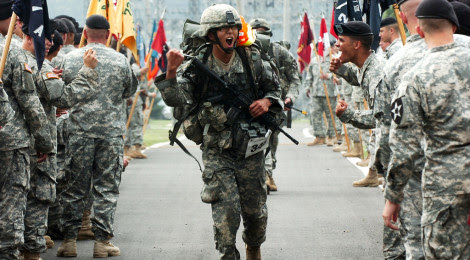
The 2nd U.S. Infantry Division recently held a ceremony to activate the first-ever combined division of U.S. and South Korean (ROK) forces. Rather than being a regression away from the transfer of wartime operational control (OPCON) of ROK forces — which would have separated the alliance command structure — this is a statement of profound operational trust that builds on a long history of combined operations between the various military organizations of these two allies. At a time when the United States faces fiscal pressures at home and China seeks to create fissures in the regional order, the U.S.-ROK alliance is moving closer together.
The current combined division concept, initiated during the tenure of Lt. Gen. Edward Cardon when he was the 2nd Infantry Division Commander, was nurtured by Maj. Gen. Thomas Vandal, and is now being implemented by Maj. Gen. Theodore Martin. It marks a fundamental continuity with, not devolution from, alliance history. During the Korean War, Gen. Paik Sun Yip’s 1st Infantry Division was assigned to the U.S. I Corps. At that time, the Korean Augmentee to the U.S. Army program (KATUSA) and the Korean Service Corps (KSC) were both established, and continue to this day. Even today, the ROK/U.S. Combined Forces Command (CFC) is arguably the most integrated combined staff in the world, including ROK and U.S. general officers who alternate between primary and deputy positions not only among the command and staff, but also in corresponding appointments down to the lowest action officer levels. Even Japan has expressed interest in establishing a combined command with the United States modeled on the ROK/U.S. CFC.
There have been many other operational examples of ROK and U.S. forces organized in a combined manner. The III U.S. Corps and XVIII Airborne Corps have occasionally been under the operational control of the Third ROK Army (TROKA) and First ROK Army (FROKA) in support of operational plans. There are also combined ROK/U.S. military service branch components, ranging from the Combined Forces Air Component Command (CFACC) to the Combined Unconventional Warfare Task Force (CUWTF). Suffice it to say that a combined division will not be difficult to make work — the concept nests within a rich tradition of ROK/U.S. alliance cooperation.
In addition to the numerous command examples above, ROK and U.S. units have routinely trained together in the decades since the Korean War; a history I’m a proud to be a part of. I recall 2nd Infantry Division units participating annually in what were then called the “Blue Dragon” river crossing exercises with ROK Marines at Kimpo. Like many others, I took part in battalion and brigade unit evaluation exercises, as well as the Super Bowl of military preparation — the exercise formerly known as Team Spirit, and today’s Foal Eagle and Key Resolve exercises. As a young 2nd Infantry Division company commander in the 1980s, I had a ROK counterpart in the 1st ROK Infantry Division. We planned and executed our own combined live-fire exercises, integrating his tank company with our infantry, TOW missile, scout and 4.2-inch mortar platoons. Combined operations aren’t just a top-down organizational chart drill; in my experience they’re a bottom-up phenomenon as well. All this training did more than just deter North Korea from invading; it gave rise to globally capable ROK combat forces, which fought with distinction in Vietnam and now operate in support of UN peacekeeping operations and other conflicts, including those in Afghanistan and Iraq.
The combined division concept recognizes the nature of the threat and the environment in Korea. The combined division will be able to focus on one of the most important missions, on the peninsula during conflict or instability: locating and securing North Korea’s weapons of mass destruction. A combined organization is well suited to this task because it harmonizes the unique capabilities, expertise, and strengths of each nation’s soldiers and their training and equipment. In addition, as U.S. forces move to a rotational force posture it will ensure more rapid integration of U.S. forces and enhance overall readiness of the division to accomplish its many missions.
(Continued at the link below)

Monday, January 19, 2015

Park calls for creating conditions for talks with N. Korea

I received the comments below in response to this from a Korea Hand who has probably forgot more about the ROK/US Alliance than the rest of us know.  I think this short paragraph does more to explain the importance of the ROK/US alliance than anything else we can read in official statements, from the press or the pundits.

The ROK-US Alliance is critical to President Park’s successful implementation of her unification policy, a policy mandated by the ROK’s 1987 Constitution (by type, not content, the latter being the individual President’s prerogative).  First, it defends the ROK people, territory and institutions by deterring North Korean aggression, albeit it only limits, not completely deters, NK provocations.  Secondly, it represents the commonly shared values of both the ROK and US in the concepts of democracy and free markets and the defense of those values.  Thirdly, the designation and manning of a US four-star to serve as the wartime commander of designated ROK and US forces amplifies the message of US commitment to the defense of the ROK, as does the bilateral manning of the ROK-US Combined Forces Command.  This is critical should NK deception be successful.  Fourthly, the US technical capabilities contribute to President Park’s awareness of NK deception in behavior, intent and negotiation through detection of inconsistent actions - not perfect, but critical.  Fifthly, it serves significantly as a consideration point in foreign investment into the ROK.  All US traders will tell you they calculate the efficacy of the alliance into their risk-vs-gain calculations when investing in the ROK, something other nations’ investors do as well.  There are many more points of consideration, but these have always been the main issues, regardless of the politics that distort, one way or another, their criticality.  President Park goes into any negotiation with NK with this kind of confidence.


---------- Forwarded message ----------
From: David Maxwell <David.Maxwell@georgetown.edu>
Date: Mon, Jan 19, 2015 at 10:29 AM
Subject: Park calls for creating conditions for talks with N. Korea
To:


This is where the alliance priority should be.  The South should absolutely be in the lead with the north.  It is really only the practical way to manage the situation with the north.  As long on President Parks has the foundation of the strong ROK/US Alliance she can have flexibility and agility in conducting diplomacy with the north.
   South Korean President Park Geun-hye on Monday called on officials to create conditions to allow North Korea to come forward for talks in the latest conciliatory gesture toward Pyongyang to jump-start stalled dialogue.

   Park also said the two Koreas should start substantial dialogue to lay the groundwork for their potential unification.

   The call came as North Korea has remained silent on South Korea's recent offer to ministerial talks in January to discuss such bilateral issues as the reunion of families separated by the 1950-53 Korean War.

   "I hope that you will make efforts to come up with conditions under which North Korea can respond," Park said in a meeting at the presidential office where she received a briefing on South Koreas' policy on North Korea, defense and foreign affairs.


   She did not elaborate on what she meant by conditions, though they appear to suggest that South Korea should take steps to stop its people from sending propaganda leaflets to North Korea.

   Park's thinly veiled request came days after North Korea's powerful National Defense Commission urged South Korea to clarify whether Seoul is serious about dialogue with Pyongyang or whether it will persist in the anti-North Korean leafleting campaign.

   The two Koreas last held high-level talks in February in 2014. They had agreed to hold high-level contact between late October and early November during a surprise visit to South Korea by a high-powered North Korean delegation. But the North later backtracked on the deal in protest of the leaflets.

   For years, North Korean defectors in the South and conservative activists have flown the leaflets to the North via balloons to help encourage North Koreans to eventually rise up against the Pyongyang regime.

   North Korea has repeatedly called for an end of the leafleting campaign that it claims insults its dignity. The issue has long been a constant source of tension between the two Koreas, which are still technically at war because the Korean War ended in a truce, not a peace treaty.

   South Korea has said there are no legal grounds to prevent its activists from floating the leaflets, citing freedom of expression. But it has also asked defectors to refrain from floating the leaflets.

   A local court ruled earlier this month that South Korean authorities can intervene and stop the leafleting campaign if there is a clear threat to the safety of South Koreans.

   In October, the two Koreas exchanged machine gun fire across the border after the North apparently tried to shoot down balloons carrying anti-Pyongyang leaflets. North Korea has repeatedly threatened to retaliate against the leafleting campaign.

   Also at the meeting, Park called on the military to maintain its readiness to defend against North Korea's possible provocations and to increase its capability to counter North Korea's asymmetric threats, including its cyber-attacks.

   The comments came after the U.S. slapped sanctions on North Korea over its alleged cyber-attack on Sony Pictures for its comedy film "The Interview," which depicts a plot to assassinate its leader Kim Jong-un.

   The FBI has determined that North Korea was behind the hacking. North Korea has denied any responsibility, although it described the attack as a "righteous deed."

   SEOUL, Jan. 19 (Yonhap)
   entropy@yna.co.kr
(END)

Tuesday, January 6, 2015

The North Korea Regime Change Debate

 Of course "regime change" has tremendous baggage and there is a visceral reaction to its use by many.  However we should keep a few facts in mind.

1) north Korea is not going to give up its nuclear weapons under any circumstances while the Kim Family Regime remains in power.  Few officials will acknowledge that publicly for obvious reasons.
2)  The horrendous human rights atrocities will not stop as long as the Kim Family regime remains in power.
3)  The proliferation of weapons to include missile technology and weapons of mass destruction to rogue states will not stop as long as the Kim Family regime remains in power.
4)  The global illicit networking of counterfeiting and drug trafficking will not stop as long as the Kim Family Regime remains in power.
5) The huge conventional military threat to the ROK will not be eliminated as long as the Kim Family regime remains in power.

To call for regime change by any officials (US, PRC, Russia, Japan or the ROK)  undercuts any diplomatic efforts. 

To call for regime change brings the wrath of the "engage at any cost" pundits who hold onto the fantasy that any of the above conditions can be changed through diplomacy and negotiation.

I do agree that we should not initiate a war to change the regime.  I also agree that we should not take measures to drive an externally driven regime collapse.  War and regime collapse will bring tremendous cost in blood and treasure and have far reaching global effects.  (But we cannot discount war or regime collapse because they could be caused by conditions we cannot control - which is why everything we do must rest on the foundation of a strong, determined, and ready ROK/US military alliance).

However, I still am an advocate of regime change.  What is different today than for the last 60 years is that there is a nascent but growing resistance potential among the north Korean people and even among lower tiers of military and security forces leadership.  Such resistance, even if it were to grow significantly will probably never develop sufficiently on its own to change the regime.  But what I do advocate is support to the growing resistance and provide them with both the tools and resources for resistance as well as the shared objective between north and South to achieve the only end state that is acceptable on the Korean peninsula: unification.  President Park has outlined an excellent vision for the future.  But the path to get there is difficult and requires either capitulation by the Kim Family Regime, regime collapse, war, or an internal regime change with an emergent leadership that shares President Park's vision.

While executing the President's trustpolitik and diplomacy by the international community to try to influence the current regime behavior, covert but decisive support should be provided to help the nascent and growing resistance on many levels from the moral level to the technical and tactical.  There needs to be a realistic strategy and campaign plan to support this resistance to support achieving the strategic objectives of the ROK and US.

Again, such a proposal will be lampooned by the "engagers at any costs" and the pundits who have long fantasized about the Kim Family regime giving up its nuclear program, stopping the human rights atrocities and eliminating the military threat to the ROK by stoping ROK/US military alliance exercises, reducing US forces on the Peninsula, providing unrestricted food aid, providing unreciprocated infrastructure development and basically create a Sunshine Policy on steroids in the hope that the regime will become a responsible member of the international community.  Perhaps counterintuitively most of those actions can lead to war and even regime collapse.

But we should think about the north Korean people, their potential, and what is going to be required to bring long term peace and stability to the Korean peninsula and Northeast Asia.  That will not be possible as long as the Kim Family Regime remains in power.


The North Korea Regime Change Debate
Image Credit: REUTERS/Jason LeeSYSTEM

The North Korea Regime Change Debate

A call for a policy of North Korean regime change sparks debate.
By Joseph A. Bosco
January 06, 2015
 40
 8
 0
 1
 
Richard Haass, the respected president of the Council on Foreign Relations, raised eyebrows among foreign policy elites recently when he proposed that regime change in North Korea should be the explicit aim of American foreign policy. The notion also stirred much-needed debate on broader national security considerations.
Haass’s Wall Street Journal article cogently made the strategic and humanitarian case for a collaborative campaign by Washington, Beijing, Seoul and Tokyo to arrange the end of the Kim Jong-un regime and bring peaceful unification to the Korean Peninsula.
Pyongyang’s infamous cyber aggression against Sony is only the latest straw. Its hard military power, both nuclear and conventional – coupled with its reckless rhetoric and behavior – directly threaten South Korea, Japan, and the United States. The regime’s massive human rights violations constitute a litany of crimes against humanity, causing the Security Council to deem North Korea’s oppression of its own population a threat to international peace and security.
Nothing less than regime change, Haass argues, will suffice to remove those internal outrages and external dangers. But his call for what he acknowledges is an ambitious and risky undertaking, coming as it does from an eminent leader in the foreign policy establishment, has stoked alarm among fellow scholars. One set of objections relates to the practical modalities of the Haass proposal: It offers no post-reunification plan going forward, and it potentially accords China an inappropriate role in U.S.-South Korea military cooperation.
Kori Schake of the Hoover Institute takes on the Haass concept more frontally in a Foreign Policy blog, calling it “unusually reckless” and seemingly oblivious to the probability of “catastrophic responses or the collapse of North Korea burgeoning into chaos.” Schake says the Haass argument “is premised on confidence that he understands both Chinese and Korean choices – that if only we provided the right incentives, China would flip from bolstering Pyongyang,” an approach American policymakers have tried in vain for more than a decade. She dismisses Beijing’s assertion (as I have) that it supports Pyongyang to ensure stability on the Peninsula, instead perpetuating a regime that is a major source of regional instability.
Schake astutely observes: “It is similarly plausible that China still sees a scary North Korea as useful in tying down Washington’s attention.” (I have argued that this good cop/bad cop routine enables China to be seen in Western eyes as a comparative good-faith negotiating partner and “responsible stakeholder.” The twenty-year charade is win-win for the Communist allies: China gets its international status; North Korea gets its nukes.)
Schake finds other “problems” and “major flaws” in the Haass proposal “surprising from someone who wrote so ardently about the mistakes of such wars of choice,” e.g., Iraq. Yet, the North Korea dilemma invites some rethinking of both that war and the entire body of conventional wisdom regarding intervention, regime change, and the post-World War II approach to “limited war.” In hindsight (and validation for some), Iraq II would not have been necessary in 2002 if Iraq I had achieved the needed regime change in 1990 when it could have been done more efficiently and humanely. (Yes, there would have been problems in getting full international support to extend the mission beyond reversing Saddam Hussein’s aggression in Kuwait, but that was never tried.
Similarly, the Korean people and the world would have been spared six decades of the Kim family-inflicted nightmare had the U.S.-led United Nations force made regime change the goal of that 1950s war. Nor would there likely have been a Kosovo onslaught and war in 1998 had Slobodan Milosevic and his murderous gang been dispatched during the (tragically belated) Bosnia intervention earlier in that decade. More recently, Washington’s inattention and vacillation robbed the Libyan people of the benefits Gaddafi’s overthrow could have provided them. Failure of U.S. leadership in the Syria situation again precluded timely regime change and produced the present strategic and humanitarian horrors there.
It is too easy to dismiss arguments for intervention and regime change in extreme cases of aggression and/or humanitarian outrages as mere war-mongering and reversion to Cold War thinking. Yet, it was precisely the U.S.-Soviet confrontation and the danger of nuclear war that led to the erosion of the pre-Cold War principles of total victory, unconditional surrender, and elimination of outlaw regimes. The end of America’s nuclear monopoly made those World War II strategies for Germany, Japan, and Italy implausible in direct Cold War conflicts between the United States and the Soviet Union/Russia or China.
But the understanding that neither major power would really go to the mat and risk mutual annihilation made the world safe for an increasing frequency of “limited wars” between their proxies, surrogates or allies. The carnage and suffering was anything but limited, of course, for the direct combatants’ populations in Korea, Vietnam, Bosnia, Kosovo and Syria. As long as the West keeps regime change off the table, the offending regime sees itself as having little to lose in its particular situation, in effect playing with the house’s money.
As to the “war-mongering” charge against regime change advocates, everyone is presumably against war in the abstract. All things being equal (rarely true), peace is better than war – but not if it indulges genocide, crimes against humanity, or threats of nuclear aggression (all of which are blatant violations of the U.N. Charter).
Moreover, the history of the last hundred years has taught that peace cheaply bought can lead to war dearly waged. Time and again, appeasement and looking the other way have proved counter-productive as well as morally wrong. Tolerating the violation of indispensable international principles has often only deferred war and made it bigger and costlier than it would have been.
In any event, war is not the only means to bring about decent governance and there are positive examples of successful peaceful change. Regimes can find enlightenment and reform themselves, as happened in South Korea, Taiwan and South Africa. U.S. President Barack Obama is hoping for a variation of that scenario in Cuba. Or, a combination of internal and external pressures can bring about largely peaceful regime collapse, as in the Soviet Union, Eastern Europe, and more recently, Ukraine.
Despite Schake’s concerns, Haass is not abandoning a prudent approach to regime change in North Korea. He is well aware that Western actions can have unintended consequences – but so can inaction. That is effectively what we have had for six decades during which containing rather than changing the regime has been the declared objective of U.S. policy.
But Schake is right that Haass overestimates China’s willingness to abandon its longstanding ally. That is why Western pressure needs to be applied to Beijing as well as Pyongyang. Indeed, it may well be true that regime change in North Korea will not happen until there is regime change in China, which itself is an outlier on international norms. U.S. policymakers need to devise specific non-kinetic policies, overt and covert, to encourage that result in both problematic systems.
Joseph A. Bosco is a member of the U.S.-China task force at the Center for the National Interest and a senior associate at the Center for Strategic and International Studies. He previously served as China country desk officer in the office of the secretary of Defense from 2005-2006.

Thursday, January 1, 2015

Park calls for military readiness amid tensions with N. Korea

Although there are some who find this unhelpful in terms of engagement with north Korea and would in fact advocate stopping alliance exercises in order to bring north Korea to the negotiating table and believe that canceling alliance exercises would change north Korean behavior.

However, I think we should understand (and fortunately President Park does) that trustpolitik and the Dresden initiative rest on the foundation of a strong ROK/US alliance because only that can guarantee the security of the Korean peninsula.  We cannot bet on north Korean words and agreements because since 1992 and the ARNE (as well as going back to 1950 when the north called for talks at Kaesong about a month before June 25, 1950) the north's actions have always been counter to their words and agreements.

A strong military provide President Park the flexibility to execute a broad range of policies that include engagement and negotiation.

Park calls for military readiness amid tensions with N. Korea

khclose

Published : 2015-01-01 09:24
Updated : 2015-01-01 09:24
President Park Geun-hye called on the military Thursday to maintain its readiness, saying robust security is a must to lay the groundwork for potential unification with North Korea.
  
"We should end the history of division by putting an end to the Cold War on the Korean Peninsula," Park said in a New Year's message to the country's 650,000-strong military.
  
The Korean Peninsula was divided into the capitalistic South and communist North after its liberation from Japan's 1910-45 colonial rule.
  
The comments came three days after South Korea proposed that the two rival Koreas hold ministerial talks in January to discuss such bilateral issues as the reunion of families separated by the war.
  
Still, it remains unclear whether North Korea will accept South Korea's offer.
  
She also expressed hope that the military will receive public trust and love by establishing a new military culture, remarks apparently aimed at boosting morale in the military.
  
South Korea's military came under fire last year over a series of deaths blamed on a deep-rooted culture of abuse and bullying in barracks.
  
In June, an Army sergeant who had been bullied by his comrades went on a shooting rampage near the border with North Korea, killing five people and wounding seven others.
  
All able-bodied South Korean men must carry out compulsory military service for about two years in a country facing North Korea across the heavily fortified border. (Yonhap)

Giving Tuesday Recommendations

  Dear Friends,  I do not normally do this (except I did this last year and for the last few years now, too) and I certainly do not mean to ...