Friday, April 17, 2015

International Journal of Korean Studies Volume XIX, Number 2 · Fall/Winter 2014

Our latest edition of the Journal.  Each of the titles should be hot links below to access each article individually.  If not please go to the link below to access the entire journal and the articles.

What the ISIS Campaign Teaches Us About the Future of War

Not mentioned below but almost everything written fits into this category: Revolution, resistance and insurgency.  Examples (http://www.soc.mil/ARIS/ARIS.html):
•Modify the Type of Government
–NPA, FARC, Shining Path, Iranian Revolution, FMLN, Karen National Liberation Army
•Identity or Ethnic Issues
–LTTE, PLO, Hutu-Tutsi Genocides, Kosovo Liberation Army, PIRA
•Drive out Foreign Power
–Afghan Mujahidin, Vietcong, Chechen Revolution, Hizbollah, Hizbol Mujahedeen
•Religious Fundamentalism
–Egyptian Islamic Jihad, Taliban, Al Qaeda
•Modernization or Reform
–Niger Delta (MEND), Revolution United Front (RUF), Orange Revolution, Solidarity


Nations and non-state actors around the world are conducting their unique forms of unconventional and political warfare.  We would do well to study and understand the phenomena in order to develop strategies and campaign plans to address these threats and conditions.

What the ISIS Campaign Teaches Us About the Future of War


APRIL 16, 2015BY PETER W. SINGER
Winning today's fights still means reaching an actual victory, focusing on changing players, and heeding history.
 
It has now been over 250 days since U.S. forces began air strikes on the Islamic State, or ISIS,. U.S. warplanes have conducted 2,893 air strikes that have hit 5,314 targets ranging from 1,425 buildings to 58 boats, according to the most recentU.S. Central Command figures for Operation Inherent Resolve. The cost has reached roughly $8.5 million per day, summing just under $2.5 billion so far.

SUBSCRIBE

Receive daily email updates:

Subscribe to Defense One Today.
Be the first to receive updates.

AUTHOR

Peter W. Singer is a strategist and senior fellow at New America, consultant for the U.S. military and Defense Intelligence Agency, author of multiple bestselling books including Corporate Warriors, Children at War; Wired for War; Cybersecurity and Cyberwar: What Everyone Needs to Know and the ...Full Bio
History is written by the victors, it is said, and this conflict is certainly far from over. But surely some lessons of battle can be learned in the midst of war. For example, by the 250th day mark of World War I, it was clear that trench warfare had changed the flow of battle and new technologies like the machine gun and submarine would play a bigger role than expected. Or 250 days into the Iraq War, it was clear the U.S. quick takeover of Iraq had devolved into a painful insurgency that was more than a few “small pockets” of “dead-enders,” as infamously claimed by former Defense Secretary Don Rumsfeld.
So we asked our multidisciplinary Future of War network of more than 20 experts and leaders:
What lessons can we learn from the experience of the campaign against ISIS so far, not merely for Iraq and Syria, but the future of war more broadly?
Three themes seemed to cut across the reactions of a group that ranges in background from Navy SEALs to lawyers, technologists, and historians:
  • “Depression is the inability to construct a future.” – The existential psychologist Rollo May would have a field day with the American security community today. A pervading sense of frustration seemed to color the responses. None of the more than 20 experts was exultant and most were downright gloomy. This is notable in that they were asked about an operation in which U.S. forces have not lost a single battle nor life. Certain aspects of the future of warfare seem easier than ever, but not the part that matters most: achieving victory.
  • The Future of War is ‘Mad Men’ Meets ‘Game of Thrones’ – War is about politics by other means, but the storylines, structures, and maybe even ends of politics in the 21stcentury are shifting. Social media and strange alliances characterize this fight as much as the traditional tools, meaning Don Draper and Littlefinger might be apt players today. The concern is that in both the sale and ugly strategy of war, non-state actors are more nimble, more successful, or at least more disruptive than ever. How to counter that will shape the future of war.
  • History is the Future; The Future is History – Again and again, the experts cited ways in which history seemed to be either repeating itself or was being ignored. Perhaps then the secret to the future of war may be how better to apply the lessons of the past to today’s fight?
Continued at the link below:


Thursday, April 16, 2015

Reading for Thursday April 16, 2015


LEAD) USFK commander voices need for THAAD deployment to S. Korea

Excerpt:

Scaparrotti is the one who brought up the need for a THAAD battery in South Korea for the first time in June. The proposal has since become one of the most sensitive defense and political issues in Seoul as China and Russia have expressed strong opposition to such a deployment.
Supporters say the advanced missile defense unit is necessary to meet ever-growing missile and nuclear threats from North Korea, while opponents claim mid- and lower-altitude missile interceptors are enough as the North is unlikely to attack the South with such high-altitude missiles.
Regarding North Korea's nuclear and missile capabilities, Scaparrotti said he assumes the communist nation has the capability to deliver a ballistic missile with a nuclear warhead.
"They claim to have a capability to deliver a nuclear-tipped ballistic missile. They paraded it and they've shown it to us. But they haven't tested it," he said."But I, as a commander, I have to be prudent and assume that they can deliver one and act on that basis."
What he did not say is that a good commander has to be prudent and ask for what he needs to accomplish the mission and defend his forces.  There should be no criticism of him or his requests to deploy THAAD.


Study pans use of '360-degree reviews'


Excerpt:

Some military officials said identifying toxic leaders is not the challenge at hand.
"Most people have worked for a toxic leader at some point, and it wasn't a secret. Everybody knew who was a jerk. The question is: What was done about it?" an unnamed official told Rand researchers. "You could find them; then what? What did we do about it? Doesn't the culture determine what happens at that point? Do we need 360 or do we know?"

A Nuclear Turning Point

Excerpt:

But on closer inspection, what is truly puzzling is that anyone supports the agreement at all. In striking this deal, the Obama administration abandoned a decades-old mainstay of U.S. nonproliferation policy, and opponents are right to reject it. The United States has always opposed the spread of sensitive nuclear technologies—uranium enrichment and plutonium reprocessing—to all states, including its own allies, and it is a mistake to make an exception for Iran.

Conclusion:
Defenders of the accord have argued that there was no viable alternative short of war. But this is not true. If the United States had given Iran a choice between, on the one hand, continued international isolation, increased economic sanctions, and, all else failing, military strikes on its nuclear facilities and, on the other hand, a zero-enrichment deal that lifted sanctions and provided other face-saving goodies, including nonsensitive nuclear technologies, Iran would have eventually chosen the latter.
Instead, we gave up the game. Iran out-negotiated us. We abandoned a clear international standard we had established in order to meet Iran halfway in its unreasonable demands. What we have to show for it is not a historic deal, but the death of a 70-year-old bipartisan pillar of American foreign policy.

The longstanding, bipartisan nonproliferation standard is dead.

Matthew Kroenig

April 20, 2015, Vol. 20, No. 30


So who are today's Adams and Mahan?

Four years later, in Realities of American Foreign Policy, Kennan wrote that the chief threat to the security of the United States was “the association of the dominant portion of the physical resources of Europe and Asia with a political power hostile to ourselves.” Such a threat to U.S. interests, he noted, could only emanate from certain regions of the globe “where major industrial power, enjoying adequate access to raw materials, is combined with large reserves of educated and technically skilled man-power.”
Such geopolitical reasoning, Kennan wrote in American Diplomacy, was scarce among Americans in 1898 when the U.S. went to war with Spain and as a result acquired the Philippine Islands. He credited two Americans of that time with understanding international realities: Brooks Adams and Alfred Thayer Mahan. Adams, Kennan noted, “sensed the ultimate importance of the distinction between sea power and land power” and grasped “the danger of political collaboration between Russia, Germany and China,” while Mahan, “was charting new paths . . . which led in the direction of a more profound appraisal of the sources of American security.” He called their efforts in this regard “an isolated spurt of intellectual activity against a background of general torpor and smugness in American thinking about foreign affairs.”
George Kennan’s Geopolitics of the Far East
U.S. Marines fighting in Seoul
Image Credit: U.S. Navy

George Kennan’s Geopolitics of the Far East

A worldview based on “unsentimental calculations of the balance of power” and an understanding of human nature.
By Francis P. Sempa
April 15, 2015


Top diplomats from S. Korea, U.S., Japan hold cooperation talks

Excerpt:

The meeting appears to reflect the urgency the U.S. sees in the need for improvement in Korea-Japan ties, which have been badly strained for years, due mainly to Tokyo's attempts to whitewash its wartime atrocities and colonial occupation, especially its sexual enslavement of women for its troops during World War II.


PACOM House of Representatives Armed Services Committee, Prepared Statement
Extensive overview of the situation and threats in PACOM.


Lippert doubts North’s sincerity

But what he could not diplomatically say is that he is not at all surprised by the regime's insincerity.

Also note his comments on Korea-Japan historical issues and the US "role."


The Politics of Rebalance: The Future of US Leadership In Asia


With the recent survey by the GOP that national security issues eclipse economic issues does that mean Asian issues will become an election issue?  Having some "contextual intelligence" would be a good thing for the next president.  But I wonder if we will ever hear the phrase contextual intelligence during the campaign - even if national security issues dominate I doubt contextual intelligence will resonate on a bumper sticker or in sound bites - e.g.,  "I have more contextual intelligence that candidate X"

Excerpt:

In crafting policy on Asia, the next U.S. president – Democrat or Republican – will require “contextual intelligence,” an essential presidential leadership skill Joseph Nye defines as “an intuitive diagnostic skill that helps a leader understand change, interpret the outside world, set objectives, and align strategies and tactics with objectives to create smart policies in a new situation.” Candidates’ level of contextual intelligence on four critical areas – Asian security, trade and investment, civil society, and China – as we previously posited in these pages may serve as a bellwether of whether pragmatic or ideological politics will drive the future of U.S. Asia policy.


How will U.S. presidential candidates frame the future of U.S. policy towards Asia?


The Iran Pact Is Not A Model For Dealing With Reclusive North Korea

Excerpts:

However, this is not the case. North Korea is very different from Iran, and is unlikely to fit in with such a plan.
The major difference is to be found in Iran’s political structure. Iran is clearly not a democracy in a strict sense, but it is still a country in which popular opinion actually matters. The Iranians can vote and their elections are generally free and fair, though participants have to act within certain established restrictions. There are competing political parties in Iran, and Iranians can protest against government policy at rallies, as well as creating political and social associations.
...
Unfortunately, the situation in North Korea is very different. To start with, North Korea is not a country in which popular opinions have any real significance. The country is run by a small group of hereditary elites. This elite group would probably not mind if its people were better off, but its ability to hold on to power does not depend on popular support. North Koreans do not vote, or rather vote in elections where the sole candidate always wins 100% of all votes. No independent political organizations exist. The media’s only interest is in the alleged greatness of the current government and its current policies. Participation in anti-government rallies is suicidal.


Friday, April 10, 2015

Should America fight more like Iran? Pentagon official raises eyebrows.

We do not need to fight like Iran.  When we talk about the unconventional warfare being conducted in the gray zone the assumption should not be made that we have to conduct operations the way they do.  We cannot and should not.  But we do have to be able to conduct our own political warfare (including unconventional warfare, counter-unconventional, and pro-active fashion unconventional warfare - See USASOC White Paper: "SOF Support to Political Warfare" here http://maxoki161.blogspot.com/2015/03/sof-support-to-political-warfare-white.html ).  The definitions of the 3 forms of unconventional warfare are on pages 19-21 of the white paper. This is my graphic representation.


Here is a link to the USSOCOM Commander's testimony from last month in which he discusses the gray zone.  http://www.armed-services.senate.gov/imo/media/doc/Votel_03-26-15.pdf

Excerpts:


Second, our success in this environment will be determined by our ability to adequately navigate conflicts that fall outside of the traditional peace-or-war construct. Actors taking a "gray zone" approach seek to secure their objectives while minimizing the scope and scale of actual fighting. In this "gray zone," we are confronted with ambiguity on the nature of the conflict, the parties involved, and the validity of the legal and political claims at stake. These conflicts defy our traditional views of war and require us to invest time and effort in ensuring we prepare ourselves with the proper capabilities, capacities, and authorities to safeguard U.S. interests.
...

As an organization that deals with crises that occur in the "gray zone," I believe USSOCOM has an important role to play in facilitating interagency discussion. 


Should America fight more like Iran? Pentagon official raises eyebrows.
The Pentagon's No. 2 civilian said the US need to be better at operating in the 'gray zone' of 'deception, infiltration, and persistent denial.' But that doesn't mean America has to play dirty, some expert say.
By Anna Mulrine, Staff writer APRIL 9, 2015
  •  
Mel Evans/AP/File
View Caption
WASHINGTON - The American military must become better at operating in a "gray zone" of war, one that sometimes calls for using "deception, infiltration, and persistent denial," the Pentagon's No. 2 official said in a little-noticed speech this week.
These are the sort of tactics that Russia has been using in Crimea and Ukraine, Deputy Defense Secretary Bob Work noted Wednesday in remarks at a strategy conference at the United States Army War College in Carlisle, Pa.
America's adversaries today use "agents, paramilitaries, deception, infiltration, and persistent denial - staying within that so-called 'gray zone,' " he told assembled officers. "That's a zone in which we don't typically operate, but one in which we must become more proficient."
Is America's second most senior civilian in the Pentagon suggesting that the country should ... play dirty? Is Russia really a model for what the kind of military action the United States wants to take?
Perhaps not, say several military analysts. Rather, his comments point to the evolving nature of war and America's need to change with it.
For the foreseeable future, America's wars will be fought in the gray zone, and it should seek to be as good in this realm as it is in conventional warfare. That means knowinghow to use militias as deftly as Russia and Iran do, how to use social media propaganda as effectively as the Islamic State, as well as how to cope with improvised explosive devices and cyber attacks.
"The whole concept of 'asymmetric' warfare just means that someone is not being stupid," says Paul Scharre, a fellow at the Center for a New American Security. "Why should you assume that our enemies won't be smart?"
(Continued at the link below)

Tuesday, April 7, 2015

Reading for Tuesday April 7


23 Countries Want India's Help in Yemen Evacuation Operations


Perhaps we should be number 24 since we seem unable to evacuate our own citizens.

Excerpt:

India’s response to the crisis in Yemen has been both competent and convincing when it comes to both the safety of its own citizens and collaborating with third parties. As I’ve written before, New Delhi is eager to build a reputation for itself as a reliable “first responder” in the Indian Ocean Region (IOR). Recently, before the current crisis in Yemen, India demonstrated this with its swift naval deployment to the Maldives after a water shortage crisis. By answering calls for assistance from nearly two dozen states in Yemen, India can prove that it’s up to the task.

A comment we have not heard made about US crisis response in some time.


23 Countries Want India's Help in Yemen Evacuation Operations
The INS Mumbai with rescued Indian citizens in Djibouti. April 5, 2015.
Image Credit: Flickr/ MEAphotogallery


India’s success in evacuating its citizens from Yemen hasn’t gone unnoticed.

U.S. agrees to refuel Saudi planes, but isn't evacuating Americans from Yemen

Perhaps we will need that new fusion cell to deal with US hostages when they are taken in Yemen by either AQAP or the Houthis.


BY JAMES ROSEN
McClatchy Washington BureauApril 6, 2015 Updated 6 minutes ago


Defector sends thousands of 'The Interview' DVDs to North Korea


Iran nuclear deal good example for N. Korea: Christopher Hill


With all due respect to Ambassador Hill I think he misses the point here.  India has nuclear weapons and is not giving them up.  That is why north Korea wants to be like India and not be like Iraq, Libya, Burma and anyone else who has given up either its actual or the pursuit of a deterrent capability.  I seriously doubt that this framework or even an actual agreement if one is ever reached with Iran will influence the Kim Family Regime to follow suit.  The only agreement the north will make will be one that recognizes the north as a nuclear power and focuses on limitation or reduction but not elimination.  And we should keep in mind that sanctions against north Korea do not have the same effects as sanctions on Iran.

   Hill said he is optimistic about the Iranian nuclear deal, and that the agreement is a good example for North Korea as it demonstrates "sincerity" on the part of the "P5," the five permanent members of the U.N. Security Council that took part in the negotiations, together with Germany.
"If I were a serious North Korean, I would be looking at that and saying, 'Why can't we do something like this?'" Hill said during the book discussions at the Johns Hopkins University's School of Advanced International Studies (SAIS).
"I say that because they (North Korea) used to tell me, 'Why can't we be India?'" said Hill, who is now dean at the University of Denver's Josef Korbel School of International Studies. "This (Iranian deal) would be a real example from the Iran talks to make the North Koreans think."
But I think Ambassador Hill is on the right track here although I just do not buy the unspoken assumption that some day Kim Family Regime will want to "join the world."  To do so may very well mean the end of the Regime.

 Hill said, however, that he has not seen a sign from the regime of North Korean leader Kim Jong-un that it is "interested anymore in getting rid of their nuclear weapons."

   "I'm not sure they understand that they have to give up their nuclear weapons. I think the basic problem, unlike Iran, unlike many people in Iran, not other people in Iran but many people in Iran, I don't think North Korea has collectively decided they want to join the world," he said.

2015/04/07 04:31
By Chang Jae-soon

TATS AND TECHIES: BUILDING THE NEXT U.S. MILITARY


Excerpt:

Taken together, the Carter and Odierno announcements suggest that U.S. military leaders are reassessing existing policies. They both point toward a new talent management approach – acknowledging the changing goals, interests, and preferences of today’s individual service members from a new generation while simultaneously ensuring that the needs of military services are fully met. If carried out, this new direction will inevitably cause major changes to long-held cultures and traditions.


I do not think talent management can occur without significant personnel reforms of DOPMA and Goldwater Nichols and the industrial age personnel philosophies of readiness )(faces to spaces) and emphasis on personnel management by template (career paths to ensure all meet the nearly identical requirements for promotion to the next rank)


But the reality is that the U.S. military is and will likely largely remain a fundamentally hierarchical, bureaucratic, and conservative organization. There are some very good reasons for that; the U.S. military does not, and should not, become like Zappos and remove its entire hierarchy while driving out employees who crave structure. The U.S. military is unlikely to embrace sweeping change for the best of reasons: The chaotic nature of wars requires substantial individual and organizational discipline to fight and win them. For sizable parts of the force, that may be appropriate – for now.
But warfare itself is changing. The next major war involving U.S. military forces may well demand more skills related to executing cyber attacks on an adversary’s networks than to launching large-scale infantry assaults. The shifting nature of emerging future warfare will inevitably encompass and combine all manner of new technologies, threats, and organizational responses. Taking on those challenges with a military that still manages its people largely like the force that entered Iraq in 2003 or even Kuwait in 1991 seems profoundly shortsighted. The changing face of 21st century warfarerequires new approaches and bold experimentation.

Conclusion:


The seeds of winning the next war may be found in the speeches that Carter and Odierno gave last week. They are quietly sounding the call for change. There is an entire generation of young American men and women ready to answer that call, and tens of thousands already in uniform who will be heartened by Carter and Odierno’s distinct (and perhaps grudging) recognition that their generation is truly different. To win the fights of the 21stcentury, the nation’s military must inspire and motivate this generation both to serve, and to stay. To do so, it must be ready to experiment with new ideas, challenge long-held norms, and be prepared to divest those things not absolutely essential.Maintaining a military filled with people capable of out-thinking and out-fighting U.S. adversaries in the next decade may depend on many of these fresh ideas catching fire and spreading throughout the force.

THE AMERICAN WORLD ORDER AND CHINA’S NEW BANK


Excerpts:

Even if China’s motives in launching the AIIB are purely self-interested, the bank responds to a pressing need. According to an August 2014 policy noteby the G-20, “the OECD estimates that $70 trillion in additional infrastructure capacity will be needed globally” by 2030. A January 2013 report by the World Economic Forum forecasts that $5 trillion of such investment will be required through then (translating to $75 trillion over the next 15 years). While the need for infrastructure may be greatest in Asia, it is universal; as such, the decision by some close U.S. allies to apply for membership in the AIIB is less about begrudging acquiescence to China’s strategic preferences than about a sensible assessment of the gains to be had by participating in the economic initiatives of a country that continues to grow by over 7 percent annually and is poised to have the world’s largest economy.
...
By declaring it would not apply for membership in the AIIB, the United States reinforced the impression that it is resistant to China’s further integration into the institutions of global economic governance — an impression that is especially regrettable considering that the United States has done more than any other country to facilitate that very incorporation.
...
The United States can continue to play a central role — even the central role — in the evolution of world order, but not if it attempts to stall or reverse deeply rooted system-level trends: The rise of China is one, as is, more broadly, the movement of the world’s center of economic gravity to the Asia-Pacific. While one may dispute Larry Summer’s proposition that “the United States lost its role as the underwriter of the global economic system” last month, it is difficult to disagree that the Bank’s success “should lead to a comprehensive review of the U.S. approach to global economics.” Such a review would likely conclude that including China in its economic initiatives and participating in China’s gives the United States more leverage to shape the Asia-Pacific’s economic order—and economic order writ large—than, respectively, excluding China and shunning its efforts.


AMERICA DID HYBRID WARFARE TOO


Good conclusion:

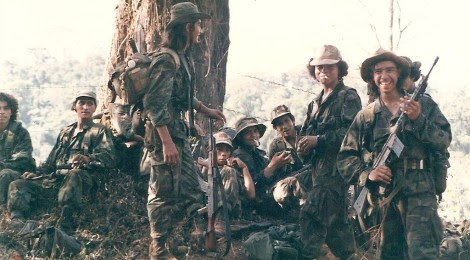
That the United States and NATO, a conventional defensive alliance, should be confounded by similar maneuvers on the part of Russia and left groping to “connect the dots” from Crimea to the Baltic is not a surprise. What should not be a matter for confusion is that hybrid warfare is not the exclusive province of a nefarious Putin, but rather a method available to any power with the motivation to employ it. This takes us only half way toward a solution. But, in paraphrase of Clausewitz, the first essential act of judgment is to establish the kind of war in which we are embroiled.
America Did Hybrid Warfare Too

April 7, 2015 · in 

The 5,548 ISIS Targets Struck By Coalition Air Forces, in 3 Charts

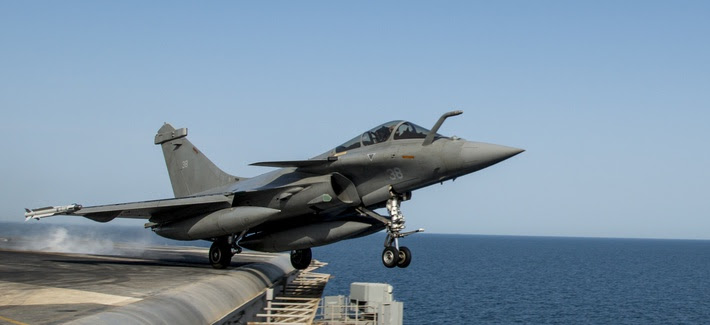
A French navy Rafale Marine aircraft launches from the U.S. Navy aircraft carrier USS Carl Vinson, on March 3, 2015.

http://www.defenseone.com/threats/2015/04/5548-isis-targets-struck-coalition-air-forces-3-charts/109426/?oref=defenseone_today_nl

APRIL 6, 2015BY KEDAR PAVGI
The Pentagon’s latest data release finally includes airplanes that were destroyed in fall 2014.

Giving Tuesday Recommendations

  Dear Friends,  I do not normally do this (except I did this last year and for the last few years now, too) and I certainly do not mean to ...