Showing posts with label ISIS. Show all posts

Wednesday, September 27, 2017

ISIS in Mindanao: A Threat to the U.S.?

ISIS in Mindanao: A Threat to the U.S.?

Wednesday, September 27, 2017
We should be clear: Mindanao is not Syria, Iraq, or Afghanistan.  We cannot approach a province of our longest standing treaty ally the same way we do in Syria or any of the other 18 or so countries to which the ISIS virus as spread.
As ISIS nears defeat in Syria and Iraq it is trying to keep its ideology alive by spreading to other countries where it is taking advantage of conditions of political resistance that weaken governments and provide safe havens for training, recruiting, and eventual resurrection of its quest for the Caliphate.  This is what appears to have attracted ISIS to Mindanao.  The attraction  is mutual, as threat groups such as the Abu Sayyaf Group (ASG) and the Maute Group have embraced the ISIS ideology to enhance their legitimacy and gain recruits, resources, and respect.  
Does this phenomenon in the Philippines and its neighboring countries pose a significant security threat to the U.S. that requires a U.S. military response?
Appreciate the Context
While the ISIS presence makes the headlines, it is important to remember that the Philippines and its neighbors are sovereign nations that are established, relatively stable, and advanced  compared to Syria and other ISIS locales.  However, the Philippines face myriad threats that complicate the security situation.  These range from the external threat of China and the territorial dispute to the existential threat posed by the Communist Party of the Philippines (CCP) and the New Peoples Army (NPA) which seek to overthrow the government.  President Duterte's drug war also garners much of the headlines. 
In Mindanao, in addition to the NPA, there is the continued friction with rogue elements of the Moro National Liberation Front (MNLF) despite the 1996 peace agreement that established the Autonomous Region of Muslim Mindanao.  There are the terrorist groups of the ASG and the Indonesian based Jemaah Islamiyah (JI).  There are also clan conflicts (ridos) and sometimes-violent competition among local political groups.  Lastly, among the major threats, there is the Moro Islamic Liberation Front (MILF) that seeks return of its ancestral domain and has nearly reached a peace agreement with the government though it has not been fully implemented. 
These conflicts together pose a serious challenge to the central government and regional structures, and this leads to sanctuary within Mindanao that allows various groups to survive and thrive.  Although there is no unified resistance to the central government, the widespread but disparate political resistance creates a cauldron that breeds political violence that ISIS has begun to exploit.
Understand the Problem
The nature of the problem is not solely a security threat.  Although the Marawi siege with the Maute Group is a lightning rod that brings focus on ISIS, it is only a symptom of the underlying problem.  It is a Philippine problem and a problem that can only be solved in the long term by the Philippine government at the national, provincial, and local levels.
To illustrate this, I will share one anecdote.  In 2007, I participated in a meeting with US diplomats and MILF leadership in their headquarters in Cotobato.  The purpose of the meeting was to express US support of the ongoing peace process and inform the MILF that a peace agreement will bring US support to the MILF just as  USAID did in 1996 for the MNLF when it signed the peace agreement.  The MILF leadership was quite clear that while they appreciated all the development support the U.S. and the international community would provide, if their political problems were not addressed and solved by the Philippine government, their insurgency would continue.
This can be applied to most of the threats in Mindanao.  The political problems that exist, from the national to the province to the barangay or village level are exploited by groups who seek to use political resistance and political violence to develop their own political power. 
The U.S. executed Operation Enduring Freedom-Philippines (OEF-P) under the authority of the 2001 AUMF which limited U.S. support to the security forces only conducting operations against Al Qaeda-linked organizations which at the time were the ASG and the JI. As described, the problems in the Philippines go beyond AQ, just as they go beyond ISIS.  It is a problem when the U.S. myopically focuses on a narrow threat that is only in its interests and does not take a holistic approach to the broader challenges faced by its ally.
While ISIS does not pose a direct threat to the U.S. from Mindanao, the political and security problems of the Philippines can serve as an incubator to allow the ISIS threat and others to metastasize and spread throughout the region.  If left unchecked it could use Mindanao as a sanctuary to rest, refit, and train new recruits.  It could exploit the maritime routes to move extremists to new targets of opportunity when it is ready to strike again.  At the very least, ISIS can use Mindanao to keep its ideology alive so that it one day can regain strength to attempt to re-establish its Caliphate somewhere.
Develop an Approach
How should the U.S. respond to the emergence of the ISIS threat in Mindanao?
First, the Philippine government must request additional support.  Despite the end of OEF-P in 2015 the U.S. has continued to provide security assistance in the Philippines to include advice and assistance with the ongoing siege in Marawi. 
Second, just as in OEF-P in 2001 it must conduct a thorough assessment of the situation in complete coordination with the Philippine military that will lead to a combined campaign plan that will integrate US support to the security forces.  The assessment will assist the Philippine government in determining the acceptable durable political arrangement necessary to stabilize the region.  This will also ensure that Philippine and U.S. interests are sufficiently aligned.
Third, the American Embassy in 2006 coined the phrase "Diplomacy, Development, and Defense" (3D) and as in 2006 the effort needs to be holistic and led by the Chief of Mission to ensure full U.S. interagency support to the Philippines.  A military only or military led mission is insufficient.  The approach must focus on assisting the Philippines more broadly than simply combatting ISIS.  It must support Philippine development and political solutions as well as security.
Fourth, the U.S. should act as part of a coalition of friends, partners, and allies.  Recent reports indicate that Australia has made the largest financial commitment to the situation in Marawi, along with the U.S. Japan, Thailand, and the EU.  China has provided the fifth largest contribution with the bulk for medical support of soldiers wounded in Marawi.  Although there are complexities that come with this approach, working as part of a coalition will minimize the focus on the U.S. and allow for greater and more effective support to the Philippines rather than the U.S. being the sole focal point for political opponents.
Fifth, the U.S. must use the right tools and forces for the mission from the capabilities of USAID to the appropriate military advisory forces from across the spectrum to include civil affairs and psychological operations as well as special forces who have developed decades long relationships with members of the Armed Forces of the Philippines.  These forces are well suited for operating "without being in charge" as they recognize that this is a Philippine problem and a Philippine fight.  This is not "leading from behind."  This is the appropriate understanding of the relationship between U.S. Special Operations Forces (SOF) and host nation forces in a sovereign nation.
A consideration for any support provided cannot be narrowly focused on ISIS and most certainly cannot use a similar approach as the U.S. has used in Syria and Iraq.  On the one hand, the challenges are bigger than ISIS, so the support to the Philippines must be broader.  On the other, a myopic focus on ISIS will enhance its legitimacy and provide fuel for growth.  It should be treated as a symptom and not the disease in the Philippines.  This must be an important theme in a supporting information and influence activities campaign.
In conclusion, ISIS is a growing global threat that is seeking to sustain itself for the long term even as it appears on the verge of defeat in Syria and Iraq.  It will exploit local political conditions in countries where it can find sanctuary so that it can live to fight another day.  However, in the Philippines, ISIS is only one security challenge.  The U.S., if requested, can provide advice and assistance to support a 3D approach  - diplomacy, development, and defense - that can reduce the ISIS threat by supporting Philippine political solutions.

Tuesday, January 19, 2016

"The Radicalized Foreign Fighter Threat: Real or Imagined? Dr. Bruce Hoffman & Dr. Daniel Byman

This 85 minute You Tube video is worth watching as two of our nation's pre-eminent scholars on terrorism share their analyses and disagreements on the foreign fighter threat.  In addition to the critically important analysis they both provide this is worth watching to illustrate the collegiality between two professionals and scholars who disagree.  I wish we could see such discourse among all the analysts on national security issues.


Published on Jan 17, 2016
Dr. Bruce Hoffman & Dr. Daniel Byman present "The Radicalized Foreign Fighter Threat: Real or Imagined?" at the CSS Lunchtime Series, on 14 January, 2016.


Tuesday, December 1, 2015

Obama Unleashes Hunter-Killers on ISIS

Kimberly Dozier references Project Gray.  I attended the conference yesterday as well.  The US Army John F. Kennedy Special Warfare Center and School has initiated a collaborative web site that will be very useful to all of those who want to focus on the Gray Zone.  I would urge those with an interest to join the site and begin contributing.  It can be accessed at this link: http://www.projectgray.org/  

Excerpt:

Linder held a one-day conference in Washington, D.C., to address how best to fight ISIS, to teach Washington policymakers and think tankers how special operations teams work to help local forces—a messy, years-long process.

​From the Project Gray Web Site:


About Project Gray


Project Gray is a collaborative study of the Gray Zone - the space between war and peace - where competitive interactions that fall short of a formal state of war, and which are characterized by ambiguity and uncertainty about relevant policy and legal frameworks, are undertaken by state and non-state actors. Conventional military responses by the Department of Defense lie outside the spectrum of appropriate responses for Gray Zone challenges. To address these conflicts, we must evolve our organization, intellectual, and institutional models to operate successfully in the Gray Zone.

Through a series of publications, forums, and events with academic, government, and military partners and other interested parties, Project Gray will enable us to analyze regional and trans-national conflicts, find solutions and develop best practices to operate in the middle ground between war and peace. It is our hope that the information shared and understanding gained can be used across geographic lines in response to similar challenges.

Project Gray is an initiative of the U.S. Army Special Operations Center of Excellence. We invite you to get engaged and join the conversation!


Now regarding this article and MG Linder's comments.  The only thing I can hope for is that the deployment of this "targeting force" could be to satisfy the need for immediate and visible action that can demonstrate metrics and actually provide "cover" and start buying some time for the forces conducting special  warfare to operate. Maybe there is a campaign plan that will employ surgical strike forces and special warfare forces in a mutually supporting and complementary manner.  See highlight paragraph below.

Excerpts:

The idea behind the new expeditionary force is to re-create a smaller version of the elite Joint Special Operations Command (JSOC) cell that operated in Iraq during the U.S. occupation. That force eventually carried out dozens of raids each night, with the evidence or information from captives in the first raid leading to the next raid.

Carter and Chairman Dunford told the House Armed Services Committee on Tuesday that the new “expeditionary” special operations force would carry out raids and hostage rescues in Iraq and Syria.

“The raids in Iraq will be done at the invitation of the Iraqi government and focused on defending its borders and building the Iraqi security force's own capacity,” Carter said at Tuesday’s hearing
​.

The targeting troops are part of a two-pronged attack by special operations forces, to buy time for the work of 50 special operations advisers, who are headed to northern Syria to work with the so-called Syrian Arab Coalition, which includes the Kurdish fighters that have proved to be some of the most effective in winning territory back from ISIS.

The idea is to use the same model as the one in Afghanistan in 2001, when roughly 60 U.S. Special Forces Green Berets worked with the Northern Alliance to overthrow the Taliban.

“You have to empower locals to fix their own problems,” said Maj. Gen. James Linder, commander of the Green Beret’s John F. Kennedy Special Warfare Center and School at Fort Bragg, North Carolina.

“You cannot clear out those villages with Americans and have the same results,” he said in an interview with The Daily Beast.

“So you have to get in there to find out who is the key communicator, what’s going to motivate those folks, what is their cause,” he said.

The U.S. advisers can teach them everything from how to train a small unit to carry out an ambush to how to coordinate multiple teams attacking the same target—something that rebel forces on their own have to learn by trial and error, with often deadly and disastrous results.

Other important lessons: teach them not to hit infrastructure or civilians, so that they’ll actually have something to govern afterwards.

Linder held a one-day conference in Washington, D.C., to address how best to fight ISIS, to teach Washington policymakers and think tankers how special operations teams work to help local forces—a messy, years-long process.

 “You need to manage expectations in the U.S. public,” he said, echoing top U.S. military officials who have spoken of this as a generational fight. “This will be a long-term engagement.”

Obama Unleashes Hunter-Killers on ISIS


BULLSEYE

The Special Ops Forces that got Bin Laden, Saddam, and Zarqawi are finally being sent by the dozens to go after the Islamic State’s leaders. Can these troops turn the tide?
“You don’t know at night who’s going to be coming in the window. And that’s the sensation that we want all of [ISIS’s] leadership and followers to have.”
The Obama administration is dispatching a targeting force of elite U.S. special operations troops into northern Iraq, after top U.S. defense and intelligence officials warned the ISIS network is growing faster than the coalition that’s fighting it, senior U.S. officials tell The Daily Beast.
The new special operations task force is aimed at denting the so-called Islamic State Group’s popularity by decimating its leadership, and gathering the intelligence needed to cut off more of its operations before they can launch.
It will be roughly 200 strong, based in northern Iraq, according to a senior defense official.
It’s the sharp end of the spear that will work with 50 special operations advisers who are deploying to northern Syria later this month, to advise local forces how to fight.
"It puts everybody on notice in Syria,” Defense Secretary Ash Carter told Congress on Tuesday. “You don’t know at night who’s going to be coming in the window. And that’s the sensation that we want all of [ISIS’s] leadership and followers to have.”
The war against ISIS began as a mission that President Barack Obama swore would not lead to ground troops. It became an operation in which U.S. officials only grudgingly acknowledged forces were not only on the ground but in combat. Tuesday’s announcement suggests that U.S. forces could now be on the front lines. 
The announcement of additional troops, made during a House Armed Services Committee on the war effort, surprised many at the Pentagon. Several of those involved in the effort struggled to answer basic questions about the new mission.
One thing that’s clear: The extra forces represent the latest adjustment to a strategy that has been stalled for months, according to Pentagon officials. Indeed, at Tuesday’s testimony, chairman of the Joint Chiefs of Staff Marine Gen. Joseph Dunford admitted that the U.S. had “not contained” ISIS. 
Carter and Chairman Dunford told the House Armed Services Committee on Tuesday that the new “expeditionary” special operations force would carry out raids and hostage rescues in Iraq and Syria.
“The raids in Iraq will be done at the invitation of the Iraqi government and focused on defending its borders and building the Iraqi security force's own capacity,” Carter said at Tuesday’s hearing.
The move was dismissed by critics of the Obama administration’s ISIS strategy, which relies on 3,500 U.S. troops already in Iraq to train local forces to do the fighting, combined with U.S. and other coalition airpower to hit ISIS targets.
“There is no firm date when we could get ISIS out of Raqqa or even Mosul,” Senate Armed Services Chairman John McCain (R-AZ) told MSNBC, referring to ISIS’s Iraqi and Syrian capitals. “And as long as they’re there and they have a base, they’re metastasizing.”
Pentagon officials say ISIS has lost 40 percent of its territory in Iraq and 5 percent of what it once held in Syria since the coalition launched attacks in August 2014. 
But U.S. intelligence officials say it continues to draw 1,000 new recruits a month, and is spreading, attracting new followers through violent actions like the attacks in Paris.
The idea behind the new expeditionary force is to re-create a smaller version of the elite Joint Special Operations Command (JSOC) cell that operated in Iraq during the U.S. occupation. That force eventually carried out dozens of raids each night, with the evidence or information from captives in the first raid leading to the next raid.
JSOC members have been on the ground in limited numbers since the start of the U.S. anti-ISIS campaign. But the new expeditionary task force will also provide the kind of airpower, combat search and rescue, and medical capability that special operations officials say will enable more aggressive raids throughout Iraq and inside Syria with a lower risk of casualties—an important requirement of the casualty-averse Obama White House.
One senior U.S. official explained that administration officials had been reluctant to approve raids without such resources available, because if operators were badly injured, they’d be outside the “golden hour” to get them to life-saving medical aid.
The targeting troops are part of a two-pronged attack by special operations forces, to buy time for the work of 50 special operations advisers, who are headed to northern Syria to work with the so-called Syrian Arab Coalition, which includes the Kurdish fighters that have proved to be some of the most effective in winning territory back from ISIS.
Senior officials say those advisers are expected to deploy in the next two weeks, with their first job to assess just how well the Syrian Arab Coalition is fighting and how to help them step up their fight against ISIS.
“All we have right now is their interpretation of what’s going on,” a senior official briefed on the operations said. He predicted the assessment of the local fighters could take weeks.
All the officials spoke on condition of anonymity to discuss the special operations deployments.
The idea is to use the same model as the one in Afghanistan in 2001, when roughly 60 U.S. Special Forces Green Berets worked with the Northern Alliance to overthrow the Taliban.
“You have to empower locals to fix their own problems,” said Maj. Gen. James Linder, commander of the Green Beret’s John F. Kennedy Special Warfare Center and School at Fort Bragg, North Carolina.
“You cannot clear out those villages with Americans and have the same results,” he said in an interview with The Daily Beast.
“So you have to get in there to find out who is the key communicator, what’s going to motivate those folks, what is their cause,” he said.
The U.S. advisers can teach them everything from how to train a small unit to carry out an ambush to how to coordinate multiple teams attacking the same target—something that rebel forces on their own have to learn by trial and error, with often deadly and disastrous results.
Other important lessons: teach them not to hit infrastructure or civilians, so that they’ll actually have something to govern afterwards.
Linder held a one-day conference in Washington, D.C., to address how best to fight ISIS, to teach Washington policymakers and think tankers how special operations teams work to help local forces—a messy, years-long process.
 “You need to manage expectations in the U.S. public,” he said, echoing top U.S. military officials who have spoken of this as a generational fight. “This will be a long-term engagement.”
—with additional reporting by Nancy A. Youssef

Sunday, August 16, 2015

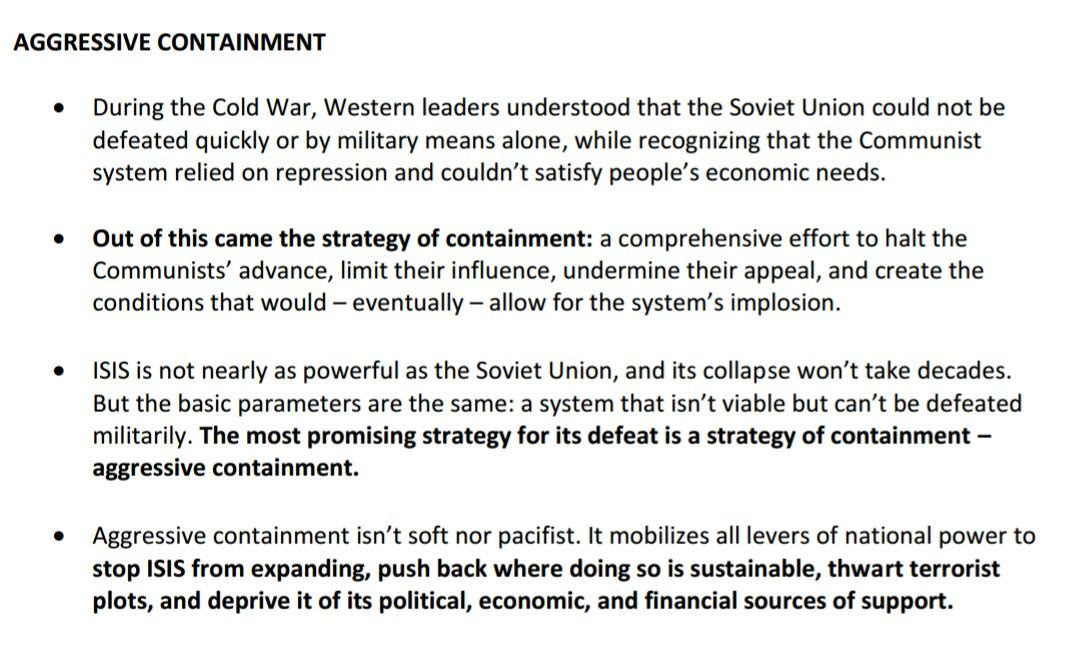
Smart and realistic: defeating ISIS through a strategy of "Aggressive Containment"

From a project Peter Neumann of King's College is working on.  You can find interesting things in the "Twitterverse"

Smart and realistic: defeating ISIS through a strategy of "Aggressive Containment"
Embedded image permalink

Tuesday, June 9, 2015

ISIS publishes manual on ‘How to Survive in the West’

You can download the entire manual at this link.  https://db.tt/mMNQg9Hv  Sorry to be late in sending this out as a friend just sent me this.  I missed then when it was discussed in March, April, and May.

I have pasted the table of contents below the article.  I guess ISIL is really taking on the image of a state as it is being nice enough to publish its "doctrine" just as we do.  Note the discussions on propaganda and guerrilla warfare.  Note also the discussion of very recent terrorist events such as in Paris and Denmark.

This really is an ISIL unconventional warfare manual (with ISIL Characteristics).

As we work to counter-Unconventional Warfare we should study this manual and we should observe for the activities described.

As you read this listen to the theme song from "Secret Agent Man" (https://www.youtube.com/watch?v=6iaR3WO71j4in your head (unless you are younger than man and do not recall the song):

As a Secret Agent, you will have to do many things and meet many people. You do not want
anyone to know your true identity, so you have to disguise yourself in different ways so your
real self iis not exposed. Below are some ideas:
But seriously this manual is very much worthy of study.


ISIS publishes manual on ‘How to Survive in the West’


ISIS manual entitled “How to Survive in the West” uses British advocacy agency’s website. (Courtesy: social media)
Text size A A A
By Staff writer | Al Arabiya News
Monday, 11 May 2015
The Islamic State of Iraq and Syria has published a manual entitled “How to Survive in the West” which advises its followers to use the website of British advocacy agency Cage for tips regarding surveillance, raids and interrogations.
The advocacy group has come under scrutiny in recent months, and is accused of being apologetic for terrorism and ISIS after the group’s leader Asim Qureshi called “Jihadi John,” who was filmed beheading American journalists, a “beautiful young man.”
The organization made media headlines when the identity of “Jihadi John” was revealed in February as Mohammed Emwazi. The group appeared to defend him, claiming that he had been harassed by international security services prior to his travels to Syria.
For its part, Cage has described itself as “an independent organization working to empower communities impacted by the War on Terror” and has spoken out against the UK’s anti-terrorism laws.
The ISIS manual includes tips for bomb making and committing fraud, and mentions the advocacy agency as a suggestion to turn to for legal aid, according to The Daily Mail.
An investigation uncovered that Moazzam Begg, a director of Cage and former Guantanamo Bay prisoner, was at the same Syrian training camp as Emwazi in 2011. Photographic evidence puts Begg in Syria with a camp commander who was also caught on video with “Jihadi John,” implying that Begg and Emwazi were at the same camp.
The Cage director was charged with attending a terrorist training camp in Syria for six months in October of last year.
Full cover for the book. (Courtesy: social media)
Last Update: Monday, 11 May 2015 KSA 14:41 - GMT 11:41

CONTENTS
Foreword ……………………………………….………………………………………………………………………...P5
Introduction ……………………………………………………………………………………………………………...P7
Chapter 1: Hiding the Extremist identity ……………………………………………………………….. P8
Chapter 2: Breaking Allegiance ………………………………………………………………………………..P11
Chapter 3: Earning Money ………………………………………………………………………………………. P13
Chapter 4: Internet Privacy ……………………………………………………………………………………….P16
Chapter 5: Training ………………………………………………………………………………………………….. P19
Chapter 6: Primitive Weapons ………………………………………………………………………………….. P23
Survival Techniques ………………………………………………………………………………………………….. P25
Chapter 7: Modern Weapons ……………………………………………………………………………………. P27
Chapter 8: B0mb Making ………………………………………………………………………………………….. P37
Chapter 9: Transporting Weapons ……………………………………………………………………………. P46
Chapter 10: What happens when you are spied on and get raided …………………………… P48
Europe's fear of returning fighters & the Sting Operation ……………………………………….... P50
Chapter 11: The Jihad Begins ……………………………………………………………………………………... P53
War in Protests ………………………………………………………………………………………………………….. P54
What is guerilla warfare? ……………………………………………………………………………………………. P63
Chapter 12: Escaping for Safety …………………………………………………………………………………... P66
Last Words of Advice …………………………………………………………………………………………………... P68
RESOURCES ………………………………………………………………………………………………………………….. P70

Friday, April 17, 2015

What the ISIS Campaign Teaches Us About the Future of War

Not mentioned below but almost everything written fits into this category: Revolution, resistance and insurgency.  Examples (http://www.soc.mil/ARIS/ARIS.html):
Modify the Type of Government
NPA, FARC, Shining Path, Iranian Revolution, FMLN, Karen National Liberation Army
Identity or Ethnic Issues
LTTE, PLO, Hutu-Tutsi Genocides, Kosovo Liberation Army, PIRA
Drive out Foreign Power
Afghan Mujahidin, Vietcong, Chechen Revolution, HizbollahHizbol Mujahedeen
Religious Fundamentalism
Egyptian Islamic Jihad, Taliban, Al Qaeda
Modernization or Reform
Niger Delta (MEND), Revolution United Front (RUF), Orange Revolution, Solidarity


Nations and non-state actors around the world are conducting their unique forms of unconventional and political warfare.  We would do well to study and understand the phenomena in order to develop strategies and campaign plans to address these threats and conditions.

What the ISIS Campaign Teaches Us About the Future of War


APRIL 16, 2015BY PETER W. SINGER
Winning today's fights still means reaching an actual victory, focusing on changing players, and heeding history.
 
It has now been over 250 days since U.S. forces began air strikes on the Islamic State, or ISIS,. U.S. warplanes have conducted 2,893 air strikes that have hit 5,314 targets ranging from 1,425 buildings to 58 boats, according to the most recentU.S. Central Command figures for Operation Inherent Resolve. The cost has reached roughly $8.5 million per day, summing just under $2.5 billion so far.

SUBSCRIBE

Receive daily email updates:

Subscribe to Defense One Today.
Be the first to receive updates.

AUTHOR

Peter W. Singer is a strategist and senior fellow at New America, consultant for the U.S. military and Defense Intelligence Agency, author of multiple bestselling books including Corporate Warriors, Children at War; Wired for War; Cybersecurity and Cyberwar: What Everyone Needs to Know and the ...Full Bio
History is written by the victors, it is said, and this conflict is certainly far from over. But surely some lessons of battle can be learned in the midst of war. For example, by the 250th day mark of World War I, it was clear that trench warfare had changed the flow of battle and new technologies like the machine gun and submarine would play a bigger role than expected. Or 250 days into the Iraq War, it was clear the U.S. quick takeover of Iraq had devolved into a painful insurgency that was more than a few “small pockets” of “dead-enders,” as infamously claimed by former Defense Secretary Don Rumsfeld.
So we asked our multidisciplinary Future of War network of more than 20 experts and leaders:
What lessons can we learn from the experience of the campaign against ISIS so far, not merely for Iraq and Syria, but the future of war more broadly?
Three themes seemed to cut across the reactions of a group that ranges in background from Navy SEALs to lawyers, technologists, and historians:
  • Depression is the inability to construct a future. – The existential psychologist Rollo May would have a field day with the American security community today. A pervading sense of frustration seemed to color the responses. None of the more than 20 experts was exultant and most were downright gloomy. This is notable in that they were asked about an operation in which U.S. forces have not lost a single battle nor life. Certain aspects of the future of warfare seem easier than ever, but not the part that matters most: achieving victory.
  • The Future of War is Mad Men Meets Game of Thrones – War is about politics by other means, but the storylines, structures, and maybe even ends of politics in the 21stcentury are shifting. Social media and strange alliances characterize this fight as much as the traditional tools, meaning Don Draper and Littlefinger might be apt players today. The concern is that in both the sale and ugly strategy of war, non-state actors are more nimble, more successful, or at least more disruptive than ever. How to counter that will shape the future of war.
  • History is the Future; The Future is History – Again and again, the experts cited ways in which history seemed to be either repeating itself or was being ignored. Perhaps then the secret to the future of war may be how better to apply the lessons of the past to today’s fight?
Continued at the link below:


Tuesday, March 10, 2015

Tuesday Reading Links


There are few as experienced as Maria Ressa with the use of social media to build communities.  I recommend paying attention to her on this.  I wish more people had paid attention to her book from Bin Laden to Facebook as she anticipated the phenomena we are experiencing today.  But her book remains timely and relevant so it is still valuable.

How to fight ISIS on social media

In nearly every language and with startling sophistication, ISIS is reaching out to young kids around the world and enticing them to see the world in new ways

America’s Dangerous Defense Cuts

Threats are rising around the globe, yet the U.S. is poised to cut $1 trillion from the Pentagon over 10 years.


My question is does north Korea, and the Kim Family Regime specifically, really want a peace agreement and what are they willing to do get one?

Although it is easy and convenient to blame the United States for all the hostility let's consider all the agreements and offers that have been made in good faith over the years from the 1991 ARNE to the 1994 Agreed Framework to the 1999 Perry Policy Initiative to the September 2005 agreement to the Leap Day Agreement (and we should also remember the 1997-2007 Sunshine Policy as well).  Why weren't any of these good enough to lead to a peace agreement?  What more does the north want to begin the peace process?  If none of these were efforts were good enough then what makes us think the north is going to come to the table for a peace agreement and then actually live up to it?

The bottom line is can north Korea be trusted to negotiate in good faith and live up to any agreements it makes?

Is it Time for the US to Broker Peace in Korea?


I actually think the DK/NA (or in my interpretation, don't know and don't care) category is most interesting.

But this conclusion is important:

Fox News' dominance puts its frequent complaints about the "mainstream media" into perspective. For millions of Americans, Fox News is the mainstream media.
Fox News is the most trusted national news channel. And it’s not that close.


U.S. envoy to Seoul leaves hospital after attack


U.S. commander says he held talks with China about N. Korea


PowerPoint Doesn’t Make Us Stupid, We Make Ourselves Stupid

For all the condemnations of PowerPoint in military culture, there’s a smart way to use it.


I have sent a similar article previously highlighting the author and her book.  I actually bought this book.  It is a fun read.  I really do admire how the author graphically portrays Sun Tzu's concepts.  Her visualization skills and capabilities could make for some useful power point charts if we were so inclined to use power point ever again (note tongue in cheek).  She can give us some lessons.


The Art of War in 7 Charts

KATHY GILSINANMAR 10 2015, 7:00 AM ET
  •  
  •  
  •  
  •  
Jessica Hagy


03.10.15

Top U.S. Commando Tells Troops: Get Counseling, I Did


http://www.thedailybeast.com/articles/2015/03/10/top-u-s-commando-tells-troops-get-counseling-i-did.html?via=ios


Is Mr. Rozeff a useful idiot or a good propagandist?  Interesting how he can compare the Russian invasion of Ukraine with Hitler's invasion of Poland, north Korea's invasion of South Korea and then the US invasion of Iraq.  It makes for an entertaining read.  But I wonder if Putin's recent statement on the annexation of Crimea undercut the author's argument.

Note that the web site lewrockwell.com for which the author writes has in its banner "anti-state anti-war pro-market"

RUSSIAN WAR AGGRESSION IN UKRAINE? IT’S A FICTION

There is no Russian aggression and there hasn’t been any Russian aggression


An interesting list of signatures of the Steering Group, Veteran Intelligence Professionals for Sanity (VIPS).

US Intel Vets Oppose Brennan’s CIA Plan

March 9, 2015


Of course it does not mention the unilateral withdrawal of US nuclear weapons in 1991.

But this is a great example of north Korean propaganda. It is quite "impressive" spin.


calendar>>March 9. 2015 Juche 104
U.S. Accused of Turning S. Korea into World's Biggest Nuclear Base

Excerpt:

But it is at the strategic level where the effects of this erosion of military ethics may be the most dangerous. To take one important example, Wong and Gerras were frequently told that the readiness assessments of partner forces in Iraq and Afghanistan were an example of ethical deception. These critically important assessments rated the ability of Iraqi and Afghan forces to fight on their own, without U.S. assistance. Yet these ratings usually depended more on the U.S. rotational unit deployment cycle than on the actual capabilities of those partner forces. In other words, partner units received low ratings when a new U.S. unit arrived, better ratings over time, and high ratings right before that unit left – only to plummet once again when a new unit arrived. This rollercoaster annual cycle would almost seem comical were it not for the fact that U.S. strategy in both Iraq and Afghanistan rested heavily on turning over the battlefield to these very same local national forces. This means that senior U.S. military and civilian decision-makers relied on fundamentally flawed data when assessing the progress towards this critical strategic objective. Thus, their decisions about whether the war should continue or end and at what pace U.S. and allied forces should withdraw were deeply distorted.

Excerpt:

The main Moro rebel group's involvement in a clash that wrought the government's largest single-day combat loss in recent memory has stalled the peace deal it signed with the Philippine government last year and sparked criticisms against President Benigno Aquino III, who approved the anti-terror commando raid.
Aquino blamed an ousted police commander, Getulio Napenas, for the huge combat loss, saying the latter launched the assault despite potentially fatal setbacks, including a three-hour delay that deprived the commandos of a night cover. Napenas also did not follow his order to coordinate with the military for backup, Aquino said.
"If I knew this is what he'll do from the start, I would have rejected this mission," Aquino said Monday. "What could have been a really successful mission, under the plan he crafted, turned up like mission impossible."

I suppose this excerpt from the Boston Globe in 2013 might explain why the administration might want him as Chairman.

America’s top military officer in charge of monitoring hostile actions by North Korea, escalating tensions between China and Japan, and a spike in computer attacks traced to China provides an unexpected answer when asked what is the biggest long-term security threat in the Pacific region: climate change.   http://bit.ly/INi3Vm


Giving Tuesday Recommendations

  Dear Friends,  I do not normally do this (except I did this last year and for the last few years now, too) and I certainly do not mean to ...