Showing posts with label political warfare. Show all posts

Sunday, January 8, 2017

We know what Russia did. But what we really need to understand is why. by Fareed Zakaria

As Frank Hoffman has been trying to hammer home to us the first principle is to understand.  There have been a number of scholars and experts advocating that we understand where Putin and Russia are coming from and why they are acting the way they do. Perhaps pundits such as Fareed Zakaria will wake people up with his article below.  Yes, the democracy movements around the world are a threat to Russia and democracy overall is a threat to Putin and Russia.  I think this is the fundamental reason why Gerasimov created his so-called Gerasimov doctrine (see Charles Bartles) that has come to be known as non-linear warfare or new generation warfare which in my opinion is modern unconventional warfare with Russian characteristics that is a holistic approach designed to influence political action at all levels from non-violence influence operations to political mobilization, to sabotage and subversion, support to terrorist activities to the integrated activities of all the elements of national power to the select application or threat of application of violence by the full range of military forces (both special and conventional) to achieve national objectives. Unconventional warfare is the most political of all forms of warfare since the focus is on exploitation of resistance movements that seek to coerce, disrupt, or overthrow...

Russia is a revisionist power seeking to undermine the legitimacy of opposing political systems and undermine the dominant international systems and institutions and make them function in its favor and interests in order to protect himself and the Russian leadership from the loss of political power at home and abroad.  China is another revisionist power.   And of course AQ and ISIS are revolutionary who seek to destroy the international system and replace nations with their ideological systems.  The question for the US and like minded nations of the world is whether it is in our interest to protect the international system that we have created since WWII and whether we will the will to commit to the defense of that system or should we let the revisionist and revolutionary powers to have their way?

I would commend everyone to read Charles K. Bartles' Military Review article on "Getting Gerasimov Right" from January 2016. (and we should all learn from the discussion of "foresight" in his article on page 31).

For U.S. readers, Gerasimov’s linking of the Arab
Spring and “color revolutions” (and in later comments,
the Maidan Movement) with military capability development
may seem odd. In order to put his comments
in context, it is necessary to look at the Russian view of
warfare and forced regime change as it has developed
since the end of the Cold War.
...
In the Russian view, the pattern of U.S.
forced regime change has been as follows:
deciding to execute a military operation;
finding an appropriate NATO’s Yugoslavia intervention is one of military
action to prevent mass genocide, Russia has a much different
view. Most Russians generally view the NATO
bombing campaign as having been illegal because it was
conducted without the approval of the UN Security
Council and believe that Serbia was simply being
punished for engaging in counterterrorism operations,
albeit with some excesses. The most egregious sin, from
the Russian view, was the partitioning of Yugoslavia.
This action set a precedent for external actors to make
decisions about the internal affairs and territorial integrity
of sovereign nations alleged to have committed
some wrong. It is important to note that Russia was
dealing with its own Islamic insurgency at the same
time in the North Caucasus. This may have caused
Russian concern about a similar NATO action taking
place inside Russia. One consequence of Western
intervention resulting in the destruction of Yugoslavia 
pretext such as to prevent genocide or seize weapons
of mass destruction; and finally, launching a military
operation to cause regime change (figure 1).


We should also go back to Anthony Cordesman's CSIS report on the "Color Revolutions" written in 2014.

Here is a summary of Russia's new generation or non-linear warfare from the Latvian Defence Academy.
Russian New Generation Warfare and the Future of War (link to the full report below - and the Poles and Finns have produced some excellent analysis of Russia's UW as well): 

As a result, it follows that the main guidelines for developing Russian military capabilities by 2020 are:
i. From direct destruction to direct influence;
ii. from direct annihilation of the opponent to its inner decay;
iii. from a war with weapons and technology to a culture war;
iv. from a war with conventional forces to specially prepared forces and commercial irregular groupings;
v. from the traditional (3D) battleground to information/psychological warfare and war of perceptions;
vi. from direct clash to contactless war;
vii. from a superficial and compartmented war to a total war, including the enemy’s internal side and base;
viii. from war in the physical environment to a war in the human consciousness and in cyberspace;
ix. from symmetric to asymmetric warfare by a combination of political, economic, information, technological, and ecological campaigns;
x. From war in a defined period of time to a state of permanent war as the natural condition in national life.

Thus, the Russian view of modern warfare is based on the idea that the main battlespace is the mind and, as a result, new-generation wars are to be dominated by information and psychological warfare, in order to achieve superiority in troops and weapons control, morally and psychologically depressing the enemy’s armed forces personnel and civil population. The main objective is to reduce the necessity for deploying hard military power to the minimum necessary, making the opponent’s military and civil population support the attacker to the detriment of their own government and country. It is interesting to note the notion of permanent war, since it denotes a permanent enemy. In the current geopolitical structure, the clear enemy is Western civilization, its values, culture, political system, and ideology.


We know what Russia did. But what we really need to understand is why.

The Washington Post · by Fareed Zakaria · January 5, 2017
I’m glad that Donald Trump will finally get a briefing on the unanimous conclusion of America’s intelligence agencies that the Russian government was behind the hacking of the Democratic National Committee and Hillary Clinton’s campaign chairman. But he should also request and receive a political briefing on Russia that can shed light on the backdrop to Russia’s actions. We need to understand why Russia behaved the way it has.
It all started with the Arab Spring. The sudden mass demonstrations and demands for democracy took most of the world by surprise. In particular, they rattled Moscow at a precarious moment. The Kremlin was in the midst of managing the country’s political future and worried about opposition at home. Parliamentary elections were scheduled in less than a year, to be followed by a presidential election. Vladimir Putin was not then president, having stepped aside in keeping with the Russian constitution, allowing Dmitry Medvedev to ascend to the office.
Roland Dannreuther of the University of Westminster in London points out that the “crises in both Libya and Syria coincided with the rise of opposition to the re-election of Putin, with unprecedented large opposition rallies in Moscow and other cities in Russia during 2011-12.” He argues that the Kremlin watched these countries as street protests morphed into broader opposition, created instability, and then attracted the attention and intervention of Western powers. Moscow was determined that no such scenario would play out in Russia or in any of its close neighbors, such as Ukraine.
In fact, there was a rare disagreement between Putin and Medvedev on how to respond to Libya. Putin bitterly attacked his own president for not vetoing a U.N. Security Council resolution sanctioning an intervention in Libya and lambasted the West for launching a “crusade” against a Muslim country. Medvedev, who was technically in charge of foreign policy, flatly contradicted him, calling his rhetoric “inexcusable.” Some Russia hands believe that this disagreement might have sealed Medvedev’s fate, ensuring that he served just one term and then made way for Putin’s return to the presidency. In any event, as Dannreuther writes, “for conservative Russian elites, the evidence of the Arab Spring confirms that such factional divisions in the guise of democracy promotion only lead to internal disorder, societal conflict and the loss of the sovereign integrity of the state.” (The fact that Clinton encouraged Russian democracy protesters at this sensitive moment branded her an archenemy in the eyes of the Kremlin elite.)
About a year later, in 2013, the chief of staff of the Russian Armed Forces, Gen. Valery Gerasimov, wrote an article suggesting that Russia’s key challenge was responding to the underlying dynamics of the Arab Spring and North Africa’s “color revolutions.” He urged that these not be viewed as non-military events because “a perfectly thriving state can, in a matter of months and even days, be transformed into an arena of fierce armed conflict, become a victim of foreign intervention, and sink into a web of chaos, humanitarian catastrophe, and civil war.” He advocated that Russia better understand and develop the non-military and asymmetrical methods, including special operations, information warfare and the use of internal opposition to cripple a society.
Since then, Moscow has made information and asymmetrical warfare central to its foreign and military policy. When asserting itself in Georgia and Ukraine, Russia has used a hybrid strategy that involves the funding of local politicians and militias, fake news and cyberattacks. Leading German and Polish politicians assert that Russia has engaged in some such activities in their countries as well. And now there is the apparent involvement in America’s election.
The idea of information warfare is not new. The Soviet Union developed and practiced a strategy of “disinformation” throughout the Cold War, complete with fake news and the penetration of Western political parties and media organizations. But the revival of this approach and the aggressive and sophisticated manner in which it is now being used in a social media landscape mark a new and dangerous trend in geopolitics.
This is the political backdrop behind the technical evidence that Russia interfered in November’s election. It needs to be moved out of a partisan framework and viewed in a much broader context. Since the end of the Cold War, no major country has challenged the emerging international system. But now, a great-power strategy, designed to work insidiously, could well succeed in sowing doubt, division, discord — and ultimately destruction — within the West.

Wednesday, November 16, 2016

Book Review: Sun Tzu, The Founding Fathers, The Art of Peace, and America’s Strategic Deficit Disorde

Book Review: Sun Tzu, The Founding Fathers, The Art of Peace, and America’s Strategic Deficit Disorder

Sun Tzu, The Founding Fathers, The Art of Peace, and America’s Strategic Deficit Disorder
David S. Maxwell
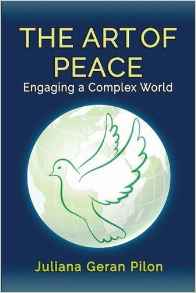
The Art of Peace: Engaging in A Complex World
Author: Dr. Juliana Geron Pilon
Transaction Publishers, 2016
If I could recommend one book to the Trump Transition Team it would be Dr. Juliana Geran Pilon’s The Art of Peace: Engaging in Complex World.
Dr. Pilon is a Senior Fellow at the Alexander Hamilton Institute for the Study of Western Civilization and a renowned scholar who has taught at the National Defense University, George Washington University and has held post-doctoral fellowships at Stanford’s Hoover Institution and the Institute for Humane Letters.   He is the author of a number of acclaimed books and over 200 articles.
I am partial to anyone who can write about Sun Tzu and apply the Art of War to contemporary strategy.  However most such attempts use Sun Tzu as a gimmick to gain attention.  Not so with The Art of Peace.  Dr. Pilon masterfully uses Sun Tzu to illustrate the problems we have with strategic thought and reminds us of the timeless elements of strategy that are arguably more relevant today than at any time in history.  I am even more partial to anyone who can combine Sun Tzu and the Founding Fathers to discuss national security strategy and Dr. Pilon masterfully incorporates American history and political philosophy into her work. 
Dr. Pilon argues that “the basic principles of war and peace are transcendent” throughout history and around the world.  What is really unique about this book is that she shows how Sun Tzu’s concepts were applied (admittedly subconsciously) by our Founding Fathers and most importantly that together Sun Tzu and the Founding Fathers still are applicable to the global geo-strategic environment of the 21st Century.
This book is a critique of American strategy and strategic culture and describes the disease from which we suffer – Strategic Deficit Disorder.  It shows us how standing true to the principles of both Sun Tzu and our Founding Fathers will make us better national security practitioners who strive to practice the “art of peace” as well as the art of war.
Why are Sun Tzu and the Founding Fathers still relevant?  They have one important trait in common.  They understood human nature and they devised strategies and built our republic in such a way that took human nature into account.  Of course human nature has always been important from Thucydides’ description of realism of fear, honor, and interest, to Clausewitz’ paradoxical trinity of passion, reason, and chance to understanding conflicts in the 21st Century that have been described as a fight for legitimacy among relevant populations.  As we seek to be able to protect U.S. interests in the gray zone between war and peace it is as important to understand the art of peace as it is the art of war.   In the post- 9-11 world we have recognized the importance of the human domain but we can look to Sun Tzu and our founding fathers to understand human nature.
Her basic premise is summarized here:
“… America can no longer afford to sit on the proverbial three-legged (”military, diplomacy, development) national security stool where one leg is a lot longer than either of the other two.  We are so much becoming militarized as decivilianized (with apologies to spell-check).”
Why is this important, especially to the Trump Transition Team?  Because according to Congressman Randy Forbes: "I think that with a President Trump, you'll see him coming out literally within the first few days saying that we are going to have an international defense strategy that is driven by the Pentagon and not by the political National Security Council."  If this is the case we will have four or more years of a decivilianized foreign policy and national security strategy.
Dr. Pilon argues that we need effective statecraft and policy makers, strategists, and statesmen who can practice political warfare that George Kennan defined as using all means at a nation’s command to achieve its objectives short of war.  Our nation’s civilian leadership needs to be well versed in political warfare and the U.S. military, and in particular special operations forces, needs to conduct operations in support of political warfare.
Today’s strategic environment is no longer bi-polar but can be described in terms of the following trinity:
  • Revisionist Powers who seek to disrupt and alter the international system to suit their strategic objectives.
  • Revolutionary Powers who seek to destroy the international system and replace it with one in which they can dominate.
  • Status Quo powers who seek to maintain the strength of the international system by respecting and protecting sovereignty and enforce the rule of law.[i]
To operate in this environment the U.S. needs to be able to conduct political warfare.

(Continued at the link below)

Friday, June 17, 2016

Remarks for Irregular Warfare Scholars and the Special Operations Campaign Artistry Program

Remarks for Irregular Warfare Scholars and the Special Operations Campaign Artistry Program (SOCAP) 
June 17, 2016
David S. Maxwell

Good morning.  Congratulations on your graduation from what I think is one of the most important programs in today’s military.  I wish that the Irregular Warfare Scholars and the Special Operations Campaign Artistry Programs had existed when I was in the Army. I would have fought to be part of these programs.  Perhaps you think it odd that I envy you but someday in the future you will be grateful for the education you have received and say you were fortunate to have been here at Ft Leavenworth which after all is the center of universe (or at least the other center when you are not at Fort Bragg). The late Colonel Ola Mize used to say that a Special Forces soldier should only want to be in two places during his career – overseas working with indigenous forces and back in the schoolhouse training and getting educated.

There are a few standard things that are said at all graduations.  Almost always you will hear speakers say that you will not remember what the graduation speaker said and everyone hopes the speaker will follow the rules of my mentor Bob Collins who told me long ago the three rules for briefing which are known as the “Three B’s”  -  “Be brief, be brilliant, be gone.”   Since no one can bat 1000 I am hoping for a 600 average and get two of three right; brief and gone, but in the end I know I will maintain a solid 300 by being gone at some point.

But I do remember some graduation speakers.  When I graduated from SAMS the former CSA General Sullivan was our speaker.  He had been our CGSC speaker the year before and gave a formal address as senior leaders must do.  However, when he spoke to us at SAMS after his retirement he gave an unforgettable speech as he started out telling us about the time he could now spend with his grandchildren and how he was able to read children’s books that he realized had strategic leadership relevance.  He proceeded with the rest of the speech telling us the leadership lessons from Dr. Seuss and while humorous and enjoyable it was actually quite brilliant. While in retirement he had a lot of time to engage with his grandchildren yet it was clear that he had not lost one of the most important traits of a senior leader; which is to be a lifelong learner and even as a former CSA he could still learn from Dr. Seuss.   I would offer one quote that that sums up the importance of being a lifelong learner:

"Education should implant a will and a facility for learning; it should produce not learned but learning people. In times of change, learners inherit the earth, while the learned find themselves equipped to deal with a world that no longer exists." – This is from Eric Hoffer, who is someone everyone in special operations should know as he wrote The True Believer.

I would ask everyone to reflect on those words not just today but throughout the rest of your careers.

I have had chance to listen to a lot of graduation speeches over the past 5 years at Georgetown.  Few are memorable but some, like last month’s, are quite provocative.  The graduate school had a Polish poet who was a human rights advocate in Mexico.  She proceeded to lecture us about how it is America’s fault that the Mexican people are oppressed.  She tried to make the argument that Mexican oppression was caused by American imperialism that began with the Monroe Doctrine and Manifest Destiny.  She told us that we should give California, New Mexico, Texas, Colorado, and even Arizona back to Mexico.  This was especially interesting because one of our graduating students was Lieutenant Jack McCain.  In the audience keeping a perfect poker face was Jack’s father, Senator John McCain. 

I will have to admit that I cannot offer anything as humorous or brilliant as General Sullivan and I hope not to be insulting and disrespectful of our students and guests here.

The second thing we hear at graduation is that at this point in time we have been at war for nearly 15 years. Of course I do not need to remind any of you of that as most of you have spent your entire careers up to this point fighting in this war.  Nor do we need to remind your family and friends.  And in the wake of San Bernadino and Orlando we may not need to remind the American people though I worry that for the public the memory that we are at war could soon fade as we return to going to the mall.

But after 15 years it is time to reflect on where we are and how we have arrived at this point in time with the threats we continue to face.  In the last 15 years there has been tremendous heroism and sacrifice.  There are heroes among you.  All of you have reached a level of technical and tactical expertise that is unmatched by any previous generation.  I am not ashamed to say that I was not anywhere near as competent as you when I was a Captain or a Major.  All of you have contributed to the tactical successes and important innovations that have been achieved,  from F3EAD – find, fix, finish, exploit, analyze, and disseminate to VSO – Village Stability Operations.  You are capable of bringing massive amounts of fire power to bear on the enemy or employing non-standard logistics to get people and equipment to remote locations to ensure sustained combat operations or exploiting intelligence, surveillance and reconnaissance systems and processes that we only dreamed about before 9-11.

But we need to pause and reflect.  Where are we, how did we get here, and where are we going? All of you are at the proverbial inflection point in your career which I think could be a fancy name for a fork in the road – and of course when faced with a fork remember Yogi Berra who told us “when you come to a fork in the road, take it.”  While that used to be humorous and people would laugh, I interpret that in other perhaps non- humorous ways:  carpe diem or seize the day, be decisive and make a decision, whichever way you go make it work, reach down for Clausewitz’ coup d’oeil – that inward looking eye of military genius that allows you to make the right decision at the right time and right place despite the fog and friction of war – whether that war is characterized by conventional, irregular, hybrid, unconventional, or political warfare.

You are transitioning from the tactical to the operational and the strategic.  This is very important to consider.   We should ask why if we have been so successful tactically we continue to be faced with such a large number of complex and diverse threats around the world that require we expend so much blood and treasure?

People do not like to invoke Vietnam but there are still many lessons we can learn and many that have been learned by SOF – VSO is a reincarnation of the CIDG program – the civilian irregular defense group.  You can take the tactical tips from Detachment B-52 and see how they have evolved to the advanced operational techniques that you employ as a matter of routine today.  Your ability to employ fires from the air and indirect fires from the ground is a natural evolution from our brethren who came before us. 

But like Vietnam we made and continue to make mistakes.  We should recall Colonel Harry Summers speaking with his Vietnamese counterpart at the negotiating table in Paris when he said, “You know, we have never been defeated on the battlefield.”  And his Vietnamese counterpart replied, “That may be true, but it is irrelevant.” I hope you all have read Giap’s strategy of Dau Tranh as we are seeing a 21st Century version of it.

Today we need to evaluate our policies, our political objectives, our strategy, and our campaign plans.  We need to look at our failures and our mistakes.  Take our recent efforts in Syria – should we be fighting a war with a program – a train and equip program?  Should we be supporting indigenous forces when our interests are not sufficiently aligned?  Should we be forcing our indigenous partners only fight for our interests and not theirs?  Or should we be campaigning which of course will include training and equipping as one part of the plan to support the strategy?  Most important, are we able to achieve the President’s strategic guidance of degrading and destroying ISIS or do we have an ends-ways mismatch in that we are not applying the ways and means to achieve the stated end? I suppose a generous assessment is that we are still in the degrade phase.

Of course I am being critical.  We seem to be doing somewhat better in Syria now that we are employing a mix of our special warfare and surgical strike forces and I truly hope we are employing the right forces for the right missions.  But we have a problem as a nation and a military.  I think that we are ineffective at strategy.  We are unable to achieve our political or policy objectives.  We do not “do strategy” well. 

One of the reasons that we do not do strategy well is that we do not understand our adversaries’ strategies.  (And we should remember that Sun Tzu not only said that it is the acme of skill to win without fighting, the true strategist must understand and be able to attack the enemy’s strategy). 

We do not understand the strategies because since 9-11 we have defined everything in terms of terrorism and in addition to terrorism, today we also define the major power threats in a neo-Cold War framework of great power competition. 

We are reaching for new terms to try to help us describe the phenomena we face – the popular new term is the Gray Zone.  I would characterize the threats we face in terms of the Gray Zone as a spectrum of cooperation, competition, and conflict in that space between peace and war.  We seek and desire cooperation, we have to be able to compete, and while we want to avoid conflict we must prepare for it.  One of the important forms of conflict can be described by revolution, resistance, and insurgency with our adversaries from AQ to ISIS to the Russian Little Green Men to the Iranian IRGC or China’s PLA all executing strategies of modern unconventional warfare, with their own unique characteristics, to exploit the conditions of revolution, resistance, and insurgency to achieve their strategic political objectives.

This is a complex environment.  As the late Sam Sarkasian said in 1993 in his seminal work, Unconventional Conflicts, we are seeing a strategic environment that can be described this way:

1.  Asymmetric conflicts: for the US these conflicts are limited and not considered a threat to survival or a matter of vital national interests; however, for the indigenous adversaries they are a matter of survival.  

2.  Protracted Conflict requires a long term commitment by the US, thus testing the national will, political resolve, and staying power of the US.

3.  Ambiguous and Ambivalent Conflicts:  It is difficult to identify the adversary, or assess the progress of the conflict; i.e., it is rarely obvious who is winning and losing.

4.  And finally, conflicts with Political-Social Milieu Center of Gravity – or in today’s parlance population centric warfare or war among the people.

So the question is how do we operate in this complex environment? How do we support the policies and achieve the political objectives established by our political leadership?

The answer is in large part you.  You are going to leave here and if the personnel system is going to evolve to effective talent management it will assign you now or in the near future to positions of great responsibility where you can contribute to campaigning.  While campaigning is not as sexy as kicking down a door or advising an indigenous force to capture or kill a high value target, it is incredibly important.  Frankly, we have great soldiers, sailors, airmen, and Marines who will accomplish any tactical mission we give them.  But they need to be given the right mission – the mission that will achieve or support the achievement of our political objectives.  We need men and women who can think critically and strategically: who can campaign.  When you are in these critical positions you are going to do a few basic things that will contribute to achieving our political objectives.  I will list seven.

            1.  Use design thinking to understand the challenges we face.  Must go beyond situational awareness to attain situational understanding – Make understanding a principle of war (Frank Hoffman)

            2.  Contribute to policy and strategy development – do not abdicate responsibility by saying this is the province of civilian political leaders – You have a responsibility to inform, educate, and when appropriate to advocate for the correct employment of the military instrument of power.

            3.  Develop campaign plans.

            4. Employ red team techniques.

            5. Assess and reassess continuously.

            6. Challenge assumptions constantly.

            7.  Ensure balance and coherency among ends, ways, and means with a recognition of threats, risks, and opportunities.  And to ensure balance and coherency you must not be afraid to recommend changes to the end state.

(And never forget the 12 SOF imperatives,* the SOF truths, and the SOF mission criteria.)

            These 7 tasks are fundamentals and not all inclusive, they are common sense, and they are really simple or at least simple to state and remember.  As Clausewitz reminds us, in war everything is simple but even the simplest thing is hard.  These 7 tasks are hard and it will take your intellectual ability and disciplined leadership to execute them effectively.  You have learned and know these 7 tasks and you are well equipped as Irregular Warfare Scholars to go forth and make important contributions to campaigns and strategy.

Let me tell one final story.  In my class at Georgetown, “Unconventional Warfare and Special Operations for Policy Makers and Strategists” I have a Navy SEAL Lieutenant.  I asked him why he was taking the course because as a SEAL he already is an expert special operator.  He described one of the weaknesses of the SEAL community and that is that it is very tactically focused.  He said that the commander of the Naval Special Warfare Command, RADM Brian Losey (who by coincidence is a National War College classmate of mine and someone I am proud to call a friend) has put out the message that SEAL officers have to learn how to campaign and must grow beyond the narrow tactical focus of direct action, counterterrorism, and surgical strike.  They have to be able to plan for and employ the entire joint special operations force.  Most important they have to be able to campaign to support strategy.  As they say, that SEAL and RADM Losey get it.  And so do you.

I have one recommendation for you.  This is really more of a request or even a heart felt plea.  Please write.  You have expertise and experience.  You have ideas.  You are critical thinkers.  Write.  Contribute knowledge to the profession of arms and to the national security dialogue.  Use the tools you found here and the intellectual gift you have.

You are Irregular Warfare Scholars and graduates of the SOF Campaign Artistry Program because you know how important it is to be able to campaign.  You came to the fork in the road here at Leavenworth and have taken it.   I expect that all of you will go on to make great contributions in many different ways which should be the goal for all of us:  To make a substantive contribution to our national security.  Be the quiet professional.  As we used to say in SAMS, be more than you appear.  Never forget the words of the late GEN Downing who adapted this from the SAS motto: who thinks, wins. 

I will close with the words of T.E. Lawrence that I think are the foundation of your education here: “Irregular warfare is far more intellectual than a bayonet charge.”  As I used to tell my Special Forces soldiers:  I know you can outfight any enemy but to win you must outthink him as well.  I know you are well prepared to outthink any enemy the United States will face.

I wish you the best.  Thank you and de oppresso liber.


*SOF Imperatives
  • Understand the operational environment 
  • Recognize political implications 
  • Facilitate interagency activities 
  • Engage the threat discriminately 
  • Consider long-term effects 
  • Ensure legitimacy and credibility of Special Operations 
  • Anticipate and control psychological effects 
  • Apply capabilities indirectly 
  • Develop multiple options 
  • Ensure long-term sustainment 
  • Provide sufficient intelligence 
  • Balance security and synchronization


Friday, June 10, 2016

Why the United States Needs a National Political Warfare Center and Regional Embassies

I would like to call attention to Kyle Johnston's excellent article in our Georgetown Security Studies Review at this link on page 84: http://georgetownsecuritystudiesreview.org/wp-content/uploads/2016/06/GSSR-Vol.-4-Iss.-2.pdf

Why the United States Needs a National Political Warfare Center and Regional Embassies by Kyle Johnston

Tuesday, December 29, 2015

Congress Has Embraced Unconventional Warfare: Will the US Military and The Rest of the US Government?

My latest article on Small Wars Journal.

Congress Has Embraced Unconventional Warfare: Will the US Military and The Rest of the US Government?

by David S. Maxwell

Journal Article | December 29, 2015 - 1:56pm
Congress Has Embraced Unconventional Warfare: Will the US Military and The Rest of the US Government?
David S. Maxwell
With the passage of the National Defense Authorization Act of 2016 the United States Congress has embraced what Russia, Iran, China, Al Qaeda and even ISIS have long known and that is unconventional warfare (UW) is a form of warfare that is optimized for achieving national objectives in the space between peace and war.  Congress, in Section 1097, has directed the Secretary of Defense to develop a strategy to counter unconventional warfare being conducted by adversaries of the US.  Congress recognizes the US has a strategy gap between peace and war and the directive to the SECDEF is the forcing function necessary to develop a strategy and to bring new and creative thinking to the national security challenges we face.
What is Unconventional Warfare?
In Section 1097 and in joint US military doctrine it is defined as “activities conducted to enable a resistance movement or insurgency to coerce, disrupt, or overthrow a government or occupying power by operating through or with an underground, auxiliary, or guerrilla force in a denied area.”
However, our adversaries employ their own unique forms of unconventional warfare by effectively integrating conventional and special operations forces, all elements of their national power, and in particular psychological warfare, while exploiting conditions, to include resistance, in countries and regions around the world to counter the west and often the US directly in order to achieve their political and security objectives.  They take a more holistic approach to unconventional warfare and are willing to employ it as a matter of course.  In     contrast the US has long viewed unconventional warfare as something only Special Forces conduct and then only to be used in very rare situations when there are no other alternatives.  In short, in the past the US has shown it does not have the stomach for unconventional warfare.  Fortunately, Congress has recognized this shortfall in US security strategy.
Directive from Congress
DOD has 180 days to provide to Congress a strategy to counter unconventional warfare.  The clock is ticking.  It will be interesting to read the response to Section 1097.  One possible bureaucratic course of action would consist of reviewing what the Department is already doing and showing the metrics of terrorists removed from the battlefield and listing all the capabilities the Department has that are and can be used to counter-unconventional warfare.  The Department will even tout the new joint unconventional warfare doctrine from the United States Special Operations Command (USSOCOM) the Joint Chiefs of Staff approved in September 2015.  The purpose of this course of action would be to meet the Congressional requirement with minimal disruption to the department and thus get Congress off its back.  Another course of action would be to view this as an opportunity for Congressional support of a new strategy that would be based on a thorough understanding of our adversaries’ strategies and how they are employing unconventional warfare.  The question is how with the department respond?
My concern is that the department and the rest of the US government will continue to have no desire to have anything to do with unconventional warfare.  It is complicated, messy, time-consuming, and hard to measure effectiveness and success especially when compared to counterterrorism and surgical strike operations where immediate results are demonstrated in the number of terrorists removed from the battlefield.
Why Focus on Counter-Unconventional Warfare Strategy?
First, our enemies are conducting their unique forms of unconventional warfare; Russia, Iran, China, Al Qaeda, ISIS (I think AQ and ISIS are much broader than "simply" terrorist organizations.)  We need to recognize the strategies they are using and attack those strategies to effectively operate in the "Gray Zone” between peace and war.
Second, focusing on our enemies conducting their unique forms of UW should lead to the recognition that we have to operate in the Special Warfare realm and not just the Surgical Strike realm.
Third, focusing on terrorism has caused us to think too tactically while a focus on counter UW can drive us to think more strategically and holistically about the problems we face by understanding the enemy’s strategy which poses complex political and military problems.
The Future of Warfare in the Gap Between Peace and War: Past is Prologue
As I opined in 2012 before a subcommittee of the House Armed Services Committee looking at the future of irregular warfare, we tend to prefer conventional conflict that can be defined as  "an armed struggle or clash between organized political parties within a nation or between nations in order to achieve political or military objectives.”  However, what we more routinely face is conflict that is “non-conventional” in nature.  It is something ambiguous and difficult to understand.  It extends the continuum of conflict.  Conflict in the conventional sense begins when the armed struggle begins; however, non-conventional conflict encompasses a broad range of types of conflict, starting with thethreat or possibility of conflict and extending past conflict termination, because the conditions that gave rise to hostilities in the first place may still remain, though not visible or easily recognized.  It also includes armed clashes by unorganized groups that are not seeking to achieve any political or military objectives but may be exploited by external actors.  Non-conventional conflict encompasses the lawlessness of a society in which the governmental system has collapsed, but no organized group has risen to take its place.  Violence and terrorist-like activity can occur out of frustration with no identifiable purpose.  This type of conflict is non-conventional, because it is difficult to determine the objectives and methods of the actors, perhaps difficult to even determine the actors, and thus it is difficult to apply conventional elements of power.  This is the sensitive and complex environment that our adversaries seek to exploit through their unique applications of unconventional warfare.
Since 9-11 we have embarked on the search for new names of forms of conflict and doctrinal terms to address those conflicts and the ever evolving nature of conflict.  We rediscovered Counterinsurgency; we have tried Asymmetric, Hybrid, and Fourth Generation Warfare and now the Gray Zone.  We have invented new doctrinal concepts such as Security Force Assistance; Train, Advise, and Assist; Building Partner Capacity, Train and Equip Programs, Human Domain, and ultimately decided on irregular warfare as the way to describe conflict in the post 9-11 world.  If we examine the history of conflict at theCorrelates of War Project we would realize the irony that what we are calling irregular in fact has been more regular than what we describe as conventional war.  Less that 20% of all conflicts since 1815 have been state-on-state conventional conflicts.  Or simply peruse Sir Lawrence Freedman’s Strategy: A History and Max Boot’s Invisible Armies to see that irregular warfare is the most prevalent form of warfare and is in fact pretty regular.
But at the heart of irregular warfare lies revolution, resistance, and insurgency.  These phenomena are taking place around the world but they are not new.  If you want to be a practitioner and strategist and operate in and develop strategy for the Gray Zone in the space between peace and war and conductpolitical warfare, unconventional warfare, and counter-unconventional warfare, as well as operate effectively in the human domain then you must read, study, and internalize the fundamentals of revolution, resistance, and insurgency as embodied in the Assessing Revolutionary and Insurgent Strategies (ARIS) project first produced by the Special Operations Research Office (SORO ) in the 1950's and 1960's. It now continues under the direction of the U S Army Special Operations Command and Johns Hopkins Applied Physics Laboratory's National Security Division.  Most important it is unconventional warfare that can support or exploit revolution, resistance, and insurgency.
Russian, Iranian, Chinese, and US Approaches to Unconventional Warfare
Unconventional warfare has not been and is not now well accepted within the US military and the US government.  The most recent attempt to raise unconventional warfare as a strategic option for our national security strategy illustrates the issue.  Some 28 years after the establishment of the USSOCOM in 1987, the command produced for the first time a joint unconventional warfare doctrinal manual.  USSOCOM had to lobby for over a year to get joint staff approval just to write the manual and when it was completed and approved in September 2015 the Joint Staff decided to make the manual For Official Use Only (FOUO).  Although this is not a classification it in effect makes the manual unavailable to the public as well as to academia.   I can only speculate the on the rationale for this but some action officers have said that it is a result of the controversy surround the unconventional warfare exercise Jade Helm that took place in 2015.  The real impact of this decision is summed up in the words of one my mentors who said that the surest way to make a doctrinal manual irrelevant and useless is to make it FOUO.
While the Joint Staff allowed unconventional warfare doctrine to be marginalized our adversaries have been perfecting and employing theirs.  The following charts summarize the unique unconventional warfare approaches of the Russians, Iranians, and the Chinese.  The last chart summarizes the US approach to supporting a resistance or insurgency.  As you read these charts notice that the Russian, Iranian, and Chinese approaches provide a strategic framework for understanding how they will employ special operations and conventional forces and all the instruments of national power to accomplish their objectives while the US approach is very tactical and focused on “how to do” UW by Special Forces only.
Russian New Generation Warfare
(Continued at the link below)

Giving Tuesday Recommendations

  Dear Friends,  I do not normally do this (except I did this last year and for the last few years now, too) and I certainly do not mean to ...