Wednesday, August 20, 2014

"The U.S. Army in Korea: Strategic Landpower at the Forward Edge of Freedom”

"The U.S. Army in Korea: Strategic Landpower at the Forward Edge of Freedom”  

“The U.S. Army in Korea: Strategic Landpower at the Forward Edge of Freedom” (Torchbearer Issue Paper, August 2014) begins with a discussion of the unpredictability and danger of the North Korean regime. As long as it continues to operate as it does, the vital interests of South Korea and the stability of the Asia-Pacific region as a whole will be constantly threatened. Since 1950, the United States’ alliance with South Korea has been in transformation to meet the mutual security interests of both nations. The relationship continues to grow and evolve, standing as a critical deterrent to the dynamic North Korean threat, supporting regional engagement with partners and enhancing responsiveness to contingencies through rotational deployments and multinational training exercises. Eighth Army is an integral part of USFK, constituting the largest military contribution to the alliance and providing the majority of American servicemembers stationed in South Korea.

http://www.ausa.org/publications/ilw/DigitalPublications/Documents/tbip-eightharmy/index.html. You will need the latest version of Adobe Flash Player to view the paper.

Tuesday, August 19, 2014

Rescued from Mount Sinjar

An alternative non-US, non-journalist view of US Special Forces operations on Mount Sinjar.  Read the whole report at the link below.


Rescued from Mount Sinjar

Rescued from Mount Sinjar
A refugee on Mount Sinjar tries to board a helicopter minutes before it crashed during an attempted take-off. (ADAM MIRANI)
By BEN LANDO of Iraq Oil Report
Published Tuesday, August 19th, 2014
ERBIL - Adam Mirani flew to Mount Sinjar on a mission that was supposed to be quick and straightforward: drop off food and water for some of the thousands of refugees stranded there, and return to Iraqi Kurdistan.
In the ensuing day and a half, however, Mirani would not only survive a deadly helicopter crash, but he would also meet some of the American Special Forces soldiers - as well as Syrian Kurdish militants from the People's Protection Units (YPG) - who were helping a handful of Kurdish Peshmerga soldiers protect civilians from the radical Islamist militants surrounding the mountain.
Mirani's Kurdish-Canadian family had helped provide a cargo of high-energy biscuits, dates, bread, and water, which were loaded onto an Iraqi Army helicopter bound for Mount Sinjar on Aug. 12. Mirani was one of the 14 people on board who flew out to distribute the supplies to members of Iraq's Yezidi minority, dozens of whom had already died of dehydration and hunger.
Two weeks ago, hundreds of thousands of Yezidis fled from the nearby city of Sinjar and other towns, after extremist militants from the so-called Islamic State (formerly the Islamic State of Iraq and al-Sham, or ISIS) launched an offensive in northern Iraq and seized several cities from Kurdish security forces. The offensive was so swift and deadly that it prompted U.S. President Barack Obama to authorize air strikes against ISIS fighters threatening Iraq's major cities and Yezidi refugees.
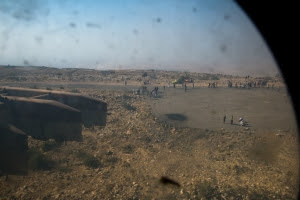
Pilots, journalists, and aid workers board a helicopter bound for Mount Sinjar on Aug. 12, 2014. (ADAM MIRANI)
After the helicopter landed, dozens of refugees swarmed around, desperate to be saved from the militants below and the withering desert heat on the mountain. As the humanitarian team unloaded the supplies, refugees climbed aboard, and Mirani estimates a total of between 30 and 40 people were on the helicopter when it was ready to lift off.
"The pilots obviously didn't want this many people on the aircraft, so one of the gunners went to the back and they really had to drag people off the helicopter because they knew there were too many," Mirani said. "Many people were screaming to let them stay. But you cannot hear people screaming because it's so loud."
The added weight made a complicated takeoff even more perilous. The mountain embankments all around made it hard to maneuver, and the threat of ISIS firepower below meant the pilot needed to take off fast. As the helicopter left the ground, it began to buck the pilot's efforts to control it.
"It hit the ground, scraped the bottom and probably took off the tires," Mirani said.
Then the nose of the chopper caught on the ground and the whole thing flipped, like a bicycle hitting only its front brake.
Refugees gather around a landing area awaiting an Iraqi Army helicopter carrying food and water. (ADAM MIRANI)
"We flipped twice, I believe, and landed front side up and on our side," Mirani said. "Everyone inside was thrown to the front of the aircraft, including me."
Next thing he knew, Mirani was caught in a tangle of bodies and limbs. He was being choked by his camera strap, with his camera wedged between several other people. His leg was also caught, and could only be freed after he ripped his pant leg and wriggled his foot from his shoe.
Continued at the link below)

North Korea and the Responsibility to Protect

The 5 page report can be downloaded in PDF format at the link below.  This is the first paper I have read that explicitly discusses Responsibility to Protect (R2P) in terms of north Korea.  Excerpt:

This Policy Brief clarifies 
the application of R2P in the case of DPRK, outlining the 
responsibility of the international community in relation 
to the government’s commission of crimes against 
humanity. While the situation remains complex and 
dangerous, the international community, especially the 
UNSC, has not exhausted all options and can no longer 
continue to overlook ongoing mass atrocity crimes in 
DPRK. 


North Korea and the 
Responsibility to Protect

INTRODUCTION 
The human rights and humanitarian situation in the 
Democratic People’s Republic of Korea (DPRK) is dire. 
Crimes against humanity as well as other systematic and 
widespread human rights violations continue to be 
committed by the government under the current 
“Supreme Leader,” Kim Jong-un. Despite testimony 
from defectors and other credible evidence accumulated 
over the last decade, the government has never 
acknowledged the existence of abuses, nor amended its 
repressive policies. Extreme political isolation and 
governmental intransigence continue to hamper further 
investigation and accountability. 
Amid mounting human rights concerns in DPRK, on 21 
March 2013 the United Nations (UN) Human Rights 
Council adopted resolution 22/13, establishing a 
Commission of Inquiry (CoI) to investigate systematic, 
widespread and grave violations of human rights, 
particularly where “these violations may amount to 
crimes against humanity.”1 
The CoI published its findings on 7 February 2014, 
establishing responsibility at the highest level of 
government for ongoing crimes against humanity, 
including “extermination, murder, enslavement, torture, 
imprisonment, rape, forced abortions and other sexual 
violence, persecution on political, religious, racial and 
gender grounds, the forcible transfer of populations, the 
enforced disappearance of persons and the inhumane 
act of knowingly causing prolonged starvation.” The 
report noted the government’s failure to uphold its 
primary responsibility to protect its population. 


For nearly a decade UN bodies, including the General 
Assembly, Human Rights Council and Secretariat, have 
expressed concern over grave human rights violations 
and called upon the government to improve the 
situation. While the UN Security Council (UNSC) has 
been engaged on DPRK in relation to nuclear weapons, 
it has never directly addressed ongoing human rights 
abuses. DPRK’s provocative nuclear policies, as well as 
security concerns over the ongoing division of the 
Korean Peninsula as a result of the 1950-1953 Korean 
War, have continued to overshadow human rights 
issues. 
The DPRK government bears the primary Responsibility 
to Protect (R2P) its population from genocide, ethnic 
cleansing, war crimes and crimes against humanity, but 
is manifestly failing to do so. This Policy Brief clarifies 
the application of R2P in the case of DPRK, outlining the 
responsibility of the international community in relation 
to the government’s commission of crimes against 
humanity. While the situation remains complex and 
dangerous, the international community, especially the 
UNSC, has not exhausted all options and can no longer 
continue to overlook ongoing mass atrocity crimes in 
DPRK. 

Friday, August 8, 2014

US expert calls for S. Korea, U.S. to ditch OPCON transfer agreement

(Note: it is the Center for Security Studies vice the Center for Peace and Security Studies. The name changed years ago but I am sure when the Yonhap journalist googled he came up with that name - google is not always your friend).


US expert calls for S. Korea, U.S. to ditch OPCON transfer agreement

2014-08-08 06:41
   South Korea and the United States should admit their agreement to transfer wartime operational control (OPCON) of South Korean troops from Washington to Seoul was a mistake and should focus on strengthening combined defense capabilities, a U.S. expert said Thursday.

   David S. Maxwell, associate director of the Center for Peace and Security Studies at Georgetown University, made the point, stressing the planned transfer would involve dismantling the Korea-U.S. Combined Forces Command (CFC), which he said would "undo sixty plus years of perfecting combined operations capabilities."

   South Korea and the U.S. held a second round of negotiations in Washington this week to determine how long to delay the planned OPCON transfer. The talks were aimed at preparing for their annual defense ministers' talks in October, known as the Security Consultative Meeting.

   "The SCM should admit that the OPCON transfer issue was a mistake built upon a shaky foundation during a period of mutual disdain and distrust by both nations," Maxwell said in the Nelson Report, a Washington-based newsletter, referring to the tense relations between the two countries when former late South Korean President Roh Moo-hyun was in office from 2003 to 2008.

   The agreement, first reached in 2006, was the product of rising anti-American sentiment in South Korea and the U.S. desire to divert its forces from Korean responsibilities to support the global war on terrorism, the expert said.

   "These conditions no longer exist and thus the initial 'rationale' (or assumptions perhaps) for OPCON transfer are no longer valid," he said. "Therefore discussion about alliance military capabilities should be focused on enhancing the combined capabilities."

   Maxwell also emphasized that keeping the CFC intact is "critically important to the strategic interests of both nations to ensure they have the most capable war fighting command to ensure deterrence, defense, the ability to defeat the North's military if attacked as well as to conduct the full spectrum of operations necessary to deal with regime collapse."

   South Korea handed over control of its forces to the U.S. during the 1950-53 Korean War to defend against invading troops from North Korea. Peacetime control of its forces was returned in 1994, and in 2006, the two countries agreed to have Seoul regain OPCON in the event of war.

   The initial target date was 2012 before it was pushed back to 2015.

   But last year, Seoul again asked for a delay in the OPCON transfer after North Korea conducted its third nuclear test, saying the security situation on the peninsula was markedly different from when the transfer was agreed upon a few years ago.

   The two countries are basically in agreement on putting off the transfer. South Korean Defense Minister Han Min-koo and U.S. Defense Secretary Chuck Hagel are expected to determine by how much it should be pushed back when they hold talks in Washington in October.

   Some American experts, however, are calling for the South to stop relying on the U.S. for its defense.

   "South Korea has achieved much, overcoming colonialism, war, and dictatorship to create a country at the front rank internationally," Doug Bandow, a senior fellow at the Cato Institute, argues in Forbes magazine online. "A serious nation in every other regard, the ROK (South Korea) is an international welfare queen when it comes to defense, abusing the generosity of the American people."

   Bandow stressed that the wartime OPCON should shift and U.S. troops should return home.

   "South Korea could then take its place among the world's nations as truly independent, freed of its embarrassing reliance on Washington for defense, perhaps the most basic attribute of nationhood," he said.

   By Chang Jae-soon
   WASHINGTON, Aug. 7 (Yonhap)
   jschang@yna.co.kr
(END)

The U.S. and South Korea Should Focus on Improving Alliance Capabilities Rather Than the OPCON Transition

Excellent discussion of the OPCON transfer issue from Bruce Klinger.  Needless to say I agree with these recommendations (but please read the entire essay).

Recommendations for an Effective Military Strategy

South Korea should affirm that it still seeks responsibility for wartime OPCON command. President Park Geun-hye should articulate plans to redress shortages in the country’s defense capabilities, including critical shortages in C4ISR.
Washington and Seoul should:
    • Not establish a new arbitrary date for the OPCON transition, but instead allow a conditions-based approach to drive the timing of the decision, based on an assessment of the North Korean threat and allied military capabilities. The dominant consideration should be ensuring robust combined and integrated allied capabilities to deter and defeat the North Korean threat.
    • Assess the potential repercussions of the OPCON transition on North Korean and Chinese behavior; U.S. force posture in the Pacific, including Japan and Okinawa; and regional perceptions of U.S. security guarantees.
    • Abandon the plan to abolish Combined Forces Command upon the OPCON transition. Instead, the allies should retain the CFC with the Chairman of South Korea’s Joint Chiefs of Staff becoming the CFC commander and the commander of U.S. Forces Korea becoming the deputy CFC commander. Washington should retain command of the UNC.
    • After the OPCON transition, South Korean officers should serve as the subordinate ground component commander and naval component commander with U.S. officers as the air component commander and a newly created position of amphibious warfare component commander. The CFC commander would continue to report to both the U.S. and South Korean National Command Authorities.
Before people get up in arms about a ROK General Officer in Command of the ROK/US Combined Forces Command because of the so-called "Pershing Rule," those critics need to understand the command relationships and if they do not then they need to hold their fire until they do.  We need to understand that the ROK/US CFC answers to the Military Committee which as I have said over and over again is made up of representatives of and answers to the National Command and Military Authorities of Korea and and the National Authority of the Untied States.  Here is an attempt to summarize of the command relationships:

The ROK/US Combined Forces Command (ROK/US)  is the warfighting headquarters of the ROK/US Alliance.  It answers to the Military Committee which provides strategic direction and operational guidance to the ROK/US CFC and consists  of representatives of both nations' National Command and Military Authorities (NCMA) (ROK) and National Authority (NA) (US).  The ROK Joint Chiefs of Staff (JCS) retains command of all ROK forces and when directed by the ROK NCMA provides forces to the ROK/US CFC for employment under its operational control.  US Forces Korea (USFK)  is a subunifed command of US Pacific Command (PACOM) which is the Combatant Command of the US and PACOM retains combatant command of all US forces in the Korean Theater of Operations with USFK exercising OPCON of US forces for PACOM.  USFK provides forces to the ROK/US CFC for employment under its operational control when directed by US National Authority.  The United Nations Command (UNC) is responsible for maintaining the Armistice and answers to the US JCS as the designated executive agent for the United Nations.  The UNC may also have operational control of international forces from United Nations' sending states should sending states chose to provide forces for the defense of the ROK in accordance with UN Security Council Resolutions 82 through 85 (circa 1950).


Backgrounder #2935 on Alliances
August 7, 2014

The U.S. and South Korea Should Focus on Improving Alliance Capabilities Rather Than the OPCON Transition

Abstract
Washington and Seoul have so fixated on the deadline for transferring wartime operational command of South Korean forces as to be distracted from ensuring robust combined and integrated allied capabilities to deter and defeat the North Korean military threat. Moreover, the current plan to dissolve Combined Forces Command is ill-advised and potentially dangerous during hostilities. For maximum deterrent and warfighting capabilities, the U.S. and South Korea should instead retain the combined command structure, although with Seoul assuming command upon OPCON transition. South Korea should commit to acquiring necessary defense capabilities, including a more effective missile defense system.
If hostilities break out between North Korea and South Korea (ROK), the current agreement between Washington and Seoul would put all ROK forces under control of the bilateral Combined Forces Command (CFC), which is led by a U.S. general. During armistice,[1] the government of South Korea controls its military forces, while the U.S. controls all U.S. and international forces on the Korean Peninsula.
In April 2014, President Barack Obama and President Park Geun-hye preliminarily agreed for a second time to postpone the planned dissolution of the CFC and return of the wartime operational control (OPCON) of South Korean military forces to Seoul.[2] Washington acquiesced to Seoul’s request to reassure an ally nervous of its defense capabilities in the face of the growing North Korean threat and a perceived weakening of U.S. resolve.
A delay beyond the December 2015 deadline would provide additional time to decide on the requisite command structure and operational plans and to procure the necessary equipment to improve allied capabilities. However, Washington and Seoul should not be complacent. The two postponements were necessitated by insufficient progress in achieving requirements and by North Korean refusal to eliminate its nuclear weapons.
Washington and Seoul should not establish a new arbitrary date for the OPCON transition. Instead, they should time the transition based on a conditions-based approach that assesses both the North Korean threat and allied military capabilities.
However, the manner of the transition is more important than its timing. The planned dissolution of the existing combined command structure into two, separate, parallel commands is ill-advised and potentially dangerous during hostilities.[3]
Washington and Seoul should instead retain the Combined Forces Command for maximum allied deterrent and warfighting capabilities. Upon regaining wartime OPCON, South Korea should assume command of the CFC with the United States shifting to the deputy commander position, while Washington retains command of United Nations Command (UNC).
Such a dramatic reversal will require extensive bilateral planning, training, and validation. South Korea will also need to increase its procurement, particularly of requisite command, control, communications, computers, intelligence, surveillance, and reconnaissance (C4ISR) capabilities.
For its part, the United States will need to address congressional and public concerns arising from appearing to place American troops under foreign operational control. U.S. military leaders should emphasize that U.S. forces would actually be under alliance operational control, as exercised in NATO.
In many ways, fixating on the OPCON transition has been a distraction. Washington and Seoul should instead focus on ensuring robust combined and integrated allied capabilities to deter and defeat the multifaceted North Korean military threat.

Control of South Korean Military Forces

Following the 1950 invasion by North Korean forces, South Korean President Syngman Rhee handed operational control of the South Korean military to the United Nations Command. Although the 1953 armistice ended the Korean War, the UNC retained OPCON until 1978, when it was transferred to the newly established Combined Forces Command. The CFC returned peacetime OPCON of South Korean forces to Seoul in 1994.[4]
The Armistice Roles of the UNC, the CFC, and USFK. The senior U.S. general on the Korean Peninsula, currently General Curtis Scaparrotti, concurrently serves as the commander of the UNC, the CFC, and U.S. Forces Korea (USFK). The UNC commander leads an 18-nation coalition responsible for maintaining the 1953 armistice agreement.
The CFC commander is responsible for deterring North Korean aggression and organizing, planning, and exercising U.S. and South Korean forces. During armistice, the Chairman of the South Korean Joint Chiefs of Staff has day-to-day responsibility for defending the country, but the CFC plans, trains, and stands ready to assume operational control in time of war.[5]
The USFK commander leads the 28,500 U.S troops in Korea. These troops do not patrol the Demilitarized Zone or conduct air or sea patrols. The USFK is not a warfighting headquarters. Its main function is to train U.S. troops in Korea, to evacuate all U.S. civilians if directed by the U.S. ambassador, and to facilitate the reception of the hundreds of thousands of troops that would come from the U.S. in case of war.[6]
During armistice, South Korean forces remain under the command and operational control of the Chairman of the South Korean Joint Chiefs of Staff (JCS) and the individual military service chiefs of staff. However, both the USFK and South Korean troops are temporarily assigned to the CFC to participate in exercises, such as Key Resolve, Foal Eagle, and Ulchi Freedom Guardian.
Transition to Wartime. If war became imminent, the presidents of both countries would approve placing their military forces under the CFC, which would then become the alliance’s warfighting headquarters. The CFC commander would lead combined U.S.–South Korean forces to defend South Korea and defeat the threat, but the U.S. commander of the CFC remains “under the firm direction and guidance of both nations’ political and military leaders in a consultative manner.”[7]
Although under the operational control of the CFC commander, both U.S. and South Korean forces would remain under the command of their respective presidents. The CFC commander receives strategic guidance from military authorities of both countries (the Chairman of the U.S. JCS and U.S Secretary of Defense for the United States and the South Korean JCS Chairman and Minister of Defense).
The UNC transitions to a headquarters that receives forces from other countries that are deployed to help defend Korea.[8] The UNC commander is responsible for the operational control and combat operations of UNC member-nation forces.[9]

Roh’s Request for OPCON

(Continued at the link below)

Tuesday, August 5, 2014

Korea, U.S. to hold second OPCON meeting this week

Again, if anyone wants to talk about OPCON transfer I think they should first have to be able to explain the ROK and US command relationships in Korea.  I will bet the number of press and pundits who can do so can be counted on one hand (go ahead and prove me wrong - I will happily administer a test to any member of the press or pundit corps).

But on a less sarcastic note what the action officers need to come up with in time for the Security Consultative Meeting (SCM) is an understandable way to explain how both nations exercise co-equal operational control of the ROK/US Combined Forces Command  (ROK/US CFC) through the Military Committee.

The SCM needs to come clean with the ROK and US press, pundits, politicians, and people.  The whole OPCON transfer issue was a misnomer.  There is no provision or process to "transfer wartime OPCON" to the ROK.  This is a much different situation than in 1994 when "peacetime OPCON" was "returned" to the ROK.  In actuality what happened in 1994 was a normalization of the military relationship of ROK forces to the ROK/US CFC to equal the same relationship as US forces.  It was normalized in this way.  The ROK JCS and US Forces Korea each are "force providers" to the ROK/US CFC, meaning when directed by their nation's command authorities they will provide forces to the ROK/US CFC and the ROK/US CFC will exercise operational control of those forces to accomplish the mission.  This only happens when designated.  Prior to 1994 ROK forces were under the OPCON of theROK/US CFC.   However, in terms of wartime OPCON the only way that can be directly exercised by the ROK is to dis-establish the ROK/US CFC and have the ROK and US establish separate war fighting commands which will undo sixty plus years of perfecting combined operations capabilities to address very real threats from the north (both war and collapse).

What the SCM should consider announcing is that the decision to keep the ROK/US CFC intact in critically important to the strategic interests of both nations to ensure they have the most capable war fighting command to ensure deterrence, defense, the ability to defeat the nKPA if attacked as well as to conduct the full spectrum of operations necessary to deal with regime collapse.  The SCM should admit that the OPCON transfer issue was a mistake built upon a shaky foundation during a period of mutual disdain and distrust by both nations (rising anti-American sentiment in the ROK and the desire by the US SECDEF to divert US forces from Korean responsibilities to support the Global War on Terrorism).  These conditions no longer exist and thus the initial "rationale" (or assumptions perhaps) for OPCON transfer are no longer valid.  Therefore discussion about alliance military capabilities should be focused on enhancing the combined capabilities to more effectively accomplish the missions directed by the Military Committee.

Second, the SCM should announce that USFK and 8th US Army will relocate to Pyongtaek (Camp Humphreys) when facilities construction is complete in accordance with the Land Partnership Plan.  However, the ROK/US CFC will remain in Seoul.

Third, when USFK and 8th Army relocate, Yongsan Army Garrison will be disestablished and the  garrison will be turned over to the ROK military control.  (It would be good for the ROK to be able to rename the garrison) The small number of US members of the ROK/US CFC will remain in Seoul and live as tenants on the renamed ROK military installation.

The perhaps after October the ROK/US CFC can remove the distraction of the past 11 years and get on with the important business of focusing on accomplishing the alliance objectives.   The bottom line; however, for the ROK and US is that both nations always retain command of their forces, both nations determine when they want to provide their forces to the ROK/US CFC and the ROK/US CFC takes its strategic direction and guidance from the Military Committee which is made up of members from both nations' National Command and Military Authorities.  And the real bottom line is that the US DOES NOT have overall operational control of ROK forces just as  the ROK does not have overall operational control of  US forces.


Korea, U.S. to hold second OPCON meeting this week


Published : 2014-08-05 20:50
Updated : 2014-08-05 20:50
South Korea and the United States will hold a second round of talks this week on delaying the planned transfer of the wartime operational control of South Korean troops from Washington to Seoul, the Pentagon said Monday.

In April, South Korean President Park Geun-hye and U.S. President Barack Obama decided that the timeline for the transition of OPCON, currently slated for 2015, can be reconsidered. They agreed to continue to work to determine the “appropriate timing and conditions for the transition of OPCON.”

Under the agreement, the two sides held their first “Executive Session” on the issue between South Korea’s Deputy Defense Minister Yoo Jeh-Seung and U.S. Deputy Assistant Secretary of Defense for East Asia David Helvey on June 16-17 in Seoul.

A second round of talks will be held in Washington on Wednesday and Thursday, the Pentagon said.

“The ROK Ministry of National Defense and U.S. Department of Defense will continue consultations on this issue in the lead-up to and in preparation for this year’s Security Consultative Meeting in October,” the Pentagon said, referring to the annual defense ministers’ talks between the two countries.

South Korea handed over control of its forces to the U.S. during the 1950-53 Korean War to defend against invading troops from North Korea. Peacetime control of its forces was returned in 1994, and South Korea is currently scheduled to get back OPCON in December 2015.

But last year, Seoul asked for a delay in the OPCON transfer after North Korea conducted its third nuclear test, saying the security situation on the peninsula was markedly different from when the transfer was agreed upon a few years ago.

The two countries are basically in agreement on putting off the transfer, and the defense ministers’ meeting set for October is expected to determine by how much it should be pushed back. (Yonhap)

Friday, August 1, 2014

National Defense Panel Releases Assessment of 2014 Quadrennial Defense Review


I know every wants to focus on their sequestration analysis but I have to wave the BS flag here from page 26 of the report:

During the wars in Iraq and Afghanistan U.S.forces forward based in and deployed to the Asia-Pacific, although reduced in capacity by theMiddle East conflicts, kept up an ambitious schedule of engagement, exercises, and securitycooperation with allies and partners, while Special Forces soldiers continued partnering with local forces in counter-terrorism operations.
SOF did/does a lot more than partner with local forces in counterterrorism operations.  This panel continues to perpetuate the myth that all SOF does is focus on counterterrorism.  Unfortunately and with all due respect to the distinguished panel members and consultants (Appendix 6 page 69) few to none have any significant experience in special warfare activities conducted by SOF (LTG (RET) Kearney notwithstanding).

However,  they do recognize that the ability to counter unconventional and political warfare must be a priority (interesting that it is listed first - but this can be extended beyond the former Soviet Union to other hostile state and non-state actors to include Iran, China, ISIL/IS, and even AQ).  From page 19:

Specific challenges that should guide U.S. planning include:1. Russia’s increasing use of rapidly mobile and well-equipped special operations forces with coordinated political warfare and cyberspace capabilities to create new “facts onthe ground,” particularly in areas of the former Soviet Union;
National Defense Panel Releases Assessment of 2014 Quadrennial Defense Review
Report Addresses U.S. National Security, Sequestration, Force Structure
Published: 
July 31, 2014
For Immediate Release: July 31, 2014
(Washington) – The National Defense Panel delivered its review of the Department of Defense 2014 Quadrennial Defense Review (QDR) to Congress today. The Congressionally mandated report, “Ensuring a Strong Defense for the Future,” was written at the request of the Department of Defense. The executive director of the project was Colonel (Ret.). Paul Hughes, a senior advisor at the United States Institute of Peace and was written in partnership with LMI, a non-profit government consulting firm. COL. Hughes also led the 2010 review of the QDR. 
The consensus conclusion of the report is that there is a growing gap between the strategic objectives the U.S. military is expected to achieve and the resources required to do so. In their cover letter to Congress, NDP co-chairs Dr. William Perry and General John P. Abizaid wrote, “We must act now to address our challenges if the nation is to continue benefiting from its national security posture.” 
“USIP is an honest, non-partisan convener of sometimes difficult conversations related to America’s security,” said Kristin Lord, acting president of USIP. “The NDP is the most recent in a long list of practical discussions involving senior leaders hosted, and led, by the Institute.” USIP has also facilitated the work of the Congressional Commission on the Strategic Posture of the United States, the Task Force on the United Nations, the Iraq Study Group, the Afghanistan Senior Working Group, the Genocide Prevention Task Force, and others.
The NDP is comprised of 10 members appointed by the House and Senate Armed Services Committees. Dr. Perry and General Abizaid were appointed to co-chair the 2014 Panel by Secretary of Defense Chuck Hagel. The report examined how the QDR presented U.S. interests and objectives; the strategic and operational environment; U.S. strategy, budget and reforms; and the readiness, capabilities and force structure of the armed services.
The other National Defense Panel members are:
·       General James Cartwright (Ret.)
·       Ambassador Eric Edelman
·       Former Undersecretary of Defense Michele Flournoy
·       Lieutenant General Frank Kearney (Ret.)
·       Lieutenant General Michael Maples (Ret.)
·       Former Congressman Jim Marshall
·       General Gregory Martin (Ret.)
·       Former Senator James Talent
###
“Ensuring a Strong U.S. Defense for the Future: The National Defense Panel Review of the Quadrennial Defense Review” represents the consensus views of the Panel members and does not necessarily reflect the view of the U.S. Institute of Peace, which does not take policy positions.

The United States Institute of Peace is a Congressionally-created, independent, nonpartisan institution whose mission is to prevent, mitigate, and resolve violent conflicts around the world. USIP does this by engaging directly in conflict zones and providing analysis, education, and resources to those working for peace. To learn more about visit www.usip.org and follow USIP on Twitter @USIP.

Giving Tuesday Recommendations

  Dear Friends,  I do not normally do this (except I did this last year and for the last few years now, too) and I certainly do not mean to ...