Showing posts with label ROK/US Combined Forces Command. Show all posts

Thursday, August 20, 2015

Who Won the August 20th north-South Provocation Exchange?

My initial thoughts on the provocation that occurred today in Korea.  I do not have anything more than the initial reports to base this on but it is my initial assessment.

Who Won the August 20th north-South Provocation Exchange?

On the afternoon of August 20th the north Korean People’s Army (nKPA) apparently fired an artillery round into South Korea ostensibly to respond to the Republic of Korea’s (ROK) decision to initiate psychological operations broadcast along the Demilitarized Zone.  Although some viewed this as a weak response to the north’s next most recent provocation of emplacing a box mine on the southern side of the Military Demarcation Line (MDL) that injured two ROK Army soldiers.  The purpose of that provocation might have been to protest the current ongoing ROK/US Combined Forces Command (ROK/US CFC) annual readiness exercise Ulchi Focus Guardian.

In response to the nKPA  artillery fire, reports indicate the ROK Army immediately and decisively responded at the time and place of provocation with counter fire directed against the nKPA firing units just as the new ROK/US  Combined Counter-provocation Plan calls for.

Some have speculated that the north could achieve a “victory” with this artillery exchange if the ROK/US CFC cancels or suspends the current exercise.  I think the exact opposite is going to happen and the “victor” from a psychological, political, and military perspective with the ROK military, the ROK government and the ROK/US alliance.

First we should consider the ROK response to the mine provocation.  Some accuse the ROK of only taking half measures and that a psychological operations only response is weak and inconsequential.  This is wrong.  The Kim Family Regime fears outside information more than an artillery attack.  A psychological operations response is a significant threat to the regime.  While people may discount loudspeaker broadcasts the regime will rightly assume that the ROK is going to intensify other PSYOP efforts to include supporting defector efforts to get information in the north.  Information is more dangerous to the regime than a kinetic military response.  This is why the north responded with threats and then with action.

Will the August 20th  provocation cause the cancellation of Ulchi Focus Guardian?  If that was the north’s intent then it will fail miserably.  It would be prudent for any commander to suspend the current exercise because no one can predict how far up the escalation ladder this incident could go.  The alliance must remain vigilant and ready for the north Korean response and conducting a training exercise in the face of increased tensions and open hostilities (if a single artillery exchange could be considered as such).  However, what the north has done in this case is provide an even “better” training scenario for the alliance and because the ROK and US headquarters are deployed to their operational headquarters and the ROK/US CFC chain of command is in effect for the exercises and the ROK and US forces have gone on higher alert the north’s provocation is actually having the opposite effect.  This also provides more opportunity for alliance PSYOP and information operations planners to develop themes and message to undercut the legitimacy of the Kim Family regime, which again is the biggest threat to it.

ROK and US forces now have the opportunity to review the current actions to confirm the counter-provocation plan.  It provides the intelligence community with a focus on observing for the next north Korea action that is better “training” than can be done on any computer scenario.

Furthermore, the ROK response should generate increased confidence among the Korean people because President Park issued decisive orders for counter-provocation and the ROK Army executed them as intended.   Most importantly people should understand that the ROK responded decisively and appropriately to two provocations with the first psychological operations response counter-intuitively being the stronger one because it threatens the regime more than artillery fire.

The north ‘s actions continue to paint the DPRK as a pariah state which will further cause its international isolation (as if it could be any more isolated).  Its actions will also likely increase the rising anti-north and pro-unification sentiment among the Korean people in the South as well.

The only objective the north can really achieve with this is that with the alliance demonstrating the will and capability to respond to provocations and the continued activation and manning of all the alliance operational headquarters and the raised alert status of alliance combat forces the north can continue its rhetoric that the alliance poses a threat to the regime and it can use this to demand further sacrifices of the Korean people living in the north to support its military.  Since that was going to happen anyway with the exercise there is no real benefit to the north.

Although it is the (correct) intent of the alliance to deter provocations and attack by the north, the response by the ROK Army to the mine and artillery provocations as well as the continued operations of the ROK/US CFC headquarters from their operational locations shows that the north has miscalculated and not been able to achieve its objectives on August 20th.

Thursday, June 11, 2015

The U.S.-South Korean Combined Infantry Division Shows The Alliance Is Closer Than Ever

The U.S.-South Korean Combined Infantry Division Shows the Alliance is Closer than Ever

THE U.S.-SOUTH KOREAN COMBINED INFANTRY DIVISION SHOWS THE ALLIANCE IS CLOSER THAN EVER

June 11, 2015 · in 


Print Friendly
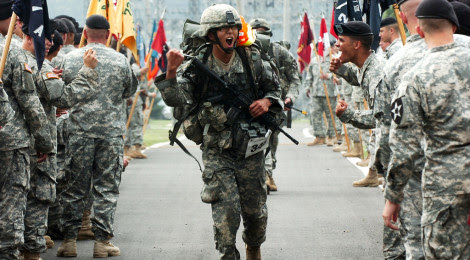
The 2nd U.S. Infantry Division recently held a ceremony to activate the first-ever combined division of U.S. and South Korean (ROK) forces. Rather than being a regression away from the transfer of wartime operational control (OPCON) of ROK forces — which would have separated the alliance command structure — this is a statement of profound operational trust that builds on a long history of combined operations between the various military organizations of these two allies. At a time when the United States faces fiscal pressures at home and China seeks to create fissures in the regional order, the U.S.-ROK alliance is moving closer together.
The current combined division concept, initiated during the tenure of Lt. Gen. Edward Cardon when he was the 2nd Infantry Division Commander, was nurtured by Maj. Gen. Thomas Vandal, and is now being implemented by Maj. Gen. Theodore Martin. It marks a fundamental continuity with, not devolution from, alliance history. During the Korean War, Gen. Paik Sun Yip’s 1st Infantry Division was assigned to the U.S. I Corps. At that time, the Korean Augmentee to the U.S. Army program (KATUSA) and the Korean Service Corps (KSC) were both established, and continue to this day. Even today, the ROK/U.S. Combined Forces Command (CFC) is arguably the most integrated combined staff in the world, including ROK and U.S. general officers who alternate between primary and deputy positions not only among the command and staff, but also in corresponding appointments down to the lowest action officer levels. Even Japan has expressed interest in establishing a combined command with the United States modeled on the ROK/U.S. CFC.
There have been many other operational examples of ROK and U.S. forces organized in a combined manner. The III U.S. Corps and XVIII Airborne Corps have occasionally been under the operational control of the Third ROK Army (TROKA) and First ROK Army (FROKA) in support of operational plans. There are also combined ROK/U.S. military service branch components, ranging from the Combined Forces Air Component Command (CFACC) to the Combined Unconventional Warfare Task Force (CUWTF). Suffice it to say that a combined division will not be difficult to make work — the concept nests within a rich tradition of ROK/U.S. alliance cooperation.
In addition to the numerous command examples above, ROK and U.S. units have routinely trained together in the decades since the Korean War; a history I’m a proud to be a part of. I recall 2nd Infantry Division units participating annually in what were then called the “Blue Dragon” river crossing exercises with ROK Marines at Kimpo. Like many others, I took part in battalion and brigade unit evaluation exercises, as well as the Super Bowl of military preparation — the exercise formerly known as Team Spirit, and today’s Foal Eagle and Key Resolve exercises. As a young 2nd Infantry Division company commander in the 1980s, I had a ROK counterpart in the 1st ROK Infantry Division. We planned and executed our own combined live-fire exercises, integrating his tank company with our infantry, TOW missile, scout and 4.2-inch mortar platoons. Combined operations aren’t just a top-down organizational chart drill; in my experience they’re a bottom-up phenomenon as well. All this training did more than just deter North Korea from invading; it gave rise to globally capable ROK combat forces, which fought with distinction in Vietnam and now operate in support of UN peacekeeping operations and other conflicts, including those in Afghanistan and Iraq.
The combined division concept recognizes the nature of the threat and the environment in Korea. The combined division will be able to focus on one of the most important missions, on the peninsula during conflict or instability: locating and securing North Korea’s weapons of mass destruction. A combined organization is well suited to this task because it harmonizes the unique capabilities, expertise, and strengths of each nation’s soldiers and their training and equipment. In addition, as U.S. forces move to a rotational force posture it will ensure more rapid integration of U.S. forces and enhance overall readiness of the division to accomplish its many missions.
(Continued at the link below)

Monday, January 19, 2015

Park calls for creating conditions for talks with N. Korea

I received the comments below in response to this from a Korea Hand who has probably forgot more about the ROK/US Alliance than the rest of us know.  I think this short paragraph does more to explain the importance of the ROK/US alliance than anything else we can read in official statements, from the press or the pundits.

The ROK-US Alliance is critical to President Park’s successful implementation of her unification policy, a policy mandated by the ROK’s 1987 Constitution (by type, not content, the latter being the individual President’s prerogative).  First, it defends the ROK people, territory and institutions by deterring North Korean aggression, albeit it only limits, not completely deters, NK provocations.  Secondly, it represents the commonly shared values of both the ROK and US in the concepts of democracy and free markets and the defense of those values.  Thirdly, the designation and manning of a US four-star to serve as the wartime commander of designated ROK and US forces amplifies the message of US commitment to the defense of the ROK, as does the bilateral manning of the ROK-US Combined Forces Command.  This is critical should NK deception be successful.  Fourthly, the US technical capabilities contribute to President Park’s awareness of NK deception in behavior, intent and negotiation through detection of inconsistent actions - not perfect, but critical.  Fifthly, it serves significantly as a consideration point in foreign investment into the ROK.  All US traders will tell you they calculate the efficacy of the alliance into their risk-vs-gain calculations when investing in the ROK, something other nations’ investors do as well.  There are many more points of consideration, but these have always been the main issues, regardless of the politics that distort, one way or another, their criticality.  President Park goes into any negotiation with NK with this kind of confidence.


---------- Forwarded message ----------
From: David Maxwell <David.Maxwell@georgetown.edu>
Date: Mon, Jan 19, 2015 at 10:29 AM
Subject: Park calls for creating conditions for talks with N. Korea
To:


This is where the alliance priority should be.  The South should absolutely be in the lead with the north.  It is really only the practical way to manage the situation with the north.  As long on President Parks has the foundation of the strong ROK/US Alliance she can have flexibility and agility in conducting diplomacy with the north.
   South Korean President Park Geun-hye on Monday called on officials to create conditions to allow North Korea to come forward for talks in the latest conciliatory gesture toward Pyongyang to jump-start stalled dialogue.

   Park also said the two Koreas should start substantial dialogue to lay the groundwork for their potential unification.

   The call came as North Korea has remained silent on South Korea's recent offer to ministerial talks in January to discuss such bilateral issues as the reunion of families separated by the 1950-53 Korean War.

   "I hope that you will make efforts to come up with conditions under which North Korea can respond," Park said in a meeting at the presidential office where she received a briefing on South Koreas' policy on North Korea, defense and foreign affairs.


   She did not elaborate on what she meant by conditions, though they appear to suggest that South Korea should take steps to stop its people from sending propaganda leaflets to North Korea.

   Park's thinly veiled request came days after North Korea's powerful National Defense Commission urged South Korea to clarify whether Seoul is serious about dialogue with Pyongyang or whether it will persist in the anti-North Korean leafleting campaign.

   The two Koreas last held high-level talks in February in 2014. They had agreed to hold high-level contact between late October and early November during a surprise visit to South Korea by a high-powered North Korean delegation. But the North later backtracked on the deal in protest of the leaflets.

   For years, North Korean defectors in the South and conservative activists have flown the leaflets to the North via balloons to help encourage North Koreans to eventually rise up against the Pyongyang regime.

   North Korea has repeatedly called for an end of the leafleting campaign that it claims insults its dignity. The issue has long been a constant source of tension between the two Koreas, which are still technically at war because the Korean War ended in a truce, not a peace treaty.

   South Korea has said there are no legal grounds to prevent its activists from floating the leaflets, citing freedom of expression. But it has also asked defectors to refrain from floating the leaflets.

   A local court ruled earlier this month that South Korean authorities can intervene and stop the leafleting campaign if there is a clear threat to the safety of South Koreans.

   In October, the two Koreas exchanged machine gun fire across the border after the North apparently tried to shoot down balloons carrying anti-Pyongyang leaflets. North Korea has repeatedly threatened to retaliate against the leafleting campaign.

   Also at the meeting, Park called on the military to maintain its readiness to defend against North Korea's possible provocations and to increase its capability to counter North Korea's asymmetric threats, including its cyber-attacks.

   The comments came after the U.S. slapped sanctions on North Korea over its alleged cyber-attack on Sony Pictures for its comedy film "The Interview," which depicts a plot to assassinate its leader Kim Jong-un.

   The FBI has determined that North Korea was behind the hacking. North Korea has denied any responsibility, although it described the attack as a "righteous deed."

   SEOUL, Jan. 19 (Yonhap)
   entropy@yna.co.kr
(END)

Thursday, September 25, 2014

Defending South Korea: Transferring Wartime Operational Command (OPCON)


The Heritage Foundation
Cordially Invites You

Defending South Korea:
Transferring Wartime Operational Command (OPCON)

Featuring a Keynote Address by
General B. B. Bell, U.S. Army (ret.)
Former Commander of U.S. Forces Korea, Combined Forces Command, and United Nations Command

Followed by a Panel Discussion with
David S. Maxwell
Associate Director, Center for Security Studies, Georgetown University

Michael E. O'Hanlon
Senior Fellow and Foreign Policy Research Director, The Brookings Institution

Hosted by
Bruce Klingner
Senior Research Fellow, Northeast Asia, The Heritage Foundation

The decision to return wartime operational control (OPCON) of Republic of Korea military forces to that country’s government has been controversial since its 2007 inception.  Washington and Seoul appear on the cusp of again postponing the scheduled date for OPCON transition.  Seoul cites North Korea’s growing nuclear capabilities as justification for delay while others argue its past time for America’s ally to assume primary responsibility for its defense.

Beyond the timing of the transfer, there are concerns that the current plan to split the combined command into two separate commands is ill-advised and potentially dangerous during hostilities.  Indeed, Washington and Seoul have so fixated on OPCON transition as to be distracted from ensuring robust combined and integrated allied capabilities to deter and defeat the North Korean military threat.

Join us as General B.B. Bell, formerly the senior U.S. commander in South Korea, provides his thoughts and recommendations on this timely and important issue, followed by a panel of distinguished experts.

Tuesday, October 7, 2014 – 2:00 to 4:00 p.m. 

The Heritage Foundation’s Lehrman Auditorium

RSVP online | or call (202) 675-1752
Terms and conditions of attendance are posted at heritage.org/Events/terms.cfm
All events may be viewed live at heritage.org
News media inquiries, call (202) 675-1761
 

214 Massachusetts Avenue, NE | Washington, DC 20002 | (202) 546-4400

Thursday, September 4, 2014

S. Korea-U.S. joint command to remain in Seoul until OPCON transfer: sources

Good news here though this seems like a premature release.  This should have been unveiled at the Security Consultative Meeting next month. But this is good for the ROK/US Alliance and the combined war fighting capabilities if true.

But I wonder if this senior Seoul government official leaked this as a trial balloon or because he is trying to undermine the agreement.  There could have been a better combined strategic communications plan to mitigate some of the political fallout that will likely occur in the ROK.  I will not go into my usual diatribe about the command relations but at least Yonhap did not once mention USFK.  

   "The two sides have agreed to maintain the CFC in Yongsan, where it is currently located, until we regain the operational control (OPCON) from the U.S.," a senior Seoul government source said, requesting anonymity.

   The CFC, which has the command over South Korean and U.S. troops stationed here, was to be disbanded upon Seoul's OPCON transfer in December 2015, but a bilateral agreement to delay the transfer has led the CFC to remain intact.

S. Korea-U.S. joint command to remain in Seoul until OPCON transfer: sources

2014-09-04 17:37
   South Korea and the United States have agreed to make the Combined Forces Command (CFC) exempt from their plan to relocate U.S. troops until Seoul retakes wartime command of its forces from Washington, sources here said Thursday.

   Seoul and Washington had been at odds over whether to move the CFC headquarters and its affiliated forces to Pyeongtaek, some 70 kilometers south of the capital, in accordance with their 2004 agreement to move the Yongsan Garrison, the sprawling U.S. military headquarters in central Seoul, and the 2nd Infantry Division stationed north of Seoul to the southern town by the end of 2016.

   "The two sides have agreed to maintain the CFC in Yongsan, where it is currently located, until we regain the operational control (OPCON) from the U.S.," a senior Seoul government source said, requesting anonymity.

   The CFC, which has the command over South Korean and U.S. troops stationed here, was to be disbanded upon Seoul's OPCON transfer in December 2015, but a bilateral agreement to delay the transfer has led the CFC to remain intact.

   "Albeit temporarily, we, in fact, accepted the U.S. request to stay them in Seoul. The U.S. has proposed the CFC be an exception for the relocation plan, citing smooth policy coordination between the allies," the source said.

   "Though the U.S. wants to have most of its forces under the CFC stay in Yongsan, we have conveyed our position that it would not be possible. Discussions are under way about the size of the remaining forces," he added.

   Their retainment is expected to spark controversy and opposition from the public, as it will affect the South Korean government's plan to turn the vast site in central Seoul into a public park. The government itself has reiterated that the relocation plan will be pushed forward as scheduled "as a pledge to the people."

   "After the decision to delay the OPCON transfer, where to put the CFC became a matter of reality. We are now striving to find ways to meet different demands and conditions," said another government source who is well-versed in the issue.

   Denying the report, however, Seoul's defense ministry said it will "seek the best ways to strengthen the joint defense posture with the U.S. while pushing for the relocation plan as scheduled."

   South Korea handed over control of its forces to the U.S. during the 1950-53 Korean War to defend against invading troops from North Korea. Peacetime control of its forces was returned in 1994, and South Korea is currently scheduled to get back operational control in the event of war in December 2015.

   But last year, Seoul asked for a delay in the OPCON transfer after North Korea conducted its third nuclear test, saying the security situation on the peninsula was markedly different from when the transfer was agreed upon a few years ago.

   The allies are scheduled to decide on the timeframe and conditions of the transfer by October, when the defense chiefs will hold their annual meeting in Washington. Many expect South Korea to retake it between 2020 and 2022.

   By Oh Seok-min
   SEOUL, Sept. 4 (Yonhap)
   graceoh@yna.co.kr
(END)

S. Korea, U.S. to create combined unit next year

Back to the future.  I wonder how many remember the ROK/US I Corps and then the Combined Field Army in Uijongbu?  But this is good news for combined operations.   Kudos to GEN Thurman and LTG Cardon who worked hard to initiate this on the US side when they were in command.  This is a good sign for the strength of the ROK/US Alliance.


S. Korea, U.S. to create combined unit next year

By Oh Seok-min
SEOUL, Sept. 4 (Yonhap) -- South Korea and the United States have agreed to establish a combined division of their troops next year that will be tasked with carrying out wartime operations, Seoul's defense ministry said Thursday.

The unit, slated to be set up in the first half of next year, will be comprised of the U.S. 2nd Infantry Division located in Uijeongbu, north of Seoul, and a South Korean brigade-level unit, the ministry said.

In peacetime, the envisioned unit will have a joint staff, which will be headed by a major general-level U.S. officer, a ministry official said.

Details on the newly-created unit's missions are not available, though officials say it will be assigned to carry out special operations such as eliminating weapons of mass destruction as well as civil missions against North Korea.

"The new joint division is expected to improve the Seoul-Washington joint deterrence posture and boost our military's capabilities to carry out joint operations," the ministry said in a statement.

The agreement, however, does not mean any revision to their ongoing plan of relocating the U.S. Forces Korea (USFK) bases south of Seoul, according to officials.

"The 2nd Division and the headquarters of the envisioned joint unit will be based in Uijeongbu. After the relocation project is completed, they will then be moved to Pyeongtaek," the ministry said.

In accordance with the 2004 agreement, Seoul and Washington have been working to relocate the Yongsan Garrison, the sprawling U.S. military headquarters in central Seoul, and the 2nd Division north of Seoul to Camp Humphreys in Pyeongtaek, some 70 kilometers south of the capital, by the end of 2016.

There has long been speculation that the reorganization of the 2nd Division aims to allow some American soldiers to remain north of the capital.

Last year, USFK commander Gen. Curtis Scaparrotti said, "In terms of the residual in what we call Area One, there may be a need operationally to leave some residual in those areas just for proper defense and response." Area One includes the northern towns of Uijeongbu and Dongducheon, Gyeonggi Province.

About 28,500 U.S. troops are currently stationed in South Korea, a legacy of the 1950-53 Korean War.
(END)

Monday, September 1, 2014

Should the US retrench from South Korea? (pro and con)

I have to give a lot of credit to Robert Kelly for trying to articulate both sides of the debate on this issue.  Few authors, even academics, and certainly not pundits really try to argue both sides of an issue.  Unfortunately , despite his best attempts, it is clear that Robert Kelly's retrenchment bias does show through but his arguments are an interesting read nonetheless.  He never really articulates US interests and why it would be bad for there to be a war or catastrophic regime collapse on the peninsula.

Excerpt:

Whether the US should stay or go is a perennial issue, that surprisingly, doesn't get discussed much. This is probably because if you really supported a US withdrawal, you would not be taken seriously in much of US or Korean foreign policy establishments.
US foreign policy is dominated by a hawkish, interventionist consensus of neocons and liberal internationalists for whom the US positions in Japan and Korea have become ends in themselves as symbols of US hegemony (in neocon-speak, that's read as: 'global basing means we're f****** awesome!').

If he was really going to debate both sides of the issue he would have laid out the realist perspective on maintaining the ROK/US alliance which I think might be different than the hawkish, interventionist consensus of neocons and liberal interventionists.

The irony is that the biggest proponent of retrenchment was Donald Rumsfeld.  The entire OPCON transfer and relocation of US forces was his attempt to drive US forces from the peninsula.  And although they do not know it or would not admit it all those in favor of the OPCON transfer are really in favor of US retrenchment and are just supporting Donald Rumsfeld's vision for the ROK/US alliance.

My Lowy Debate on whether US should Retrench from South Korea, part 1: Yes

Posted on September 1, 2014
This is a re-up of a debate couplet on the US position in South Korea, which I wrote for the Lowy Institute. Part one, the reasons for US retrenchment, is here (and below); part 2, the argumentsagainst a US departure, ishere. And that pic is me and my North Korean minder at the North Korea side of the DMZ. Note the KWP pin above his breast pocket.
Whether the US should stay or go is a perennial issue, that surprisingly, doesn't get discussed much. This is probably because if you really supported a US withdrawal, you would not be taken seriously in much of US or Korean foreign policy establishments. US foreign policy is dominated by a hawkish, interventionist consensus of neocons and liberal internationalists for whom the US positions in Japan and Korea have become ends in themselves as symbols of US hegemony (in neocon-speak, that's read as: 'global basing means we're f****** awesome!'). In tandem, the Korean discussion,for all its lazy anti-Americanism, assumes a permanent American presence to the point of irresponsibility. But all this misses the real hole at the center - the end of the Cold War and the collapse of the North Korean conventional threat (and before you say, 'heh wait, they could blow up Seoul,' recall that South Korea easily has the resources to ramp up in a big way; it just doesn't do it).
Read Both sides at the links below:

Should the US retrench from South Korea? Yes

20 August 2014 9:30AM

Should the US retrench from South Korea? Part 2: No

22 August 2014 12:00PM

Giving Tuesday Recommendations

  Dear Friends,  I do not normally do this (except I did this last year and for the last few years now, too) and I certainly do not mean to ...