Thursday, June 11, 2015

The U.S.-South Korean Combined Infantry Division Shows The Alliance Is Closer Than Ever

The U.S.-South Korean Combined Infantry Division Shows the Alliance is Closer than Ever

THE U.S.-SOUTH KOREAN COMBINED INFANTRY DIVISION SHOWS THE ALLIANCE IS CLOSER THAN EVER

June 11, 2015 · in 


Print Friendly
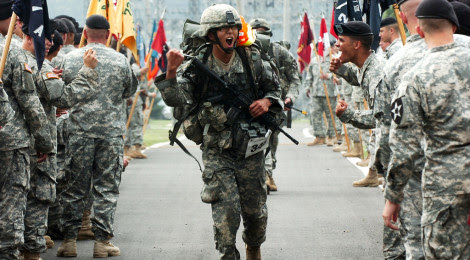
The 2nd U.S. Infantry Division recently held a ceremony to activate the first-ever combined division of U.S. and South Korean (ROK) forces. Rather than being a regression away from the transfer of wartime operational control (OPCON) of ROK forces — which would have separated the alliance command structure — this is a statement of profound operational trust that builds on a long history of combined operations between the various military organizations of these two allies. At a time when the United States faces fiscal pressures at home and China seeks to create fissures in the regional order, the U.S.-ROK alliance is moving closer together.
The current combined division concept, initiated during the tenure of Lt. Gen. Edward Cardon when he was the 2nd Infantry Division Commander, was nurtured by Maj. Gen. Thomas Vandal, and is now being implemented by Maj. Gen. Theodore Martin. It marks a fundamental continuity with, not devolution from, alliance history. During the Korean War, Gen. Paik Sun Yip’s 1st Infantry Division was assigned to the U.S. I Corps. At that time, the Korean Augmentee to the U.S. Army program (KATUSA) and the Korean Service Corps (KSC) were both established, and continue to this day. Even today, the ROK/U.S. Combined Forces Command (CFC) is arguably the most integrated combined staff in the world, including ROK and U.S. general officers who alternate between primary and deputy positions not only among the command and staff, but also in corresponding appointments down to the lowest action officer levels. Even Japan has expressed interest in establishing a combined command with the United States modeled on the ROK/U.S. CFC.
There have been many other operational examples of ROK and U.S. forces organized in a combined manner. The III U.S. Corps and XVIII Airborne Corps have occasionally been under the operational control of the Third ROK Army (TROKA) and First ROK Army (FROKA) in support of operational plans. There are also combined ROK/U.S. military service branch components, ranging from the Combined Forces Air Component Command (CFACC) to the Combined Unconventional Warfare Task Force (CUWTF). Suffice it to say that a combined division will not be difficult to make work — the concept nests within a rich tradition of ROK/U.S. alliance cooperation.
In addition to the numerous command examples above, ROK and U.S. units have routinely trained together in the decades since the Korean War; a history I’m a proud to be a part of. I recall 2nd Infantry Division units participating annually in what were then called the “Blue Dragon” river crossing exercises with ROK Marines at Kimpo. Like many others, I took part in battalion and brigade unit evaluation exercises, as well as the Super Bowl of military preparation — the exercise formerly known as Team Spirit, and today’s Foal Eagle and Key Resolve exercises. As a young 2nd Infantry Division company commander in the 1980s, I had a ROK counterpart in the 1st ROK Infantry Division. We planned and executed our own combined live-fire exercises, integrating his tank company with our infantry, TOW missile, scout and 4.2-inch mortar platoons. Combined operations aren’t just a top-down organizational chart drill; in my experience they’re a bottom-up phenomenon as well. All this training did more than just deter North Korea from invading; it gave rise to globally capable ROK combat forces, which fought with distinction in Vietnam and now operate in support of UN peacekeeping operations and other conflicts, including those in Afghanistan and Iraq.
The combined division concept recognizes the nature of the threat and the environment in Korea. The combined division will be able to focus on one of the most important missions, on the peninsula during conflict or instability: locating and securing North Korea’s weapons of mass destruction. A combined organization is well suited to this task because it harmonizes the unique capabilities, expertise, and strengths of each nation’s soldiers and their training and equipment. In addition, as U.S. forces move to a rotational force posture it will ensure more rapid integration of U.S. forces and enhance overall readiness of the division to accomplish its many missions.
(Continued at the link below)

U.S. Pacific Commander vows strong response to N.K. provocations

Hopefully the responses won't be the tepid ones that were too little, too late in response to Cheonan sinking  and Y-P Do artillery attack.  The only thing that might deter Kim Jong-un is decisive demonstration of strength.  

We really have to get "WMD" right - word, message, and deed or as I like to think  word, mind, and deed  -the words mean nothing to the mind of the target audience unless they are connected to the right deeds that back up the words (just like the problem we have with ISIL - our ends ways disconnect - degrade and destroy ISIL does not compute in the minds of ISIL, Syrian "moderate" resistance, Iraq government and people, the international community, and the American public when it is not backed with the appropriate deeds - and the "deed" is contracting out the ways to inept proxy indigenous and host nation forces whose interests are not aligned with ours so that they cannot possibly achieve our ends).  Sorry for the seeming rant across continents, theaters and threats - but I think there are similarities to how we should approach "WMD" - word, mind, and deed.

U.S. Pacific Commander vows strong response to N.K. provocations

2015-06-10 17:25
   The new head of the U.S. Pacific Command reaffirmed Wednesday stern responses to any provocations by the "dangerous and unpredictable" North Korea based upon the steadfast alliance with South Korea.

   Adm. Harry Harris, chief of the U.S. Pacific Command, made the pledge during his visit to the South Korean Navy's 2nd Fleet Command in Pyeongtaek, Gyeonggi Province, some 70 kilometers south of Seoul, where he paid tribute to sailors killed in the North's deadly attack on the South Korean warship Cheonan.

   On March 26, 2010, the 1,200-ton naval corvette sank in the Yellow Sea, killing 46 South Koreans. An international investigation found that Pyongyang had torpedoed the ship, though the belligerent regime has denied responsibility. The hull of the vessel is on display at the fleet's headquarters.

   "I believe North Korea is dangerous, it's unpredictable, and it's led by the leader (Kim Jong-un) who is arrogant. I consider North Korea a rogue nation discredited by the entire world," Harris said, pointing out that Pyongyang has expressed its "willingness to use military provocations to achieve its national goals."

   In a saber-rattling move against South Korea and the U.S., the North has continued to build up its asymmetric capabilities and launch provocative actions. Last month alone, the North carried out live-fire drills twice near the Northern Limit Line, the de facto inter-Korean maritime border in the Yellow Sea.

   "So I have to tell you that the U.S. remains vigil in the face of North Korea's continued provocations and steadfast in our alliance's commitment to the ROK. It is no accident that the first country that I visited as the Pacific Command commander in the bilateral sense was Korea," he added, referring to South Korea by its official name, the Republic of Korea.

   He assumed the command position of the U.S. Pacific Command in May 2015.

   Stressing solid bilateral relations and friendship between Seoul and Washington, Harris also said the strong alliance will "allow us together to overcome provocations by North Korea."

Tuesday, June 9, 2015

ISIS publishes manual on ‘How to Survive in the West’

You can download the entire manual at this link.  https://db.tt/mMNQg9Hv  Sorry to be late in sending this out as a friend just sent me this.  I missed then when it was discussed in March, April, and May.

I have pasted the table of contents below the article.  I guess ISIL is really taking on the image of a state as it is being nice enough to publish its "doctrine" just as we do.  Note the discussions on propaganda and guerrilla warfare.  Note also the discussion of very recent terrorist events such as in Paris and Denmark.

This really is an ISIL unconventional warfare manual (with ISIL Characteristics).

As we work to counter-Unconventional Warfare we should study this manual and we should observe for the activities described.

As you read this listen to the theme song from "Secret Agent Man" (https://www.youtube.com/watch?v=6iaR3WO71j4in your head (unless you are younger than man and do not recall the song):

As a Secret Agent, you will have to do many things and meet many people. You do not want
anyone to know your true identity, so you have to disguise yourself in different ways so your
real self iis not exposed. Below are some ideas:
But seriously this manual is very much worthy of study.


ISIS publishes manual on ‘How to Survive in the West’


ISIS manual entitled “How to Survive in the West” uses British advocacy agency’s website. (Courtesy: social media)
Text size A A A
By Staff writer | Al Arabiya News
Monday, 11 May 2015
The Islamic State of Iraq and Syria has published a manual entitled “How to Survive in the West” which advises its followers to use the website of British advocacy agency Cage for tips regarding surveillance, raids and interrogations.
The advocacy group has come under scrutiny in recent months, and is accused of being apologetic for terrorism and ISIS after the group’s leader Asim Qureshi called “Jihadi John,” who was filmed beheading American journalists, a “beautiful young man.”
The organization made media headlines when the identity of “Jihadi John” was revealed in February as Mohammed Emwazi. The group appeared to defend him, claiming that he had been harassed by international security services prior to his travels to Syria.
For its part, Cage has described itself as “an independent organization working to empower communities impacted by the War on Terror” and has spoken out against the UK’s anti-terrorism laws.
The ISIS manual includes tips for bomb making and committing fraud, and mentions the advocacy agency as a suggestion to turn to for legal aid, according to The Daily Mail.
An investigation uncovered that Moazzam Begg, a director of Cage and former Guantanamo Bay prisoner, was at the same Syrian training camp as Emwazi in 2011. Photographic evidence puts Begg in Syria with a camp commander who was also caught on video with “Jihadi John,” implying that Begg and Emwazi were at the same camp.
The Cage director was charged with attending a terrorist training camp in Syria for six months in October of last year.
Full cover for the book. (Courtesy: social media)
Last Update: Monday, 11 May 2015 KSA 14:41 - GMT 11:41

CONTENTS
Foreword ……………………………………….………………………………………………………………………...P5
Introduction ……………………………………………………………………………………………………………...P7
Chapter 1: Hiding the Extremist identity ……………………………………………………………….. P8
Chapter 2: Breaking Allegiance ………………………………………………………………………………..P11
Chapter 3: Earning Money ………………………………………………………………………………………. P13
Chapter 4: Internet Privacy ……………………………………………………………………………………….P16
Chapter 5: Training ………………………………………………………………………………………………….. P19
Chapter 6: Primitive Weapons ………………………………………………………………………………….. P23
Survival Techniques ………………………………………………………………………………………………….. P25
Chapter 7: Modern Weapons ……………………………………………………………………………………. P27
Chapter 8: B0mb Making ………………………………………………………………………………………….. P37
Chapter 9: Transporting Weapons ……………………………………………………………………………. P46
Chapter 10: What happens when you are spied on and get raided …………………………… P48
Europe's fear of returning fighters & the Sting Operation ……………………………………….... P50
Chapter 11: The Jihad Begins ……………………………………………………………………………………... P53
War in Protests ………………………………………………………………………………………………………….. P54
What is guerilla warfare? ……………………………………………………………………………………………. P63
Chapter 12: Escaping for Safety …………………………………………………………………………………... P66
Last Words of Advice …………………………………………………………………………………………………... P68
RESOURCES ………………………………………………………………………………………………………………….. P70

Saturday, June 6, 2015

With a series of major hacks, China builds a database on Americans

You can access an original translation of Unrestricted Warfare here: https://www.dropbox.com/s/llltfszyecpj6s6/UnrestrictedWarfare.pdf?dl=0

As you read about the Chinese hack of OPM and over 4 million government employees I think it is worth reflecting on these excerpts from the 1999 book by Chinese PLA Colonels, Unrestricted Warfare.  This is from the first FBIS translation of the book that I have saved over all these years.  Of course you can also buy a commercial copy of the book from Amazon.  I wonder how many people have read these prescient words.  Please pay attention to the highlighted words.  I know many have criticized this book and those who read it and in 2004 when I was a student at the National War College I asked the visiting Chinese Defense Minister if this book was being used to inform Chinese doctrine and strategic thinking he replied that the book had bene discredited in China and for me not to believe everything I read. (though I am violating the non-attribution rule - but I will take my lumps for that when compared to what the Chinese have done to us).  So while we applaud Snowden (and he applauds himself) for defending our privacy from the NSA who is protecting not only our privacy but our national security from the Chinese?


[FBIS Editor's Note: The following selections are taken from "Unrestricted Warfare," a book published in China in February 1999 which proposes tactics for developing countries, in particular China, to compensate for their military inferiority vis-à-vis the United States during a high-tech war. The selections include the table of contents, preface, afterword, and biographical information about the authors printed on the cover. The book was written by two PLA senior colonels from the younger generation of Chinese military officers and was published by the PLA Literature and Arts Publishing House in Beijing, suggesting that its release was endorsed by at least some elements of the PLA leadership. This impression was reinforced by an interview with Qiao and laudatory review of the book carried by the party youth league's official daily Zhongguo Qingnian Bao on 28 June. Published prior to the bombing of China's embassy in Belgrade, the book has recently drawn the attention of both the Chinese and Western press for its advocacy of a multitude of means, both military and particularly non-military, to strike at the United States during times of conflict. Hacking into websites, targeting financial institutions, terrorism, using the media, and conducting urban warfare are among the methods proposed. In the Zhongguo Qingnian Bao interview, Qiao was quoted as stating that "the first rule of unrestricted warfare is that there are no rules, with nothing forbidden." Elaborating on this idea, he asserted that strong countries would not use the same approach against weak countries because "strong countries make the rules while rising ones break them and exploit loopholes . . .The United States breaks [UN rules] and makes new ones when these rules don't suit [its purposes], but it has to observe its own rules or the whole world will not trust it." (see FBIS translation of the interview, OW2807114599) [End FBIS Editor's Note]


Everyone who has lived through the last decade of the 20th century will have a profound sense of the changes in the world. We don't believe that there is anyone who would claim that there has been any decade in history in which the changes have been greater than those of this decade. Naturally, the causes behind the enormous changes are too numerous to mention, but there are only a few reasons that people bring up repeatedly. One of those is the Gulf War. One war changed the world. Linking such a conclusion to a war which occurred one time in a limited area and which only lasted 42 days seems like something of an exaggeration. However, that is indeed what the facts are, and there is no need to enumerate one by one all the new words that began to appear after 17 January 1991. It is only necessary to cite the former Soviet Union, Bosnia-Herzegovina, Kosovo, cloning, Microsoft, hackers, the Internet, the Southeast Asian financial crisis, the euro, as well as the world's final and only superpower -- the United States. These are sufficient. They pretty much constitute the main subjects on this planet for the past decade

War in the age of technological integration and globalization has eliminated the right of weapons to label war and, with regard to the new starting point, has realigned the relationship of weapons to war, while the appearance of weapons of new concepts, and particularly new concepts of weapons, has gradually blurred the face of war. Does a single "hacker" attack count as a hostile act or not? Can using financial instruments to destroy a country's economy be seen as a battle? Did CNN's broadcast of an exposed corpse of a U.S. soldier in the streets of Mogadishu shake the determination of the Americans to act as the world's policeman, thereby altering the world's strategic situation? And should an assessment of wartime actions look at the means or the results? Obviously, proceeding with the traditional definition of war in mind, there is no longer any way to answer the above questions. When we suddenly realize that all these non-war actions may be the new factors constituting future warfare, we have to come up with a new name for this new form of war: Warfare which transcends all boundaries and limits, in short: unrestricted warfare.

Mao Zedong's theory concerning "every citizen a soldier" has certainly not been in any way responsible for this tendency. The current trend does not demand extensive mobilization of the people. Quite the contrary, it merely indicates that a technological elite among the citizenry have broken down the door and barged in uninvited, making it impossible for professional soldiers with their concepts of professionalized warfare to ignore challenges that are somewhat embarrassing. Who is most likely to become the leading protagonist on the terra incognita of the next war? The first challenger to have appeared, and the most famous, is the computer "hacker." This chap, who generally has not received any military training or been engaged in any military profession, can easily impair the security of an army or a nation in a major way by simply relying on his personal technical expertise. A classic example is given in the U.S. FM100-6 Information Operations regulations. In 1994, a computer hacker in England attacked the U.S. military's Rome Air Development Center in New York State, compromising the security of 30 systems. He also hacked into more than 100 other 46 systems. The Korea Atomic Energy Research Institute (KAERI) and NASA suffered damage, among others. What astounded people was not only the scale of those affected by the attack and the magnitude of the damage, but also the fact that the hacker was actually a teenager who was merely 16 years old. Naturally, an intrusion by a teenager playing a game cannot be regarded as an act of war. The problem is, how does one know for certain which damage is the result of games and which damage is the result of warfare? Which acts are individual acts by citizens and which acts represent hostile actions by non-professional warriors, or perhaps even organized hacker warfare launched by a state? In 1994, there were 230,000 security-related intrusions into U.S. DOD networks. How many of these were organized destructive acts by non-professional warriors? Perhaps there will never be any way of knowing [see Endnote 7].

More murderous than hackers--and more of a threat in the real world--are the non-state organizations, whose very mention causes the Western world to shake in its boots. These organizations, which all have a certain military flavor to a greater or lesser degree, are generally driven by some extreme creed or cause, such as: the Islamic organizations pursuing a holy war; the Caucasian militias in the U.S.; the Japanese Aum Shinrikyo cult; and, most recently, terrorist groups like Osama bin Ladin's, which blew up the U.S. embassies in Kenya and Tanzania. The various and sundry monstrous and virtually insane destructive acts by these kinds of groups are undoubtedly more likely to be the new breeding ground for contemporary wars than is the behavior of the lone ranger hacker. Moreover, when a nation state or national armed force, (which adheres to certain rules and will only use limited force to obtain a limited goal), faces off with one of these types of organizations, (which never observe any rules and which are not afraid to fight an unlimited war using unlimited means), it will often prove very difficult for the nation state or national armed force to gain the upper hand.


During the 1990's, and concurrent with the series of military actions launched by nonprofessional warriors and non-state organizations, we began to get an inkling of a non-military type of war which is prosecuted by yet another type of non-professional warrior. This person is not a hacker in the general sense of the term, and also is not a member of a quasi-military organization. Perhaps he or she is a systems analyst or a software engineer, or a financier with a 48 large amount of mobile capital or a stock speculator. He or she might even perhaps be a media mogul who controls a wide variety of media, a famous columnist or the host of a TV program. His or her philosophy of life is different from that of certain blind and inhuman terrorists. Frequently, he or she has a firmly held philosophy of life and his or her faith is by no means inferior to Osama bin Ladin's in terms of its fanaticism. Moreover, he or she does not lack the motivation or courage to enter a fight as necessary. Judging by this kind of standard, who can say that George Soros is not a financial terrorist? Precisely in the same way that modern technology is changing weapons and the battlefield, it is also at the same time blurring the concept of who the war participants are. From now on, soldiers no longer have a monopoly on war. Global terrorist activity is one of the by-products of the globalization trend that has been ushered in by technological integration. Non-professional warriors and non-state organizations are posing a greater and greater threat to sovereign nations, making these warriors and organizations more and more serious adversaries for every professional army. Compared to these adversaries, professional armies are like gigantic dinosaurs which lack strength commensurate to their size in this new age. Their adversaries, then, are rodents with great powers of survival, which can use their sharp teeth to torment the better part of the world.


With a series of major hacks, China builds a database on Americans


By Ellen Nakashima June 5 at 5:55 PM  
China is building massive databases of Americans’ personal information by hacking government agencies and U.S. health-care companies, using a high-tech tactic to achieve an age-old goal of espionage: recruiting spies or gaining more information on an adversary, U.S. officials and analysts say.
Groups of hackers working for the Chinese government have compromised the networks of the Office of Personnel Management, which holds data on millions of current and former federal employees, as well as the health insurance giant Anthem, among other targets, the officials and researchers said.
“They’re definitely going after quite a bit of personnel information,” said Rich Barger, chief intelligence officer of ThreatConnect, a Northern Virginia cybersecurity firm. “We suspect they’re using it to understand more about who to target [for espionage], whether electronically or via human ­recruitment.”
The targeting of large-scale data­bases is a relatively new tactic and is used by the Chinese government to further its ­intelligence-gathering, the officials and analysts say. It is government espionage, not commercial espionage, they say.
(Continued at the link below)


Tuesday, June 2, 2015

Unification of the Korean Peninsula: Issues and Opportunities

     You are cordially invited to attend 
 
Unification of the Korean Peninsula:  
Issues and Opportunities  

Thursday, June 25: 8:45 AM - 6:00 PM
Friday, June 26: 9:30 - 12:00 PM
Copley Formal Lounge, Copley Hall  
Georgetown University, 37th and O St. NW


Gtown Skyline 
 
 
We cordially invite you to join us for the Annual Conference of the International Council on Korean Studies, "Unification of the Korean Peninsula: Issues and Opportunities."
This year's conference is co-hosted by the International Council on Korean Studies and the Georgetown University Center for Security Studies, jointly with
the Committee for Human Rights in North Korea, the Korea Economic Institute, the One Free Korea Foundation, the Korea Foundation, with generous support from the Philip and Patricia Bilden Asian Security Studies Fund.   
The full conference agenda is below; attendeance is free and this event is open to the press and public.  Breakfast will be provided both days as well as a full catered lunch on Thursday, June 25. 
Attendees should RSVP no later  than Monday, June 22, 2015.  
June 25, 2015, Thursday

08:15 AM                         Registration Opens

08:45 - 09:00 AM          Opening Remarks

Speakers            
Dr. Bruce E. Bechtol, Jr., President
International Council of Korean Studies and Angelo State University

Professor David Maxwell, Associate Director,
Center for Security Studies, Georgetown University

Mr. Greg Scarlatoiu, Executive Director
Committee for Human Rights in North Korea

Honorable Donald Manzullo, President
Korea Economic Institute of America

09:00 - 11:45 AM          Panel I. Human Rights in North Korea: The Impact on Unification

Moderator            
Dr. Douglas Streusand, Professor, Marine Corps University

Papers                  
"Internal Security Issues and Human Rights in North Korea"
Mr. Robert Collins, Committee for Human Rights in North Korea


"Human Security in North Korea"
Mr. Greg Scarlatoiu, Executive Director, HRNK

"Post-Unification Human Rights and Humanitarian Concerns"
Ms. Roberta Cohen, Brookings Institution

Discussants        
Ms. Amanda Mortwedt Oh, Committee for Human Rights in North Korea

Dr. Terence J. Roehrig, U.S. Naval War College


12:00 - 1:45 PM  Luncheon and Luncheon Speech

"Security and Unification Issues on the Korean Peninsula"
General John H. Tilelli, USA (Ret.), Co-Chairman
Council on U.S.-Korean Security Studies (U.S. Council)

2:00 - 3:45 PM    Panel II: Future Shape of Korea's Economy

Moderator            
Dr. Soon Paik, U.S. Department of Labor (Ret.) and Professor, Washington University of Virginia and ICKS

Papers 
"Korean Unification and the Financial System"
Mr. Bradley Babson, US-Korea Institute

"Energy and the Environment: Challenges to a Post-Unification
Economic Recovery"
Mr. Troy Stangarone, Korea Economic Institute of America

"DPRK Agriculture - Recent Developments and Prospects after Unification"
Dr. W. Randall Ireson, Rural Development Solutions

Discussants        
Dr. Mark Manyin, Senior Fellow, Congressional Research Service
Dr. Hugo Kim, Professor, Washington University of Virginia and ICKS

4:00 - 6:00 PM   Panel III: The Major Powers and Korean Unification

Moderator         
Dr. Patrick Cronin, Senior Advisor and Senior Director
Asia-Pacific Security Program, Center for New American Security

Papers 
"China and the Korean Peninsula: Why the problems?"
Mr. Gordon G. Chang, Forbes.com

"Japan's role in Korean Unification"
Mr. James R. Kendall, Sasakawa Peace Foundation, USA

"The North Korean threat to the USA and Unification"
Dr. Bruce E. Bechtol Jr., Angelo State University

Discussants          
Dr. Andrew Scobell, Senior Fellow, RAND Corporation Washington
Dr. Jong O. Ra, Professor, Hollins University and Virginia Tech


June 26, 2015, Friday

9:30 - 11:30 AM      Panel IV: Planning for a Unified Korea

Moderator            
Dr. Jai P. Ryu, President, One Korea Foundation and
Professor Emeritus, Loyola University of Maryland

Papers

"Unification Options and Scenarios"
Professor David Maxwell, Georgetown University

"Engagement and Coercion: Finding the Right Combination for the DPRK"
Dr. Tara O, Pacific Forum CSIS

"Government and Security in a Unified Korea"
Mr. Sungmin Cho, Georgetown University

Discussants        
Dr. Bruce Bechtol, Angelo State University
Dr. Hang Yul Rhee, Professor, Shepherd University (Retired)


11:45 - 12:00 PM       Closing Remarks

Speakers            
Dr. Bruce E. Bechtol, Jr., President
International Council of Korean Studies and Angelo State University

Honorable Donald Manzullo, President
Korea Economic Institute of America

Mr. Greg Scarlatoiu, Executive Director
Committee for Human Rights IN North Korea

David Maxwell, Associate Director, Center for Security Studies,
Georgetown University
Questions?  
Contact the Center for Security Studies at
or (202) 687-043(202) 687-0436
Accommodation requests related to a disability should be made by June 17 using the contact information above.  A good faith effort will be made to fulfill requests made after June 17.
Visitors to campus may find information on public transportation and the Georgetown University Shuttlehere.  Visitors who prefer to park at Georgetown University are encouraged to use the Southwest Garageon campus.

Giving Tuesday Recommendations

  Dear Friends,  I do not normally do this (except I did this last year and for the last few years now, too) and I certainly do not mean to ...
