Showing posts with label 2d Infantry Division. Show all posts

Thursday, June 11, 2015

The U.S.-South Korean Combined Infantry Division Shows The Alliance Is Closer Than Ever

The U.S.-South Korean Combined Infantry Division Shows the Alliance is Closer than Ever

THE U.S.-SOUTH KOREAN COMBINED INFANTRY DIVISION SHOWS THE ALLIANCE IS CLOSER THAN EVER

June 11, 2015 · in 


Print Friendly
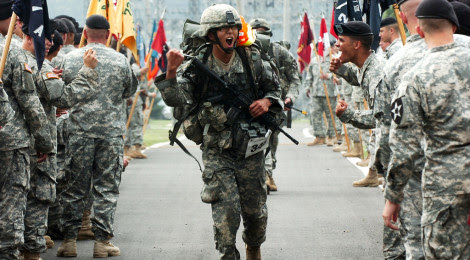
The 2nd U.S. Infantry Division recently held a ceremony to activate the first-ever combined division of U.S. and South Korean (ROK) forces. Rather than being a regression away from the transfer of wartime operational control (OPCON) of ROK forces — which would have separated the alliance command structure — this is a statement of profound operational trust that builds on a long history of combined operations between the various military organizations of these two allies. At a time when the United States faces fiscal pressures at home and China seeks to create fissures in the regional order, the U.S.-ROK alliance is moving closer together.
The current combined division concept, initiated during the tenure of Lt. Gen. Edward Cardon when he was the 2nd Infantry Division Commander, was nurtured by Maj. Gen. Thomas Vandal, and is now being implemented by Maj. Gen. Theodore Martin. It marks a fundamental continuity with, not devolution from, alliance history. During the Korean War, Gen. Paik Sun Yip’s 1st Infantry Division was assigned to the U.S. I Corps. At that time, the Korean Augmentee to the U.S. Army program (KATUSA) and the Korean Service Corps (KSC) were both established, and continue to this day. Even today, the ROK/U.S. Combined Forces Command (CFC) is arguably the most integrated combined staff in the world, including ROK and U.S. general officers who alternate between primary and deputy positions not only among the command and staff, but also in corresponding appointments down to the lowest action officer levels. Even Japan has expressed interest in establishing a combined command with the United States modeled on the ROK/U.S. CFC.
There have been many other operational examples of ROK and U.S. forces organized in a combined manner. The III U.S. Corps and XVIII Airborne Corps have occasionally been under the operational control of the Third ROK Army (TROKA) and First ROK Army (FROKA) in support of operational plans. There are also combined ROK/U.S. military service branch components, ranging from the Combined Forces Air Component Command (CFACC) to the Combined Unconventional Warfare Task Force (CUWTF). Suffice it to say that a combined division will not be difficult to make work — the concept nests within a rich tradition of ROK/U.S. alliance cooperation.
In addition to the numerous command examples above, ROK and U.S. units have routinely trained together in the decades since the Korean War; a history I’m a proud to be a part of. I recall 2nd Infantry Division units participating annually in what were then called the “Blue Dragon” river crossing exercises with ROK Marines at Kimpo. Like many others, I took part in battalion and brigade unit evaluation exercises, as well as the Super Bowl of military preparation — the exercise formerly known as Team Spirit, and today’s Foal Eagle and Key Resolve exercises. As a young 2nd Infantry Division company commander in the 1980s, I had a ROK counterpart in the 1st ROK Infantry Division. We planned and executed our own combined live-fire exercises, integrating his tank company with our infantry, TOW missile, scout and 4.2-inch mortar platoons. Combined operations aren’t just a top-down organizational chart drill; in my experience they’re a bottom-up phenomenon as well. All this training did more than just deter North Korea from invading; it gave rise to globally capable ROK combat forces, which fought with distinction in Vietnam and now operate in support of UN peacekeeping operations and other conflicts, including those in Afghanistan and Iraq.
The combined division concept recognizes the nature of the threat and the environment in Korea. The combined division will be able to focus on one of the most important missions, on the peninsula during conflict or instability: locating and securing North Korea’s weapons of mass destruction. A combined organization is well suited to this task because it harmonizes the unique capabilities, expertise, and strengths of each nation’s soldiers and their training and equipment. In addition, as U.S. forces move to a rotational force posture it will ensure more rapid integration of U.S. forces and enhance overall readiness of the division to accomplish its many missions.
(Continued at the link below)

Thursday, September 4, 2014

S. Korea, U.S. to create combined unit next year

Back to the future.  I wonder how many remember the ROK/US I Corps and then the Combined Field Army in Uijongbu?  But this is good news for combined operations.   Kudos to GEN Thurman and LTG Cardon who worked hard to initiate this on the US side when they were in command.  This is a good sign for the strength of the ROK/US Alliance.


S. Korea, U.S. to create combined unit next year

By Oh Seok-min
SEOUL, Sept. 4 (Yonhap) -- South Korea and the United States have agreed to establish a combined division of their troops next year that will be tasked with carrying out wartime operations, Seoul's defense ministry said Thursday.

The unit, slated to be set up in the first half of next year, will be comprised of the U.S. 2nd Infantry Division located in Uijeongbu, north of Seoul, and a South Korean brigade-level unit, the ministry said.

In peacetime, the envisioned unit will have a joint staff, which will be headed by a major general-level U.S. officer, a ministry official said.

Details on the newly-created unit's missions are not available, though officials say it will be assigned to carry out special operations such as eliminating weapons of mass destruction as well as civil missions against North Korea.

"The new joint division is expected to improve the Seoul-Washington joint deterrence posture and boost our military's capabilities to carry out joint operations," the ministry said in a statement.

The agreement, however, does not mean any revision to their ongoing plan of relocating the U.S. Forces Korea (USFK) bases south of Seoul, according to officials.

"The 2nd Division and the headquarters of the envisioned joint unit will be based in Uijeongbu. After the relocation project is completed, they will then be moved to Pyeongtaek," the ministry said.

In accordance with the 2004 agreement, Seoul and Washington have been working to relocate the Yongsan Garrison, the sprawling U.S. military headquarters in central Seoul, and the 2nd Division north of Seoul to Camp Humphreys in Pyeongtaek, some 70 kilometers south of the capital, by the end of 2016.

There has long been speculation that the reorganization of the 2nd Division aims to allow some American soldiers to remain north of the capital.

Last year, USFK commander Gen. Curtis Scaparrotti said, "In terms of the residual in what we call Area One, there may be a need operationally to leave some residual in those areas just for proper defense and response." Area One includes the northern towns of Uijeongbu and Dongducheon, Gyeonggi Province.

About 28,500 U.S. troops are currently stationed in South Korea, a legacy of the 1950-53 Korean War.
(END)

Monday, January 28, 2013

Along Korea's DMZ, Lone Forward-Deployed US Division Stays Prepared


Again, Mr Herman misses the significance of 2015.  It is not the transfer of wartime OPCON (we know that the Military Committee exercises operational control of the ROK/US Combined Forces Command so both Korea and the US have joint operational control over the combined force so the OPCON transfer is really a red herring), it is the dissolution of the ROK/US Combined Forces Command that is going to occur in 2015.

But as an aside, although the article notes that 2ID has been patrolling close to the DMZ since 1965, it would be really good if it were to return to patrolling the actual DMZ.
V/R
Dave

Along Korea's DMZ, Lone Forward-Deployed US Division Stays Prepared


M1-A2SEP Abrams tanks participating in a platoon qualifying exercise near the DMZ. (Photo: VOA / Steve Herman)

January 28, 2013
POCHEON, SOUTH KOREA — At a time of rising tensions on the Korean peninsula, a quartet of U.S. Army “Abrams” M1-A2SEP tanks rolls onto the frozen ground of the Rodriguez Live Fire Range near the DMZ during one of the coldest days of the winter.

The tanks and their crews, from Dragon Company of the 1st Battalion’s 72nd Armor Regiment (1-72 AR), are a small but lethal component of the U.S. Army's 2nd Infantry Division stationed close to the tense border separating North and South Korea.


The division has the unenviable task of holding off - until reinforcements arrive - a much larger enemy force, should there be an invasion similar to the one that began the Korean War in 1950.

The tankers' advanced qualification exercise (known as a gunnery table XII) not only involves the crews inside the 70-ton 1,500-horsepower vehicles, but 400 other support personnel scattered across the range, including those in an observation tower and a large heated tent that serves as the battalion tactical operations center.  
(Continued at the link below)

Giving Tuesday Recommendations

  Dear Friends,  I do not normally do this (except I did this last year and for the last few years now, too) and I certainly do not mean to ...