Monday, August 17, 2015

Why the New Syrian Army Failed: Washington and Unconventional Warfare

warontherocks.com

Why the New Syrian Army Failed: Washington and Unconventional Warfare

  • by David Maxwell 
  •  Aug. 17, 2015 
  •  5 min read 
  •  original
All public signs point to failure in a key U.S. effort to turn the tide of the brutal Syrian civil war — the training and fielding of a vetted and politically palatable Syrian force to fight the Islamic State. As Nancy Youssef reveals in The Daily Beast, exasperated U.S. officials are trying to adapt in the wake of disastrous setbacks for the Syrian forces back by the United States, including the New Syrian Army and Division 30.  An initial contingent was beaten up badly by rival groups, including al Qaeda’s affiliate in Syria, not long after it was introduced back into the wild. Washington’s favored Syrians are now in disarray and in a public spat with the Pentagon over its mission.
This should lead us to ask, why can’t the United States conduct effective unconventional warfare any longer?
What is unconventional warfare? The Department of Defense defines it as “activities conducted to enable a resistance movement or insurgency to coerce, disrupt, or overthrow a government or occupying power through and with an underground, auxiliary, or guerrilla force in a denied area.”
Recent examples of successful UW campaigns and supporting operations include Afghanistan in 2001 and Northern Iraq in 2003, in which the 5th and 10th Special Forces Groups conducted operations built on a foundation of long established relationships either through the intelligence community (Afghanistan) or directly between Special Forces and indigenous Kurdish elements (in Iraq dating back to 1991 and Operation Provide Comfort).
In the case of Syria, the Obama administration failed to allow strategists and planners to develop and conduct a comprehensive, integrated, and holistic unconventional and political warfare campaign. How do we know this? The terms President Obama used to describe this effort tell the story. Instead of a campaign to support a strategy, the White House directed the military to implement a “program.” Instead of unconventional warfare, the White House chose to call the program “train and equip” and severely limited U.S. personnel from conducting the necessary tasks of an unconventional warfare campaign . This is  evidenced by the sole focus on train and equip without ground assessments and direct advising of indigenous forces, as well as the lack of authorities necessary to develop an underground and auxiliary — fundamental elements of any unconventional warfare campaign. It is also troubling that there are two “train and equip programs,” one being conducted by the military and the other by the CIA, according to media reports.  Most egregious is that the Obama administration started much too late. The right time to start an unconventional warfare campaign against the Assad regime was years ago when it was actually a feasible, acceptable, and suitable course of action. Had an unconventional warfare campaign been effectively executed it may have resulted in the overthrow of Assad through an organized resistance with significant support from the Syrian population. It is true that we cannot know what the outcome might have been, but the situation would likely be better than the one we now face.
As Eliot Cohen and John Gooch wrote in their seminal work,Military Misfortunes, all military failures can be attributed to three causes: failure to learn, failure to adapt, and failure to anticipate. Our military and government agencies have done a lot of learning and adapting over the last fourteen years, particularly in the areas of counterterrorism and counterinsurgency.  However, the future may require better anticipation of threats and opportunities in the area of unconventional and political warfare.  The United States must to be able to both support resistance movements through unconventional warfare campaigns and counter other state and non-state actors conducting their own unique forms of unconventional warfare, including ISIL, Al Qaeda, Russia, Iran, and even the Chinese.
(Continued at the link below)

Sunday, August 16, 2015

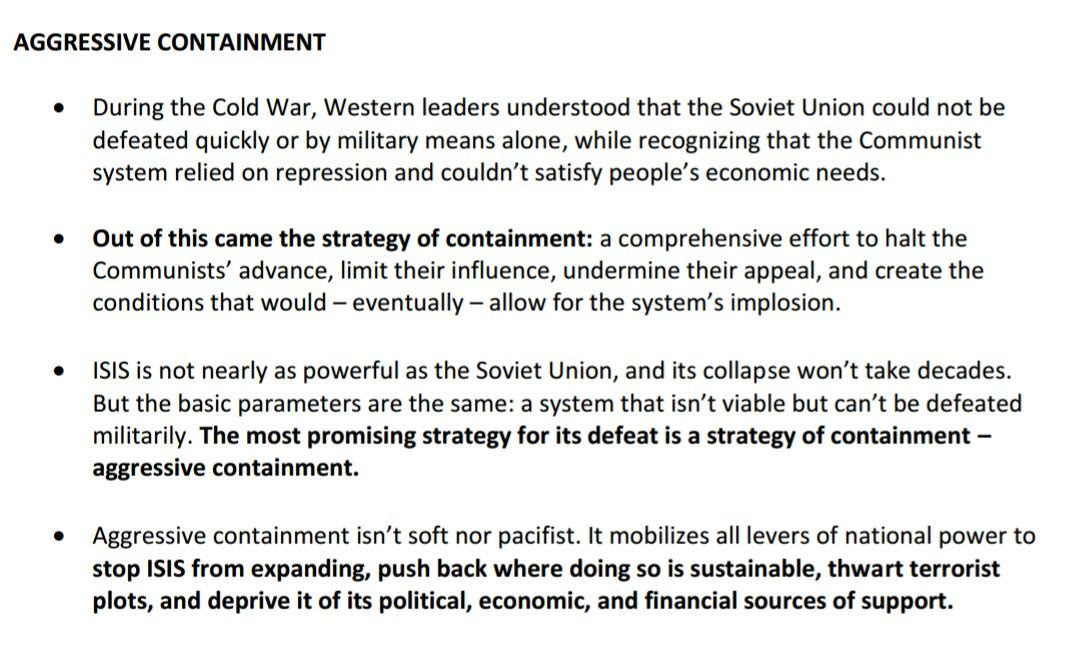
Smart and realistic: defeating ISIS through a strategy of "Aggressive Containment"

From a project Peter Neumann of King's College is working on.  You can find interesting things in the "Twitterverse"

Smart and realistic: defeating ISIS through a strategy of "Aggressive Containment"
Embedded image permalink

Thursday, August 13, 2015

Special Operations Today: FSR Interviews LTG Cleveland (Ret.) Formerly Commanding General, USASOC

From the Fletcher Security Review.  The entire interview can be downloaded at this link: http://media.wix.com/ugd/c28a64_c14626a276f942c0aed3b777abd0dd0d.pdf

I have placed an excerpt regarding the question "highly SOF kinetic" versus "models for the future for SOF on the lower end of the conflict scale" as well as "the important elements of an unconventional warfare campaign" below.

12 August 2015

Special Operations Today:

FSR Interviews LTG Cleveland (Ret.)

Formerly Commanding General, 

USASOC


Inline image 1Inline image 2


Lieutenant General Charles T. Cleveland, an Army Special Forces Officer, relinquished command of the United States Army Special Operations Command (USASOC) and retired after 37 years of military service on 01 July 2015. He previously commanded the Special Operations Command Central and Special Operations Command South as well as the Combined Joint Special Operations Task Force-North during Operation Iraqi Freedom. LTG Cleveland is a native of Arizona and a 1978 graduate of the United States Military Academy at West Point, New York. His military awards and decorations include the Defense Superior Service Medal and the Legion of Merit Medal.


FSR: On a related note, highly kinetic SOF operations tend to get more press than other operations – when prominent terrorists are killed, etc. Can you give examples that you believe to be successes and models for the future for SOF on the lower end of the conflict scale? 

LTG Cleveland: I think it’s natural that those types of operations gain a lot of press. Long term we’ve had good success in the Philippines. Working with the Filipino military has gained us a little bit of notoriety. There are some good cases in Africa, including the efforts to counter Koney [Joseph Kony, leader of the Uganda-based Lord’s Resistance Army rebel group] and the influence of the Lord’s Resistance Army in the region. There are lots of successes coming from our ability to message to his fighters that there is an alternative. You don’t get a lot of press on that, but those are all good successes from an influence ops standpoint. There are also a lot of places where we have had capability building success. In Colombia, for example, we have shown considerable progress in their development and we’ve done so, by and large, under the radar. It took a long-term, disciplined approach to the campaign. 

FSR: What would you characterize as the most important elements of a successful unconventional warfare campaign, or is that even something that can be done given the primacy of context? 

LTG Cleveland: Every one of these [campaigns] is highly individualistic. Every campaign is going to be different. As an example, we’re now changing our vocabulary to talk about special warfare as opposed to just unconventional warfare or foreign internal defense. In reality, what you see is that there are places where we are doing ostensibly a FID [Foreign Internal Defense] mission but it has unconventional warfare activities included in it. There are places where we are doing things that are necessarily part of working 100% with your partner – there are [also] things we do unilaterally, for example at the same time as training and capability building. There are other places – we have very publicly spoken about the Syria train and equip mission. That is a very unconventional warfare activity, but it has pretty significant FID overtones to it. We’re going to “train and equip” – that’s even the words that we use. The Northern Alliance and working with the Peshmerga at the beginning of both Afghanistan and Iraq were unconventional warfare efforts, but again, there was a chain of command and it was done somewhat from sanctuary [at least initially] and so it had FID-like qualities to it. There are a couple of activities in places where it is purely unconventional warfare, working with surrogate groups. So each one of these cases is tailored by the circumstance, what’s generating the problem, and by the capacity and capability of whoever is there. If there is one overriding thing, it’s having the ability to understand the local and indigenous problems and using that and leveraging that in order to develop the appropriate solutions. You have to know up front what it is. You can’t just take the formula from the last successful venture and think it’s going to work in the next one. That is why there is a premium on language understanding and area knowledge.

Wednesday, August 5, 2015

Support to Korean Resistance: Has the Time Come?


Support to Korean Resistance: Has the Time Come?

by David S. Maxwell

Journal Article | August 5, 2015 - 1:50am
Support to Korean Resistance: Has the Time Come?
David S. Maxwell
“It is time to take a professional approach to supporting a resistance among the Korean people living in the north.”
Unification of Korea is the only outcome that will solve three of the most intractable problems in Northeast Asia: (1) the Kim Family Regime’s nuclear threat; (2) the human rights atrocities and crimes against humanity that have been perpetrated on the Korean people living in the north[1] each and every day for the past six decades; and (3) the threat to peace and prosperity in the region.  It is only through unification, described as  “a stable, secure, peaceful, economically vibrant, non-nuclear peninsula, reunified under a liberal constitutional form of government determined by the Korean people,”[2] that can bring security and stability to Northeast Asia.  No enlightened person can deny that this is what all Korean people deserve.
The combination of threats posed by North Korea with its conventional and asymmetric military capabilities, and the impact of conflict on the region and globally as well as the thought of the humanitarian crisis with 25 million hungry and suffering Korean people, has paralyzed the nations that have a major role in the region (the Republic of Korea, the United States, Japan, China, and Russia) as well as the broader international community.  For decades we have approached the security and humanitarian problems through stovepipes trying to solve pieces and parts of the overall problem.  There are the Six Party Talks trying to solve the nuclear problem while the regime continues to develop and test nuclear weapons and missile delivery systems while rewriting its constitution to call itself a nuclear state.  For the first time there is the United Nations Commission of Inquiry (COI) investigation of the human rights atrocities that called for the referral of Kim Jong-un to the International Criminal Court.  There are many other initiatives of engagement with governments and non-government organizations to assist the north with education, technology development, and agricultural development as well as food aid trying to assist the Korean people living in the north.
It is time to recognize the central problem and to understand that nuclear weapons and human suffering are the result of one thing:  the existence of the Kim Family Regime and its oppression and enslavement of the Korean people living in the north.  With recognition of the problem it may be possible to harness or at least orchestrate the actions of the many disparate organizations to achieve one goal: to free the people in the north and reunite the entire Korean peninsula.
Of course to many this is interpreted as regime change and in effect that is what I am arguing except that I am not arguing for an externally imposed regime change but one organized, led, and executed by people from within the northern part of Korea so that they can be free to peacefully reunite with their Korean brothers and sisters in the Southern half of the peninsula. 
What stymies the international community and regional powers from achieving decisive change in the Kim Family Regime behavior and solving the nuclear and human rights issues is first and foremost the existence of the Regime and its vital national interest: regime survival.   The regime will not succumb to international engagement or pressure or carrots or sticks.  It will only continue to practice its time worn strategy of conducting blackmail diplomacy by using provocations to gain political and economic concessions while conducting illicit activities (counterfeiting, drug trafficking, and weapons proliferation to rogue states and non-state actors) around the world to gain hard currency and vital resources to ensure survival of the regime.  There is no carrot or stick that will cause the regime to end its quest for nuclear weapons or lift the yoke of oppression from the people in the north because both are deemed as key to regime survival. 
The second obstacle that prevents action is the uncertainty of regime collapse that could very likely lead to conflict or the outbreak of war between north and South on the Peninsula.  The only thing we know with some certainty is that any form of conflict from regime collapse or war will lead to a tremendous loss of blood and treasure on the peninsula and the economic effects of conflict will have global impact.
Some will argue that supporting a resistance in North Korea poses a moral hazard as it could put innocent Koreans at risk if the Kim Family Regime conducts widespread security operations to suppress a resistance.  I would argue that the regime is already conducting such operations because the system is designed in such a way as to deliberately oppress the people to prevent coups and resistance.  Yes there will be crackdowns and Koreans will be arrested and put into the gulags and worse.  But I would counter the moral hazard argument with a reminder that the 25 million Koreans living in the north are already suffering horrendously with many being sent to the gulags and worse already.  They deserve to be free and the risk posed by supporting a resistance is one worth taking for the people to attain freedom.  We should consider the morality of not helping them and remember the history of not helping the suffering and oppressed which has in past times led to genocide in other parts of the world.

(Continued at the link below)

Friday, July 24, 2015

A Look into SOCOM (GEN Votel at the Aspen Institute today, 24 July)

Note that the audio does not seem to work until 53 seconds into the video so be patient.
The Aspen Institute  19,235
  
110 views
 
Streamed live on Jul 24, 2015
The Commander of Special Operations Command discusses his unique band of warriors and how they are protecting America’s interests around the world.

Joseph Votel, C

Thursday, July 23, 2015

Special Operators and Intelligence Analysts: the 21st Century’s Lead Warriors

1 hour panel at the link below.

Special Operators and Intelligence Analysts: the 21st Century’s Lead Warriors


Streamed live on Jul 23, 2015
Huge ground invasions and indefinite occupation forces are so last decade. Today’s wars, big and little, are being fought largely by the strategic deployment of limited Special Operators on the ground and intelligence analysts back stateside who dispatch them and drones to the world’s hot spots for quick “in and out” operations. Experts in this kind of 21st century warfare discuss the strengths and weaknesses of this approach to global crises.

Kathleen Hicks, Senior Vice President, Henry A. Kissinger Chair, and Director, International Security Program, Center for Strategic and International Studies

Eric Olson, former Commander of US Special Operations Command (SOCOM) and a member of the Aspen Institute Homeland Security Group

Michael Vickers, Former Under Secretary of Defense for Intelligence

Moderator: Kim Dozier, Contributing Writer, The Daily Beast; Global Analyst, CNN

Giving Tuesday Recommendations

  Dear Friends,  I do not normally do this (except I did this last year and for the last few years now, too) and I certainly do not mean to ...