Monday, September 8, 2014

Yes, Russia Matters: Putin’s Guerrilla Strategy

Guerrilla is probably a term thrown around a little too much.  But there is political and unconventional warfare coming out of Russia.

Excerpt:

A similarly subtle, shape-shifting approach informs the Kremlin’s manipulations in the world of ideas and political narratives. For a country that President Obama claims “has no global ideology,” Putin’s Russia cares very much about ideas, carefully controlling media, education, and parties inside the country and investing hundreds of millions of dollars in international broadcasting, intellectual influencers, and think tanks abroad.
...
These are not the innovations of a bankrupt state mired in the “old ways,” in President Obama’s words. Rather, the Kremlin is ideologically supple and cleverly maneuvering through a globalized world. But what does Russia want? What are its aims?
Whether or not the Kremlin has a grand global vision, it does have several priorities on its international agenda. Since the annexation of Crimea, President Putin has pegged his domestic popularity to victory in military campaigns in his near abroad, and in order to maintain his standing he might well need to provoke more—with Moldova and Estonia, for instance. Still fully engaged with the West, despite his aggressions, Putin will continue to try to undermine the EU so as to create a continent under Russia’s energy thumb. Globally, Kremlin leaders are encouraging the decline of a rules-based system, which sets the stage for the prosperity of “global reiders” such as themselves.
This is quite a conclusion:

The core EU-US alliance not only needs to be rehabilitated but supplemented by an approach to the new, successful democracies of the global south. As historian Anne Applebaum points out in a recent “Democracy Works” paper for the Legatum Institute, India, Brazil, and South Africa should all be examples of how liberal democracy can be successful. But during the crisis in Ukraine, Western diplomacy didn’t take the trouble to present its case to these nations, so Russia was able to manipulate residual anticolonial, anti-Western resentment in all three, and all three refused to condemn the annexation of Crimea or back sanctions against Moscow. These “swing states” need to be made stakeholders in the camp of international democracy, and the idea of the “West” needs to be expanded to include them.
Particular attention must also be paid to what is perhaps the strongest weapon in the Kremlin’s armory: the ability to corrupt Western elites, which both stymies geopolitical action and in turn strengthens the Kremlin’s underlying argument that Western democracies have no true values. Once upon a time, for example, Russian and Ukrainian dissidents used to speak of the West generally, and London in particular, as their guiding beacon. Today, by being so ready to take post-Soviet money and ask so few questions, these places are now increasingly perceived as supporting the autocratic, corrupt systems of Moscow. “Don’t you realize you risk creating a global system where corrupt, state-connected companies from Russia win and your companies aren’t able to compete?” asks Vladimir Ashurkov of the Anti-Corruption Fund.

Yes, Russia Matters: Putin’s Guerrilla Strategy

The Obama administration seems to believe that Vladimir Putin should not be taken too seriously. The annexation of Crimea and belligerence over Ukraine are, to quote the president and his secretary of state, a sign of “weakness,” the hallmark of a “regional” power stuck in “the old ways of doing things,” leading no bloc of nations and having “no global ideology.” These assumptions may be comforting rationales for a lack of response to the Kremlin’s recent moves, but they misread the game Putin is playing—and underestimate its significance.
It is true that Russia is relatively weak compared to the Soviet Union, to which its current leader looks back with nostalgia. It faces demographic problems, its economy (the eighth-largest in the world) is flatlining, and its military spending is only a sixth of America’s (though still the third-largest in the world, and growing). But today’s Kremlin has seen something: in the globalization and interdependence of the twenty-first century, it’s how you use your relative weakness that counts.
One way the Kremlin advances its interests is by making other states reliant on its money and markets, approaching each country according to its unique vulnerability. Britain, for example, has wedded itself to a development strategy of becoming the capital of global finance, so Russia keeps its money flowing into London to help keep the economy purring. The London Stock Exchange, whose regulations are looser than those of the US, is perceived as a more hospitable place for Russian companies, more than seventy of which are listed and traded there, with companies from the former Soviet states raising $82.6 billion in the past two decades. And that’s just the transparent money. Much more is thought to flow from Russia to London through the UK’s network of murky offshore zones such as the British Virgin Islands. According to the British Financial Services Authority, approximately one-third of UK banks appeared willing to endure “money-laundering risk if the immediate reputational and regulatory risk was acceptable,” an attitude which has led London to be nicknamed “the money laundering capital of the world” by the satirical magazine Private Eye. “I’ve regularly told the UK Financial Services Authority to investigate Russian state companies in the UK,” says Vladimir Ashurkov, head of the Moscow-based Anti-Corruption Fund, “but they never do: at one point you realize it’s a question of political will.”

Related Essay

Putin and Europe’s Far Right

Alina Polyakova | ESSAY
If Europe’s far-right, pro-Russia parties gain in upcoming national elections, the EU may divide further and find it very difficult to deter Russian aggression in Ukraine and elsewhere.
The UK is addicted to these financial flows not because the amounts are huge, but because clamping down on the Russians would signal that London was willing to surrender its position as global financial capital for larger principles. The Kremlin is aware that the British will not take such a stand. “The UK should not support for now, trade sanctions . . . or close London’s financial center to Russians,” one of the British government’s key security advisers wrote in a strategy memo accidentally leaked to the press during the crisis over Ukraine.
On the continent, it is energy, not money, that is Russia’s great trump card. Since the annexation of Crimea, companies entangled in Russia’s energy market, including Germany’s BASF and Italy’s ENI, have been vocal in opposing EU sanctions against Moscow. But while Russia positions itself as a reliable energy partner to Western European states, it can be far more aggressive in its negotiations with direct neighbors such as Lithuania, where Russia has raised the gas price by four hundred and fifty percent over the last seven years in what many see as geopolitical punishment. “Russia shows a different face to different parts of Europe,” an energy security adviser to a Central European government told me recently. “So when we talk about Russia, we find we’re talking about different Russias, and that makes building a unitary position difficult.” It is a complex game. In the South Stream pipeline project, which aims to deliver Russian gas via Southern and Central Europe, Moscow is setting countries like Bulgaria and Hungary, which would benefit from it, against the European Commission in Brussels, which believes the bilateral deals Russia struck are in breach of EU law. The net effect of all these energy games is to break the political unity of the European Union, and increase Russia’s dominance over the continent.
(Continued at the link below)

Sunday, September 7, 2014

Top Russian General Lays Bare Putin's Plan for Ukraine

Again, we really need to pay attention to Russia's political and unconventional warfare.  We fail to study these forms of warfare and fail to learn how to counter political and unconventional warfare at our peril.

Gerasimov writes about how "a perfectly thriving state can, in a matter of months and even days, be transformed into an arena of fierce armed conflict, become a victim of foreign intervention, and sink into a web of chaos, humanitarian catastrophe, and civil war."
This is achieved, Gerasimov writes, by "the broad use of political, economic, informational, humanitarian, and other non-military measures applied in coordination with the protest potential of the population." The goal is "to create a permanently operating front through the entire territory of the enemy state."
Gerasimov's article is of great interest to military specialists, but it is of broader interest as well. It reveals much about Russia's view of the West -- particularly the United States -- which the Kremlin believes carries out such operations regularly around the world. The view of global affairs presented in this article, I think, accurately reflects an important strain of Kremlin thinking. After all, it is presented in an obscure publication and its exposure to foreign audiences could not have been foreseen.
(I would take exception to the last sentence - if the Russians are as sophisticated in political and information warfare they are made out to be someone likely forsaw that this article would be exposed).


Robert Coalson Headshot
 Become a fan 
Prague-based editor and writer for Radio Free Europe/Radio Liberty

Top Russian General Lays Bare Putin's Plan for Ukraine


Posted: 09/02/2014 12:19 pm EDT Updated: 09/03/2014 3:59 pm EDT
476776329


PRAGUE -- When the crisis in Ukraine dramatically heated up last November and in the ensuing weeks, I was impressed by the ability of the Russian state to mobilize so many different tools in its bid to destabilize its neighbor. It became clear very quickly that Russian politicians, journalists, purportedly nongovernmental organizations, state companies, think tanks, the military, the courts, government agencies and the Duma were all working from the same instructions for the same goals. At the time I remarked on Twitter that the crisis showed the tactical effectiveness of the "unitary state" Russian President Vladimir Putin has been building since 1999.
In June, I came across a fairly obscure article by General Valery Gerasimov, the chief of the general staff of the Russian Federation, and was struck by how closely it mirrored my observations of the unfolding Ukraine crisis.
Gerasimov writes about how "a perfectly thriving state can, in a matter of months and even days, be transformed into an arena of fierce armed conflict, become a victim of foreign intervention, and sink into a web of chaos, humanitarian catastrophe, and civil war."
This is achieved, Gerasimov writes, by "the broad use of political, economic, informational, humanitarian, and other non-military measures applied in coordination with the protest potential of the population." The goal is "to create a permanently operating front through the entire territory of the enemy state."
Gerasimov's article is of great interest to military specialists, but it is of broader interest as well. It reveals much about Russia's view of the West -- particularly the United States -- which the Kremlin believes carries out such operations regularly around the world. The view of global affairs presented in this article, I think, accurately reflects an important strain of Kremlin thinking. After all, it is presented in an obscure publication and its exposure to foreign audiences could not have been foreseen.
It also presents a candid and fairly negative assessment of Russian military science. Gerasimov notes the field has been stymied in the past by "a scornful attitude toward new ideas," for which the Soviet Union paid "in great quantities of blood" during World War II. Reading between the lines, one might learn a lot from this article about relations between the military and the government and about competing schools within security structure itself.
Finally, I think this article offers a lesson for the West. The Russian government is intentionally shrouded in secrecy, but it is not nearly as inscrutable as the Soviet government was. There is a huge amount of important and revealing information to be found that needs to be researched, translated, and brought into the larger discussion of Russia's relations with the West and its role in the world. But very little of this information ever gets beyond a small circle of specialists. And that is proving to be a very costly mistake.
Here is my translation of key portions of General Gerasimov's article, which appeared on "Military-Industrial Kurier" on February 27, 2013
In the 21st century we have seen a tendency toward blurring the lines between the states of war and peace. Wars are no longer declared and, having begun, proceed according to an unfamiliar template.

The experience of military conflicts -- including those connected with the so-called colored revolutions in north Africa and the Middle East -- confirm that a perfectly thriving state can, in a matter of months and even days, be transformed into an arena of fierce armed conflict, become a victim of foreign intervention, and sink into a web of chaos, humanitarian catastrophe, and civil war.

The Lessons of the "Arab Spring"

Of course, it would be easiest of all to say that the events of the "Arab Spring" are not war and so there are no lessons for us -- military men -- to learn. But maybe the opposite is true -- that precisely these events are typical of warfare in the 21st century.

In terms of the scale of the casualties and destruction -- the catastrophic social, economic, and political consequences -- such new-type conflicts are comparable with the consequences of any real war.

The very "rules of war" have changed. The role of non-military means of achieving political and strategic goals has grown, and, in many cases, they have exceeded the power of force of weapons in their effectiveness.

The focus of applied methods of conflict has altered in the direction of the broad use of political, economic, informational, humanitarian, and other non-military measures -- applied in coordination with the protest potential of the population.

All this is supplemented by military means of a concealed character, including carrying out actions of informational conflict and the actions of special operations forces. The open use of forces -- often under the guise of peacekeeping and crisis regulation -- is resorted to only at a certain stage, primarily for the achievement of final success in the conflict.
(Continued at the link below)
http://www.huffingtonpost.com/robert-coalson/valery-gerasimov-putin-ukraine_b_5748480.html?utm_hp_ref=twzzz

Friday, September 5, 2014

SACEUR: Allies must prepare for Russia ‘hybrid war’

SACEUR knows that we need to be able to counter political and unconventional warfare.  The Latvians and Poles have described Russia's new generation warfare (Latvia) and Russian information warfare (Poland) the best in their reports this past spring

NATO members, especially the Baltic states that border Russia, must take into account such tactics as allies prepare for future threats, he said. That means steps should be taken to help build the capacity of other arms of government, such as interior ministries and police forces, to counter unconventional attacks, including propaganda campaigns, cyberassaults or homegrown separatist militias.
“What we see in Russia now, in this hybrid approach to war, is to use all the tools they have ... to stir up problems they can then begin to exploit through their military tool,” said Breedlove, NATO’s supreme allied commander.
By building up pre-crisis capabilities to deal with such tactics, nations will be better able to assign responsibility to an aggressor nation, which is key to triggering NATO involvement in a crisis, Breedlove said.
“When you cannot attribute (to an aggressor), this causes problems,” Breedlove said. “But the moment we attribute these actions to an aggressor nation, now this is Article 5. So we need to build the nations’ ability to fight through that first onslaught, attribute to an aggressor nation, and then NATO Article 5 kicks in.”
I hate to beat a dead horse but we should pay attention to our own George Kennan who described this in 1948:

•Political warfare is the logical application of Clausewitz's doctrine in time of peace. In broadest definition, political warfare is the employment of all the means at a nation's command, short of war, to achieve its national objectives. Such operations are both overt and covert. They range from such overt actions as political alliances, economic measures (as ERP--the Marshall Plan), and "white" propaganda to such covert operations as clandestine support of "friendly" foreign elements, "black" psychological warfare and even encouragement of underground resistance in hostile states. 


SACEUR: Allies must prepare for Russia ‘hybrid war’

On Sept. 4, 2014, Gen. Phil Breedlove (right), Supreme Allied Commander Europe, speaks with Gen. Knud Bartels (left), Chairman of the NATO military Committee, just before the meeting on Afghanistan kicks off at NATO Summit 2014 in the Wales, United Kingdom.
EDOUARD BOCQUET/NATO
By John Vandiver
Stars and Stripes
Published: September 4, 2014

NATO must help allies in the east bolster first-line defenses to counter any aggression from Russia, whose unconventional tactics in Ukraine could pose special challenges if deployed on alliance turf, Gen. Philip Breedlove, NATO’s top military commander, said Thursday.
Before the incursion of what Western officials say are regular Russian troops into Ukraine, Moscow stirred unrest in other ways during the early stages of the crisis, Breedlove said during an Atlantic Council event that coincided with the start of NATO’s two-day summit in Wales.
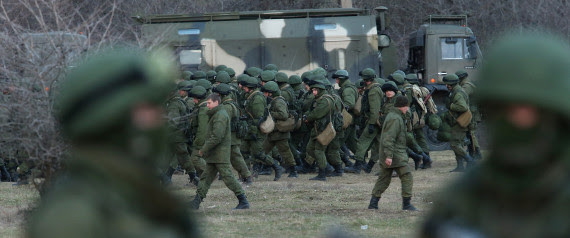
Russia’s utilization of troops without national uniforms — the so-called “little green men” — and perhaps “the most amazing information warfare blitzkrieg we have ever seen in the history of information warfare” were part of the first Russian push in Ukraine, Breedlove said.
NATO members, especially the Baltic states that border Russia, must take into account such tactics as allies prepare for future threats, he said. That means steps should be taken to help build the capacity of other arms of government, such as interior ministries and police forces, to counter unconventional attacks, including propaganda campaigns, cyberassaults or homegrown separatist militias.
“What we see in Russia now, in this hybrid approach to war, is to use all the tools they have ... to stir up problems they can then begin to exploit through their military tool,” said Breedlove, NATO’s supreme allied commander.
By building up pre-crisis capabilities to deal with such tactics, nations will be better able to assign responsibility to an aggressor nation, which is key to triggering NATO involvement in a crisis, Breedlove said.
“When you cannot attribute (to an aggressor), this causes problems,” Breedlove said. “But the moment we attribute these actions to an aggressor nation, now this is Article 5. So we need to build the nations’ ability to fight through that first onslaught, attribute to an aggressor nation, and then NATO Article 5 kicks in.”
Article 5 is the NATO principle that an attack on one member requires a collective response from all.
Russia continues to deny it has forces in Ukraine, an assertion Breedlove described as absurd.
“We’re observing Russian forces fighting alongside separatists inside Ukraine,” Breedlove said. “Russian air defense assets are being used to conceal the advance of Russian tactical units throughout eastern Ukraine, and still, still, Moscow is continuing to deny any direct involvement across the border. Despite the casualties and deaths that are mounting of their own soldiers.”
In Wales, NATO is expected to act on plans to establish a more visible presence in eastern Europe with a focus on maintaining a troop presence at a series of bases in the region. NATO also needs a forward-stationed headquarters in the region that is focused on Article 5 preparedness, Breedlove said.
An increased presence, along with a NATO Response Force reshaped to better handle rapid-reaction missions, is needed in answer to Russian aggression in Ukraine, Breedlove said. With an operational presence in the east, NATO will also have the ability to surge forces if needed.
“If we need to, we can rapidly respond with much larger and more capable forces if we see an act of aggression,” Breedlove said.

Thursday, September 4, 2014

S. Korea-U.S. joint command to remain in Seoul until OPCON transfer: sources

Good news here though this seems like a premature release.  This should have been unveiled at the Security Consultative Meeting next month. But this is good for the ROK/US Alliance and the combined war fighting capabilities if true.

But I wonder if this senior Seoul government official leaked this as a trial balloon or because he is trying to undermine the agreement.  There could have been a better combined strategic communications plan to mitigate some of the political fallout that will likely occur in the ROK.  I will not go into my usual diatribe about the command relations but at least Yonhap did not once mention USFK.  

   "The two sides have agreed to maintain the CFC in Yongsan, where it is currently located, until we regain the operational control (OPCON) from the U.S.," a senior Seoul government source said, requesting anonymity.

   The CFC, which has the command over South Korean and U.S. troops stationed here, was to be disbanded upon Seoul's OPCON transfer in December 2015, but a bilateral agreement to delay the transfer has led the CFC to remain intact.

S. Korea-U.S. joint command to remain in Seoul until OPCON transfer: sources

2014-09-04 17:37
   South Korea and the United States have agreed to make the Combined Forces Command (CFC) exempt from their plan to relocate U.S. troops until Seoul retakes wartime command of its forces from Washington, sources here said Thursday.

   Seoul and Washington had been at odds over whether to move the CFC headquarters and its affiliated forces to Pyeongtaek, some 70 kilometers south of the capital, in accordance with their 2004 agreement to move the Yongsan Garrison, the sprawling U.S. military headquarters in central Seoul, and the 2nd Infantry Division stationed north of Seoul to the southern town by the end of 2016.

   "The two sides have agreed to maintain the CFC in Yongsan, where it is currently located, until we regain the operational control (OPCON) from the U.S.," a senior Seoul government source said, requesting anonymity.

   The CFC, which has the command over South Korean and U.S. troops stationed here, was to be disbanded upon Seoul's OPCON transfer in December 2015, but a bilateral agreement to delay the transfer has led the CFC to remain intact.

   "Albeit temporarily, we, in fact, accepted the U.S. request to stay them in Seoul. The U.S. has proposed the CFC be an exception for the relocation plan, citing smooth policy coordination between the allies," the source said.

   "Though the U.S. wants to have most of its forces under the CFC stay in Yongsan, we have conveyed our position that it would not be possible. Discussions are under way about the size of the remaining forces," he added.

   Their retainment is expected to spark controversy and opposition from the public, as it will affect the South Korean government's plan to turn the vast site in central Seoul into a public park. The government itself has reiterated that the relocation plan will be pushed forward as scheduled "as a pledge to the people."

   "After the decision to delay the OPCON transfer, where to put the CFC became a matter of reality. We are now striving to find ways to meet different demands and conditions," said another government source who is well-versed in the issue.

   Denying the report, however, Seoul's defense ministry said it will "seek the best ways to strengthen the joint defense posture with the U.S. while pushing for the relocation plan as scheduled."

   South Korea handed over control of its forces to the U.S. during the 1950-53 Korean War to defend against invading troops from North Korea. Peacetime control of its forces was returned in 1994, and South Korea is currently scheduled to get back operational control in the event of war in December 2015.

   But last year, Seoul asked for a delay in the OPCON transfer after North Korea conducted its third nuclear test, saying the security situation on the peninsula was markedly different from when the transfer was agreed upon a few years ago.

   The allies are scheduled to decide on the timeframe and conditions of the transfer by October, when the defense chiefs will hold their annual meeting in Washington. Many expect South Korea to retake it between 2020 and 2022.

   By Oh Seok-min
   SEOUL, Sept. 4 (Yonhap)
   graceoh@yna.co.kr
(END)

S. Korea, U.S. to create combined unit next year

Back to the future.  I wonder how many remember the ROK/US I Corps and then the Combined Field Army in Uijongbu?  But this is good news for combined operations.   Kudos to GEN Thurman and LTG Cardon who worked hard to initiate this on the US side when they were in command.  This is a good sign for the strength of the ROK/US Alliance.


S. Korea, U.S. to create combined unit next year

By Oh Seok-min
SEOUL, Sept. 4 (Yonhap) -- South Korea and the United States have agreed to establish a combined division of their troops next year that will be tasked with carrying out wartime operations, Seoul's defense ministry said Thursday.

The unit, slated to be set up in the first half of next year, will be comprised of the U.S. 2nd Infantry Division located in Uijeongbu, north of Seoul, and a South Korean brigade-level unit, the ministry said.

In peacetime, the envisioned unit will have a joint staff, which will be headed by a major general-level U.S. officer, a ministry official said.

Details on the newly-created unit's missions are not available, though officials say it will be assigned to carry out special operations such as eliminating weapons of mass destruction as well as civil missions against North Korea.

"The new joint division is expected to improve the Seoul-Washington joint deterrence posture and boost our military's capabilities to carry out joint operations," the ministry said in a statement.

The agreement, however, does not mean any revision to their ongoing plan of relocating the U.S. Forces Korea (USFK) bases south of Seoul, according to officials.

"The 2nd Division and the headquarters of the envisioned joint unit will be based in Uijeongbu. After the relocation project is completed, they will then be moved to Pyeongtaek," the ministry said.

In accordance with the 2004 agreement, Seoul and Washington have been working to relocate the Yongsan Garrison, the sprawling U.S. military headquarters in central Seoul, and the 2nd Division north of Seoul to Camp Humphreys in Pyeongtaek, some 70 kilometers south of the capital, by the end of 2016.

There has long been speculation that the reorganization of the 2nd Division aims to allow some American soldiers to remain north of the capital.

Last year, USFK commander Gen. Curtis Scaparrotti said, "In terms of the residual in what we call Area One, there may be a need operationally to leave some residual in those areas just for proper defense and response." Area One includes the northern towns of Uijeongbu and Dongducheon, Gyeonggi Province.

About 28,500 U.S. troops are currently stationed in South Korea, a legacy of the 1950-53 Korean War.
(END)

Wednesday, September 3, 2014

A broad approach to countering the Islamic State

I concur that a broad approach is needed; however approaching the problem from the default positions of COIN or CT is too limiting and may (if it has not already) stifle creative strategic thought.  I think we are making a mistake in trying to put everything into a COIN or CT "box."

That said ISIL clearly has evolved from an Islamist extremist based terrorist organization. I know we do not want to legitimize it by calling it the Islamic State but I think we have to look at it as more than a terrorist organization.  Although there are tremendous political problems in Iraq and those political problems have created security vacuums that ISIL has been able to exploit I do not think ISIL is conducting an insurgency against the Iraqi government.  What ISIL has done has become an occupying power in northern Iraq and is not seeking traditional forms of legitimacy from among the relevant population.  It is oppressing (and ethnic cleansing)  the people living in its occupied territory and it is obviously using the tactics of terrorism to oppress (and ethnic cleanse) the population.  It may have the objective to defeat all of Iraq and occupy it but I do not think that it will attempt to do so through insurgency and terrorism (though it will continue to conduct terrorism in support of its objective).  It will conduct large scale military type operations to achieve its objectives and to ISIL the population is secondary and is either used for exploitation or is simply in the way and an obstacle to be eliminated (again ethnic cleansing).  If we focus exclusively on CT and COIN we may very well miss the bigger picture and thus provide the wrong response to the wrong problem.

I think the broad approach needed is to not approach this from an insurgency or terrorism perspective but to approach it from an occupying power perspective.  This might lead to a two pronged approach - one is conventional forces (perhaps Iraqi and Kurdish) conducting conventional operations to retake lost terrain and population centers and defeat the ISIL forces hopefully with the support of a coalition with air power, ISR, and advisory support.  The second lesser and supporting approach might be an unconventional approach that leads to the overthrow of an occupying power if there is any remaining indigenous resistance potential in the occupied territory.  While coalition forces could provide external support to such resistance on the ground support might best be provided by non-western regional elements (from the Iraqi or Kurdish militaries), again with coalition external support.

But the bottom line for me is that using a COIN or CT approach is too strategically limiting and we need to address the ISIL threat as it really is (an occupying power) and not as we would wish it to be (an insurgent or terrorist organization).


By Christopher Paul and Colin P. Clarke September 2 at 10:09 AM

Iraqi soldiers celebrate on Monday after Iraqi forces broke through to the jihadist-besieged town of Amerili the previous day. (JM Lopez/AFP/Getty Images)
In 2013 we completed “Paths to Victory: Lessons from Modern Insurgencies,” a study of 71 counterinsurgencies since the end of World War II that quantitatively tested the performance of 24 concepts, or building blocks, for specific counterinsurgency (COIN) approaches, against the historical record. Some of the concepts were drawn from classical perspectives on COIN from the previous century, such as pacification and resettlement; others were contemporary concepts suggested for operations in Iraq and Afghanistan, such as “boots on the ground” and the concept implicit in U.S. Army Field Manual (FM) 3-24, Counterinsurgency.
The selected cases are the 71 most recent resolved insurgencies, spanning the period from World War II through 2010. In addition to being perfectly representative of the modern history of insurgency, these cases represent geographic variation (mountains, jungles, deserts, cities), regional and cultural variation (Africa, Latin America, Central Asia, the Balkans, the Far East), and variation in the military capabilities and tactics of COIN forces and insurgent forces alike.

Map of the 71 Insurgencies – Green shading indicates that the COIN force prevailed (or had the better of a mixed outcome), while red shading indicates that the outcome favored the insurgents (thus, a COIN loss).
The study resulted in a definitive set of findings about historical cases of counterinsurgencies, several of which are detailed below.
First, we found that in every case where they succeeded, counterinsurgent forces managed to substantially overmatch the insurgents and force them to fight as guerrillas before getting down to the activities traditionally associated with counterinsurgency.
This means that step one in defeating militants from the Islamic State, formerly referred to as the Islamic State of Iraq and Syria (ISIS), is to overmatch them and defeat their conventional aspirations. While this has not happened yet in Iraq, U.S. air power could make a significant contribution toward that end. Airstrikes will help curb Islamic State advances in strategically important parts of Iraq and thus, help bolster the Iraqi government and security forces, at least in the short term.
Second, we concluded from the research that “effective COIN practices tend to run in packs,” meaning that governments that managed to defeat insurgencies implemented numerous effective practices rather than just a few. Qualitative Comparative Analysis (QCA) techniques identified three COIN concepts critical to success. These three concepts were implemented in each and every COIN win, and no COIN loss implemented all three: Tangible support reduction; commitment and motivation; and flexibility and adaptability.
The recent Islamic State military offensive throughout northern Iraq has generated debate about what the U.S. role should be in countering the group. The broader strategy to defeat the growing insurgency in Iraq – and ISIS does represent an insurgency, as its stated goal is to topple the Iraqi and Syrian governments and replace them with a sharia state – will have to involve U.S. support on several levels, though the Iraqi security forces must be in the lead.
(Continued at the link below)

Monday, September 1, 2014

Should the US retrench from South Korea? (pro and con)

I have to give a lot of credit to Robert Kelly for trying to articulate both sides of the debate on this issue.  Few authors, even academics, and certainly not pundits really try to argue both sides of an issue.  Unfortunately , despite his best attempts, it is clear that Robert Kelly's retrenchment bias does show through but his arguments are an interesting read nonetheless.  He never really articulates US interests and why it would be bad for there to be a war or catastrophic regime collapse on the peninsula.

Excerpt:

Whether the US should stay or go is a perennial issue, that surprisingly, doesn't get discussed much. This is probably because if you really supported a US withdrawal, you would not be taken seriously in much of US or Korean foreign policy establishments.
US foreign policy is dominated by a hawkish, interventionist consensus of neocons and liberal internationalists for whom the US positions in Japan and Korea have become ends in themselves as symbols of US hegemony (in neocon-speak, that's read as: 'global basing means we're f****** awesome!').

If he was really going to debate both sides of the issue he would have laid out the realist perspective on maintaining the ROK/US alliance which I think might be different than the hawkish, interventionist consensus of neocons and liberal interventionists.

The irony is that the biggest proponent of retrenchment was Donald Rumsfeld.  The entire OPCON transfer and relocation of US forces was his attempt to drive US forces from the peninsula.  And although they do not know it or would not admit it all those in favor of the OPCON transfer are really in favor of US retrenchment and are just supporting Donald Rumsfeld's vision for the ROK/US alliance.

My Lowy Debate on whether US should Retrench from South Korea, part 1: Yes

Posted on September 1, 2014
This is a re-up of a debate couplet on the US position in South Korea, which I wrote for the Lowy Institute. Part one, the reasons for US retrenchment, is here (and below); part 2, the argumentsagainst a US departure, ishere. And that pic is me and my North Korean minder at the North Korea side of the DMZ. Note the KWP pin above his breast pocket.
Whether the US should stay or go is a perennial issue, that surprisingly, doesn't get discussed much. This is probably because if you really supported a US withdrawal, you would not be taken seriously in much of US or Korean foreign policy establishments. US foreign policy is dominated by a hawkish, interventionist consensus of neocons and liberal internationalists for whom the US positions in Japan and Korea have become ends in themselves as symbols of US hegemony (in neocon-speak, that's read as: 'global basing means we're f****** awesome!'). In tandem, the Korean discussion,for all its lazy anti-Americanism, assumes a permanent American presence to the point of irresponsibility. But all this misses the real hole at the center - the end of the Cold War and the collapse of the North Korean conventional threat (and before you say, 'heh wait, they could blow up Seoul,' recall that South Korea easily has the resources to ramp up in a big way; it just doesn't do it).
Read Both sides at the links below:

Should the US retrench from South Korea? Yes

20 August 2014 9:30AM

Should the US retrench from South Korea? Part 2: No

22 August 2014 12:00PM

Giving Tuesday Recommendations

  Dear Friends,  I do not normally do this (except I did this last year and for the last few years now, too) and I certainly do not mean to ...