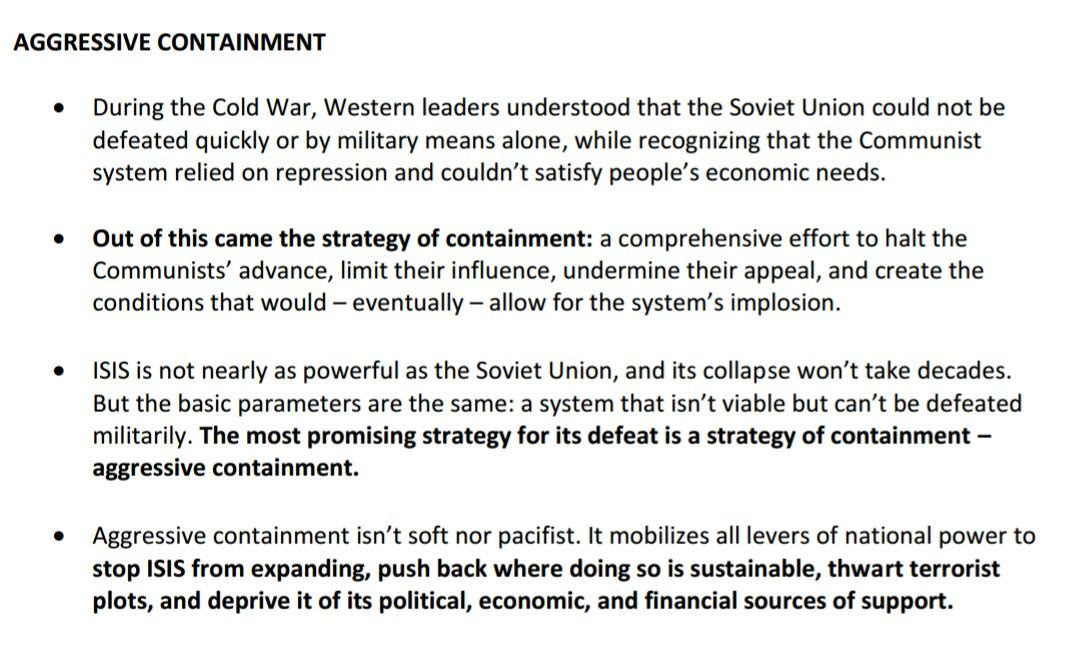
From a project Peter Neumann of King's College is working on. You can find interesting things in the "Twitterverse"
Smart and realistic: defeating ISIS through a strategy of "Aggressive Containment"
The debate over NSC-68 might have sputtered out and the memo might have become nothing more than a historical footnote if not for North Korea’s invasion of South Korea on June 25, 1950. The attack by Moscow’s ally seemed to confirm what NSC-68 had argued, the Soviet slave state was on the march and only American military might could stop it. Truman’s nearly immediate decision to order U.S. troops to come to South Korea’s aid guaranteed a major jump in U.S. defense spending. (Truman had proposed a $13 billion defense budget for FY 1951; it ended up ballooning to $58 billion.) With cost no longer an obstacle, NSC-68 became official policy. As Acheson later observed, “Korea saved us.”
Historians might debate Acheson’s claim—and some have. They might also debate whether NSC-68 correctly gauged Soviet intentions and actions, or exaggerated the Soviet threat and exposed the United States and the rest of the Free World to needless conflicts and crises. What isn’t in dispute is that the blandly named “United States Objectives and Programs for National Security” set the basic guidelines that would govern U.S. national security policy for four decades.
 The cover of NSC-68. (Harry S. Truman Library and Museum)
The issues that face us are momentous, involving the fulfillment or destruction not only of this Republic but of civilization itself. They are issues which will not await our deliberations. With conscience and resolution this Government and the people it represents must now take new and fateful decisions.