Showing posts with label Kim Jong-un. Show all posts

Saturday, April 7, 2018

[Washington Talk] North Korea denuclearization solution ...

Ambassador Joseph DeTrani and I participated in a 20 minute talk show "Washington Talk" with host Eunjung Cho produced by the Voice of America.  This is broadcast in both South Korea and north Korea and the target audience is the elite in Pyongyang.  

Unfortunately I do not think we solved the denuclearization problem. :-)

The video is in English with Korean subtitles and is at this link:

[Washington Talk] North Korea denuclearization solution ...

​​
Washington tackles a weekly analysis of North Korean hot issues with Washington experts. This week, we will examine whether the US and North Korea will be able to find contacts in the denuclearization law, and analyze the meaning of Korean art troupes' Pyongyang performances.

Wednesday, March 28, 2018

ICAS Event on C-SPAN: U.S.-North Korea Talks

This event for the Institute of Corean American Studies took place yesterday on Capitol Hill.  Dr. Taro O and I had to do an impromptu talk in place of the Honorable Mary Beth Long who could not make it at the last minute.  My remarks are first followed by Dr. O and the William Brown and Larry Niksch.  

Edward Luttwak followed with a talk (at the 1 hour mark) on how unprepared is the ROK government and military based on his four visits to the Peninsula since Jimmy Carter was President.  I have never heard such a disrespectful presentation that was extremely insulting to not only our allies but also to every US commander in Korea since Jimmy Carter.  Needless to say I was incredulous when I heard his presentation.

Last to speak is Tong Kim (at the 2:04 mark).  He is a career State Department translator who has spent decades translating for our senior most US officials to include our Presidents in north and South Korea.  He accompanied Secretary Albright to north Korea, among other trips to Pyongyang.  He has met more senior north Korean officials than any American.

U.S.-North Korea Talks A group Korean Peninsula analysts shared their views and insights on the strategies President Trump and North Korean leader Kim Jong-Un can bring to their meeting scheduled for later in the spring. The panelists also gave a historic perspective of previous U.S.-North Korean talks and what some of the drawbacks can be when negotiating with the North Korean regime. close 


PEOPLE IN THIS VIDEO

  • William BrownFellowInstitute for Corean-American Studies
  • Sang Joo KimSenior Fellow & Executive V.P.Institute for Corean-American Studies
  • Synja KimPresidentInstitute for Corean-American Studies
  • Tong KimFellowInstitute for Corean-American Studies
  • Edward N. LuttwakConsultantDepartment of Defense->Office of Net Assessment
  • David S. MaxwellFellowInstitute for Corean-American Studies
  • Larry A. NikschFellowInstitute for Corean-American Studies
  • Tara OSpecialistCenter for Strategic and International Studies->Pacific Forum Asia Policy
Fewer People 

HOSTING ORGANIZATION

Thursday, April 7, 2016

Kim Jong-un: The Unauthorized Biography (Documentary on You Tube)

An hour long documentary on north Korea recently published on YouTube.  Some interesting footage and analysis.  

I was interviewed for this documentary about a year ago and it also includes others such as Dr. Victor Cha, Kieth Luse,  and Ambassador Joe DeTrani.

This was produced by a European documentary team (based in France).  It covers a lot of ground from Kim Jong-un's schooling to Jang Sang Taek's execution and much more.

I am not sure where the idea that Kim Jong-un is grooming his sister for succession came from.


Wednesday, December 31, 2014

South Korean to drop Sony film into North by balloon


For all the hype on the movie and getting it into north Korea I hope people realize that this is absolutely no substitute for what is really needed in terms of a sophisticated Psychological Operations effort to undercut the legitimacy of the regime without undercutting the personal identifies of the north Korean people.  While this is a feel good for us in terms of the humor and insults to Kim Jong-un we must understand that a sustained sophisticated PSYOP effort is necessary to both support resistance as well as help prepare the people for unification.  We should be under no illusion that this film will do either or both.  It will not by itself.  That said, the north's actions toward the movie will make a bigger contribution to undercutting its legitimacy  and that is why I support getting the movie into the north.  But the movie itself is going to have little long term impact because it is not the appropriate vehicle to influence the key target audiences of the north Korean second tier leadership and the general population.  But the PSYOP campaign that is necessary must be based on thorough target audience analysis and understanding the Korea culture in general both historical and contemporary.  Even Juche cannot be ( or should not be) directly attacked or satirized but instead must as an example be shown to be an irresponsible adaptation of Korean culture in order to show that there there are underlying cultural continuities between north and South and there are more similarities at the fundamental cultural level than there are differences at the more superficial levels (e.g. the two Korean "miracles - the one on the Han (i.e., South Korean people thriving on the opportunity a free political system and open market economy) and the one on the Taedong (i.e., north Korea people surviving 60+ years of oppression and extreme adversity).  But a film like the Interview cannot get to that level of subtlety and sophistication (and of course it its defense it is not meant to - but that is why we need to focus on a real PSYOP campaign (that is focused on supporting President Park's Dresden Initiative for Koran unification) and not be taken in by our western emotional response to this movie and the mirror imaging analysis that we are unwittingly conducting, i.e., if this movie makes us despise Kim Jong-un then the north Korean people will despise him as well).


South Korean to drop Sony film into North by balloon


By HYUNG-JIN KIM
The Associated Press
Published: December 31, 2014
Balloons to North Korea
On Oct. 10, 2014, anti-North Korea activists launch balloons containing anti-Pyongyang leaflets into the North from South Korea.
MOD DIGITAL VIDEO SCREENSHOT

RELATED

SEOUL, South Korea — A South Korean activist said Wednesday that he will launch balloons carrying DVDs of Sony's "The Interview" toward North Korea to try to break down a personality cult built around dictator Kim Jong Un.
The comedy depicting an assassination attempt on Kim is at the center of tension between North Korea and the U.S., with Washington blaming Pyongyang for crippling hacking attacks on Sony Entertainment. Pyongyang denies that and has vowed to retaliate.
Activist Park Sang-hak said he will start dropping 100,000 DVDs and USBs with the movie by balloon in North Korea as early as late January. Park, a North Korean defector, said he's partnering with the U.S.-based non-profit Human Rights Foundation, which is financing the making of the DVDs and USB memory sticks of the movie with Korean subtitles.
Park said foundation officials plan to visit South Korea around Jan. 20 to hand over the DVDs and USBs, and that he and the officials will then try to float the first batch of the balloons if weather conditions allow.
"North Korea's absolute leadership will crumble if the idolization of leader Kim breaks down," Park said by telephone.
If carried out, the move was expected to enrage North Korea, which expressed anger over the movie. In October, the country opened fire at giant balloons carrying anti-Pyongyang propaganda leaflets floated across the border by South Korean activists, trigging an exchange of gunfire with South Korean troops.
But it is not clear how effective the plan will be, as only a small number of ordinary North Korean citizens are believed to own computers or DVD players. Many North Koreans would not probably risk watching the movie as they know they would get into trouble if caught. Owning a computer requires permission from the government and costs as much as three months' salary for the average worker, according to South Korean analysts.
Not everyone supports sending balloons into the North, with liberals and border town residents in South Korea urging the activists to stop. North Korea has long demanded that South Korea stop the activists, but Seoul refuses, citing freedom of speech.
Park said the ballooning will be done clandestinely, with the pace picking up in March when he expects the wind direction to become more favorable.
Calls to the Human Rights Foundation on Wednesday were not immediately answered. The foundation says on its website that it works with North Korean defectors to use hydrogen balloons to send material across the border, as well as smuggling items through China and broadcasting radio transmissions to reach those who own illegal short wave radios.

Saturday, November 8, 2014

North Korea frees detained US men Miller and Bae

As I am sure every knows our citizens have been released.  Here is my initial assessment.

Short answer is I wonder what agreements have been made behind the scenes - we should never forget that north Korea conducts blackmail diplomacy and every action (provocation or illegal detention of Americans) is designed to obtain political and economic concessions.

It is surprising the DNI was chosen for this but that was probably the compromise; e.g., someone of sufficient stature that allows the regime to say that the Americans came to Korea to kowtow for the release of its "criminals."  It will be interesting to read the propaganda in KCNA over the next few days.  But the DNI may only be the visible concession.  The question is what is happening behind the scenes.

The alternative story could be along two lines.  The Administration's policy of strategic patience has backed the north against the wall and they are forced to make some kind of concessions to try to restart dialogue, thus the reason of the release.  Or the UN Commission of Inquiry's report on north Korean human rights atrocities (which is unprecedented) has forced them to do something to make them look better in the eyes of the international community (but which it has never cared about in the past and has never influenced its past decision making).

So there are basically three explanations.  I do not think the regime has changed so therefore I am skeptical about the second and third explanations above and I think that the north may very well have received some kind of political and economic concessions in response to its continued blackmail diplomacy.  I just do not think the DNI coming to get our Americans is enough. It was important to achieve the release but there is likely more behind the scenes.

V/R
Dave

8 November 2014 Last updated at 11:48 ET

North Korea frees detained US men Miller and Bae
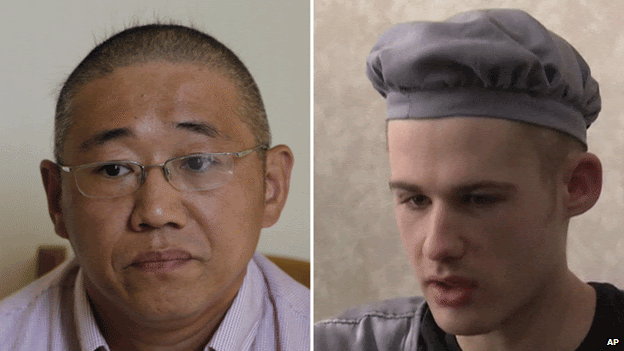
Kenneth Bae and Matthew Miller, file pix
Kenneth Bae (left) had been held for two years and Matthew Miller for seven months
Two Americans who were being held in detention in North Korea, Matthew Todd Miller and Kenneth Bae, have been released and are on their way home.
US Director of National Intelligence James Clapper travelled to North Korea and is accompanying the men back, the US has confirmed.
A third US citizen, Jeffrey Fowle, was freed last month and no Americans are now being held in North Korea.
US President Barack Obama said he was "grateful" for their safe return.
He said it was "a wonderful day" for the men and their families.
The US had accused North Korea of using its citizens as pawns in a diplomatic game. Pyongyang denies the accusations.
'Hostile acts'
Mr Clapper travelled to North Korea for direct talks with the authorities.
Mr Obama said: "I appreciate the director doing a great job on what was obviously a challenging mission."
The BBC's Charles Scanlon says that the contact will lead to hope of a breakthrough in the long diplomatic deadlock between the two sides.
The US department of state said in a statement that it "welcomes the release of US citizens Kenneth Bae and Matthew Todd Miller from the DPRK [North Korea], where they have been held for two years and seven months, respectively".
Jeffrey Fowle, an American detained in North Korea.
Jeffrey Fowle, who reportedly left a Bible in a toilet, flew home in October
It added: "The United States has long called on DPRK authorities to release these individuals on humanitarian grounds. We join their families and friends in welcoming them home."
The son of Kenneth Bae told Reuters: "It's awesome. Couldn't be happier."
One US official told Associated Press news agency that nothing was offered in return for the releases.
The official said that the releases had not changed the US view of North Korea's nuclear programme and that the North should show a serious commitment to denuclearisation and improved human rights.
The US thanked Sweden, which serves as the US protecting power in North Korea, for its efforts in the releases.
Mr Miller, 24, had been sentenced to six years' hard labour in September for what North Korean state media described as "hostile acts".
He had been in custody since 10 April when, according to North Korean sources, he destroyed his tourist visa and demanded asylum.
Mr Bae, 42, had been arrested in November 2012 as he entered the north-eastern port city of Rason, a special economic zone near North Korea's border with China.
He has been described as both a tour operator and Christian missionary. North Korea said he used his tourism business to form groups to overthrow the government.
He was sentenced to 15 years' hard labour in May 2013.
Jeffrey Fowle flew home to the US last month following negotiations.
Mr Fowle, 56, had entered North Korea in April and was detained in early June as he was leaving the country. He was charged with "anti-state" crimes.
He was reported to have left a Bible in the toilet of a restaurant in the northern port city of Chongjin.

Sunday, October 5, 2014

'No problem at all' for North Korea leader Kim's health, says official

Of course we would not expect the answer to be anything other than this. However, I wonder what the answer would be if the question of "who is really in command in north Korea?" was asked.  There is a real danger that this visit to the South could mean that the Kim Jong-un may not have full control and thus there is the potential for instability which can be a real danger to the ROK, the alliance and the region.  Or it could mean that there is an opportunity to exploit that situation if the ROK can deal with the right people who have the potential to rise to power.  The ideal situation (other than a desire to peacefully unify by the north) would be for a new leader to emerge who would seek the 5 R's:  respect, reconciliation, reform, rebuilding, and reunification (R5).  But on the other hand Kim Jong-un may be in full control and this is simply a new page to the Kim Family Regime playbook - while the tactics and operational approach may change the ends/vital interests/strategic objectives of the regime have not.  We need to be cautious so we "won't get burned again" yet agile and flexible enough to exploit any opportunities that may arise from the situation in Pyongyang.  Again, not to beat a dead horse but President Park has positioned herself and her government to be agile and flexible with the right policy foundations and initiatives:  Dresden Initiative, Trustpolitik, the Northeast Asia Peace and Cooperation Initiative (NAPCI) all resting on the strength and capability of a strong military deterrent force in the ROK/US Alliance that is prepared for any contingency that might arise from any of the paths that could lead to unification:  peaceful unification based on mutual consent, internal resistance leading to a new nK leader who seeks unification (R5 above), catastrophic regime collapse, or the worst case, war.
 

'No problem at all' for North Korea leader Kim's health, says official

SEOUL Sat Oct 4, 2014 10:16pm EDT
North Korean leader Kim Jong Un visits the October 8 Factory in this undated photo released by North Korea's Korean Central News Agency (KCNA) in Pyongyang August 31, 2014. REUTERS/KCNA
North Korean leader Kim Jong Un visits the October 8 Factory in this undated photo released by North Korea's Korean Central News Agency (KCNA) in Pyongyang August 31, 2014.

CREDIT: REUTERS/KCNA


(Reuters) - A senior North Korean official on a rare visit to South Korea has denied reports that the country's young leader Kim Jong Un is ill, saying there is "no problem at all," a South Korean minister said on Sunday.
Speculation that Kim's unusually long absence from public view may be due to ill health was fueled by a North Korean TV report that he was suffering from "discomfort," which was regarded as an implicit acknowledgement that he was sick.
Kim, 31, who is frequently the centerpiece of the isolated country's propaganda, has not been photographed by state media since appearing at a concert alongside his wife on Sept. 3.
"I said to Secretary Kim Yang Gon while in a car there was a report that (Kim Jong Un) was in 'discomfort' and asked him how was his health, and Secretary Kim said there was no problem at all," South Korea's Unification Minister Ryoo Kihl-jae told KBS television on Sunday.
Kim Yang Gon is a senior official of the North's ruling Workers' Party and a long time aide close to the North's leaders who was part of a high-level delegation that made a surprise visit to the South on Saturday.
Ryoo is South Korea's main policymaker on inter-Korean affairs and was host to Kim, Hwang Pyong So, a top military aide and confidant to Kim Jong Un who headed the delegation, and Choe Ryong Hae, another close adviser to the leader.
North and South Korea agreed on Saturday to resume reconciliation talks after Pyongyang sent its most senior delegation ever to its neighbor at just 24 hours' notice.
Kim Jong Un had been seen walking with a limp since an event with key officials in July and in a pre-recorded documentary broadcast by state media in late September appeared to have difficulty walking.
Kim has rapidly gained weight since coming to power after his father died of a heart attack in 2011, photos released by state media show.
North Korea observers speculate Kim's weight and family background may have contributed to his condition.
(Reporting by Jack Kim and Yang Kahyun; Editing by Jeremy Laurence)

Tuesday, September 30, 2014

U.S. says it has 'no confirmation' of rumors of military coup in N. Korea

This kind of speculation is to be expected when Kim is not seen for days.  

However, I wonder if the ROK/US Alliance would be ready to exploit the situation if there was a military coup.  Do we have a plan in place to make immediate contact with a new leader?  What would be the ROK message, the US message or the Alliance message? Who would reach out first and how?  What would be our public policy statements?

If such a coup happened it could obviously be a game changer but perhaps only if we were prepared to exploit it.  This would especially be the case of the coup leader was leading a resistance organization that would seek reconciliation with the ROK.

The bottom line is would the Administration be ready for the proverbial 3am wake up call if a coup really happened?

 U.S. says it has 'no confirmation' of rumors of military coup in N. Korea

2014-09-30 06:30
   The United States said Monday it cannot confirm rumors of a military coup in North Korea that have spread widely amid growing questions about leader Kim Jong-un's prolonged absence from public view.

   Kim has not been seen in public for nearly a month, leading to rumors that a military coup has broken out in North Korea and Kim has been arrested. Other rumors have it that Kim suffered a sort of stroke just as his late father, Kim Jong-il, did in 2008.

   "I can just say that I have no confirmation of the reports. We've seen them, but we don't have any confirmation," State Department spokeswoman Jen Psaki told reporters after a regular briefing. She declined to discuss the issue any further.

   The rumors of a coup spread quickly on Weibo, China's version of Twitter.

   The Global Times, run by China's ruling Communist Party's mouthpiece the People's Daily, carried a commentary on its edition earlier Monday, criticizing Chinese Internet users for spreading "false" rumors of a coup in Pyongyang.

   North Korea is one of the most closed nations in the world, with no freedom of speech or press, and it is extremely hard to determine what is going on inside the communist nation.

   Speculation has also been rife that the young leader, in his early 30s, may have a health problem, as recent video footage released by the North shows him walking with a limp. Sources said Kim could be suffering from gout due to his poor management of health and family traits.

   The health of North Korea's leader is a focus of intense media attention because it is believed to be linked closely to the country's fate. The current leader took over after his father died in 2011 in communism's second hereditary succession of power.

   Analysts said Kim's health problem would be a minor one, considering the country's rare admission of a health issue of its leader. In the North's video footage where Kim is seen limping, the narrator lauded him for trying to improve the livelihoods of the people even though he is "unwell."

   It was believed to be the first time Pyongyang's state media have acknowledge a leader's health problem.

   "They feel relaxed enough to admit publicly that he has some health issues," said John Merrill, an analyst at the Center for Strategic and International Studies, during a Brookings Institution seminar on inter-Korean relations.

   "This is, again, something that's new. I don't know anything for sure about what specific issues are or how bad the condition is, but I suspect that it's probably minor," he said.

   Shin Gi-wook, director of Stanford University's Shorenstein Asia-Pacific Research Center, also said that he is less concerned about Kim's health because Kim is still young.

   "I don't think he'll die anytime soon," he said.

   Shin said, however, that Kim's frequent change in military leaderhip is a cause for concern, referring to the North's recent removal of Choe Ryong-hae as vice chairman of the National Defense Commission.

   "Choi Ryong-hae was number two in that position only like for what, six months? Very short," the analyst said. "In any country, not only in North Korea, but any country, if you change the number two guy so soon that means something."

   By Chang Jae-soon
   WASHINGTON, Sept. 29 (Yonhap)
   jschang@yna.co.kr
(END)

Friday, April 4, 2014

North Korea tells world 'wait and see' on new nuclear test

I guess the secret is out.  Now the north knows.  I want to know if "hell bent" describes ways or means in strategy!

"The U.S. is hell bent on eliminating the DPRK politically, isolating DPRK economically and annihilating the DPRK militarily," Ri told reporters. "There is a great question mark why the U.S. is hell bent on increasing the tension, ignoring the DPRK proposals, very important for peace and security."

North Korea tells world 'wait and see' on new nuclear test

UNITED NATIONS Fri Apr 4, 2014 7:22pm EDT
North Korean leader Kim Jong Un addresses commanding officers of the combined units of the Korean People's Army (KPA) in this undated photo released by North Korea's Korean Central News Agency (KCNA) in Pyongyang April 2, 2014. REUTERS/KCNA
North Korean leader Kim Jong Un addresses commanding officers of the combined units of the Korean People's Army (KPA) in this undated photo released by North Korea's Korean Central News Agency (KCNA) in Pyongyang April 2, 2014.
CREDIT: REUTERS/KCNA
(Reuters) - North Korea said on Friday that the world would have to "wait and see" when asked for details of "a new form" of nuclear test it threatened to carry out after the United Nations Security Council condemned Pyongyang's recent ballistic missile launch.
North Korea fired two medium-range Rodong ballistic missiles into the sea on March 26. Its first firing in four years of mid-range missiles that can hit Japan followed a series of short-range rocket launches over the past two months.
Members of the Security Council on March 27 condemned the move as a violation of U.N. resolutions and that it would continue discussions on an "appropriate response.
North Korea (DPRK) reacted on Sunday with a threat to conduct what it called "a new form of nuclear test.
"The DPRK made it very clear, we will carry out a new form of nuclear test. But I recommend you to wait and see what it is," North Korea's Deputy U.N. Ambassador Ri Tong Il said on Friday during the normally reclusive state's third U.N. news conference this year.
Ballistic missile launches are banned under U.N. Security Council resolutions adopted in response to North Korea's multiple nuclear tests and rocket firings. The council expanded its existing sanctions after Pyongyang's February 2013 atomic test, its third nuclear detonation since 2006.
The Security Council's sanctions on Pyongyang target the country's missile and nuclear programs and attempt to punish North Korea's reclusive leadership through a ban on the export of luxury goods to the country.
Ri accused the United States of being "hell bent on regime change" in North Korea by blaming its leaders for human rights violations. He also said Washington was blocking a bid for the denuclearization of the Korean peninsula by ignoring North Korean proposals, so it can maintain military presence in the region.
U.S. 'GOING AROUND CRAZY'
"The U.S. is hell bent on eliminating the DPRK politically, isolating DPRK economically and annihilating the DPRK militarily," Ri told reporters. "There is a great question mark why the U.S. is hell bent on increasing the tension, ignoring the DPRK proposals, very important for peace and security."
A U.S. diplomat said that Washington had long made clear that it was open to improved relations with North Korea if Pyongyang lived up to its international obligations.
"North Korea's nuclear programs will not make the country more secure. The only way for North Korea to achieve the security and prosperity it seeks is by complying with its international obligations and commitments," the diplomat said.
Nuclear expert Jeffrey Lewis, director of the East Asia Nonproliferation Program at the Monterey Institute of International Studies in the United States, said North Korea's reference to a new form of nuclear test could mean simultaneous detonation of two or more devices as part of a program of more intense testing expected over the next few years.
Lewis said he thought it unlikely North Korean leader Kim Jong Un would move for the moment from underground to atmospheric testing - something he might do to demonstrate an ability to deploy nuclear armed missiles or artillery - for fear of inflaming Chinese public opinion.
"He's only likely to do that ... if he no longer cares what Beijing thinks," Lewis said. "Still, it is useful to remember that Kim Jong Un has a number of other unpleasant provocations from which he might choose."
(Continued at the link below)

Giving Tuesday Recommendations

  Dear Friends,  I do not normally do this (except I did this last year and for the last few years now, too) and I certainly do not mean to ...