Showing posts with label ROK Army Special Warfare Command. Show all posts

Saturday, August 29, 2015


General Baek Kun-ki is my old commander at the Special Warfare Command/Combined Unconventional Warfare Task Force (CUWTF).  I also worked with him when he was the G3 of CUWTF.

I have not spoken with him in a few years but I hope he recalls all our unconventional warfare discussions in the 1990's.  Dialogue can be a very important tool for assisting in internal regime change as I outlined in my 2004 strategy(Can be downloaded here https://db.tt/9T8Ak32N)  Summary is below (note that this was written in 2003-2004 when the state of the ROK/US Alliance was not at its best, thus requirement for "repair of the alliance - and of course the "Korea Questions" is the phrase from the 1953 Armistice Agreement, para 60, that recognized the Korea question as the unnatural division of the peninsula and must be solved for their to be lasting peace):

This paper proposes a long term ROK-US combined security strategy to work toward resolution of the “Korea question”: Comprehensive Engagement with Strength: Partner and Prosper.  It establishes a long term end state toward which all efforts will focus.  It provides a framework that allows management of the current and future crises while simultaneously allowing the ROK and US to identify opportunities stemming from current and future emerging crises that will support achievement of the long term end state.  . 

Key Points:

·      Ensure that an effective defensive capability remains in place until the “Korea Question” is resolved

·      Method for developing a combined strategy

(1) Consultations at the political and military level between the ROKG and USG. 
(2) Increased high level contacts. 
(3) Establishment of a combined planning group (Korea Strategy Group (KSG)) with permanent NSC level members that meet on a rotating basis in Washington and Seoul.

    • Repair the alliance: This will take a concerted effort by the President and senior US leadership.  Must come to agreement on the divergent ROK and US policies (sunshine policy versus regime change).  They are not mutually exclusive if you do not use the Iraq/Afghanistan models for regime change. 

    • Proposed mutually acceptable strategic end state: A stable, secure, peaceful, economically vibrant, non-nuclear peninsula, reunified under a liberal constitutional form of government determined by the Korean people.

            This end state implies regime change.  But it must come from within.  Most importantly while the US desires regime change it has not prepared for it.  Fundamental to the strategy is that near term crises must be managed (and exploited for possible opportunities) while it prepares the foundation for a post Kim Family Regime era.

General-turned-lawmaker calls for more dialogue between two Koreas

Despite the military background, Baek firmly believes in the power of dialogue to solve problems on Korean Peninsula
August 28th, 2015
0
   
South Korean lawmaker Baek Kun-ki, one of leading lawmakers of the New Politics Alliance for Democracy (NPAD), notes a sharp drop in dialogue between the two Koreas since 2008.
According to his data, meetings between the two Koreans in the fields of politics, military, economic development, humanitarian aid, society and culture dropped from 171 during former President Roh Moo-hyun’s term (2003-2008) to 21 times during President Lee Myung-bak’s era and 32 times in 2013-2014 under incumbent President Park Geun-hye’s administration.
“Sun Tzu’s book The Art of War book emphasizes the importance of winning the battle without bleeding from either side,” he told NK News. “War inevitably brings massive direct and collateral damage to both sides. The mental and physical damage that the Korean War has inflicted on us is still unhealed and unsolved, as was shown in the recent conflict caused by North Korea’s provocation.”
Despite his prominent military background, particularly as a former four-star commander of the Third ROK Army, he strongly promotes the power of dialogue.
“The wound that the Korean War left on our society will be healed in time when our future generations get to be the leaders of Korea. If another Korean War occurs between us, the Korean Peninsula will once again be forced to live in pain and agony for centuries. That is why we have to emphasize the need for more talks, and now is the perfect time for it.”
As much as he emphasized the need for more dialogue, he firmly believes in the military readiness of South Korean troops to maintain peace on the Korean Peninsula. Being the member of National Defense Committee of the National Assembly, he has been one of most active lawmakers in prioritizing national defense.
“National defense and peace are like two sides of a coin, they always come in pairs and one can’t stand without another. The NPAD and National Defense Committee are struggling day to day to find out what is best for our troops so all of Korea may live in peace.”
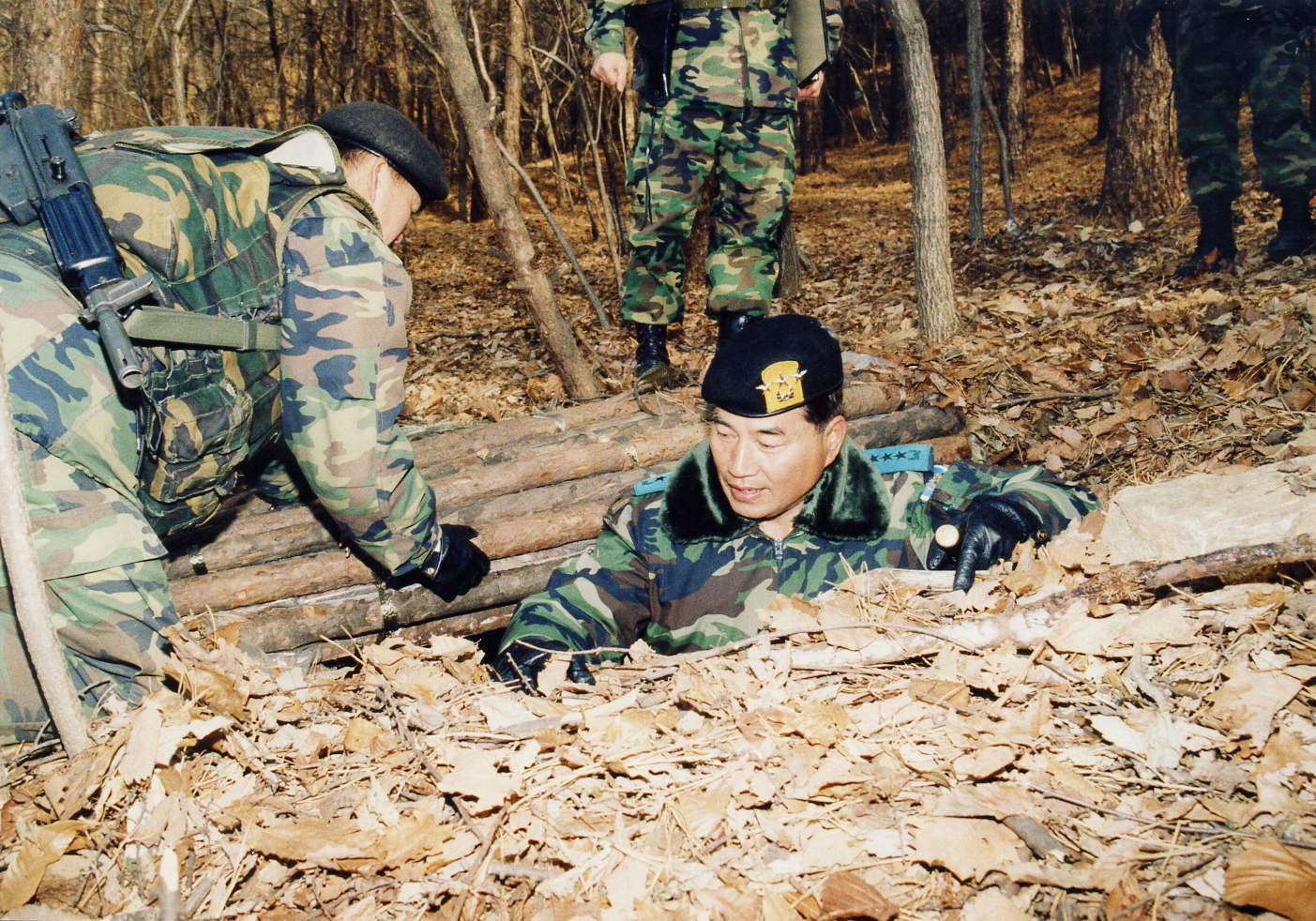
특전사령관 비트
Baek Kun-ki during his time as commander of the Republic of Korea’s Special Warfare Command. Courtesy of Baek’s office
(Continued at the link below)

Tuesday, June 24, 2014

Ban Seok Choi: A Soldier’s Reflection on South Korea’s Contribution to Global Peacekeeping Operations

Two things about this from a rank and file ROK Army Special Forces soldier:

1) it is a very candid critique of the ROK Army, with an admission of racial bias.  Yes this exists.  But the important thing in this is that a former soldier recognizes this and is willing to write about it.  Although I cannot prove this it has been my experience over the past 3 decades of working in Korea that the US "after action review" process used in a combined environment has had an effect on the ROK military and has reduced some of the Confucian based mindset that often prevents self-criticism.  I have seen many ROK soldiers and officers critically evaluate performance during training exercises and I would bet this soldier experienced that.  That does not mean that the Confucian ethic still does not prevail; in many cases it still does. However, exposure to our AAR process over the past few decades has likely had a positive effect (again at least in my anecdotal experience)

2) Note his comments about assessment and preparation.  This will be especially important when dealing with north Korea in either a post-regime collapse or post-conflict situation.  Every ROK peacekeeping operation around the world will contribute in some way (some small and some large) to the ROK military's ability to prepare for what comes next in north Korea.


Ban Seok Choi: A Soldier’s Reflection on South Korea’s Contribution to Global Peacekeeping Operations

ROK-UNMISS-PKOUnited Nations peacekeepers from South Korea secure an airport in Bor on March 15, 2014 (Andreea Campeanu/Courtesy: Reuters).

Share

0Share
1Tweet
Ban Seok Choi served as part of the UN Peacekeeping Force in South Sudan with the South Korean military. He finished his military service—which is mandatory for South Korean men—earlier this month.
During my military service, I had ample opportunity to experience how South Korea contributes to global security by being dispatched as part of the UN Peacekeeping Force in South Sudan. The First Contingent of the Republic of Korea’s Horizontal Mechanical Engineering Company (ROK HMEC) was dispatched in March 2013 and returned to Korea in October the same year. It paved an amicable relationship between the two nations by launching civil-military cooperation. The unit has also provided medical treatment and has supported the country’s reconstruction by constructing flood-control conduits and reconstructing the local road system.
I was deployed with the Second Contingent. As an airborne paratrooper of the ROK Army Special Operations Command, I was dispatched as the force protection unit. Our main objective in the field was to secure our base and the UN Mission in South Sudan (UNMISS) compound in Bor, as well as to protect the ROK HMEC, which was tasked with reconstruction tasks by the UN.
The December 15, 2013 coup attempt organized by South Sudanese former vice president Riek Machar highlighted ROK HMEC’s ability to adapt to different situations. Handling crucial matters such as treating critically ill patients, supplying internally displaced persons (IDPs) with water and food, and handling the deceased in a quick, calm way demonstrates that the ROK military can contribute to peacekeeping activities in volatile situations. Moreover, provision of safe shelters for the United Nations Police, Military Liaison Officers, and other key members of the United Nations and the UNMISS within our compound is further proof of the safety within the boundaries of the Korean compound.
Despite successes in compound fortification and assistance to refugees and IDPs, some aspects of the ROK military activity in South Sudan should be discussed further. When foreigners were asked to evacuate the country, it was the ROK HMEC that facilitated most of the foreigner evacuation operation in the Bor area. However, I witnessed an incident regarding the issue of racial discrimination on the part of ROK soldiers who were evacuating the foreigners. While their manner of speaking English and style of dress differed from the other people, from the point of view of other South Korean soldiers the African Americans’ skin color caused them to blend with the other refugees and came to our compound, seeking protection. The South Korean forces were not friendly to them because their skin tone was similar with the domestic refugees. However, when they told us that they are Americans, we started to treat them differently from the Sudanese. We started by calling the U.S. embassy in Juba and even arranged a helicopter flight for them to evacuate. Witnessing all this as an interpreter and a primary source, I felt a little embarrassed that the ROK military is still closed-minded when it comes to race. Such a misunderstanding shows that the ROK military, if it continues to serve abroad in multiethnic settings, should be more respectful to other ethnic groups regardless of their national competitiveness.
The lack of preparedness is another area of concern about the ROK military. During the coup, the ROK HMEC lacked adequate ammunition and bulletproof vests for all personnel. Only the Force Protection Unit and some officers could outfit themselves with full gear. The Ministry of National Defense claimed that because the ROK HMEC’s primary task was to provide engineering support for reconstruction projects, rather than combat, full gear for all personnel was unnecessary. The Ministry of National Defense clearly did not expect that the operation area to which we would be deployed would face a coup. The ROK military still lacks complete ability to assess its operation area thoroughly. Moreover, because the Korean peninsula is still at war despite a long-standing armistice, ROK military’s failure to supply basic gears and dispatching an inadequately prepared contingent to a very unstable part of Africa gave me a sense of anxiety and mistrust while I was serving there. It also raises questions about South Korea’s crisis management ability of similar possible incidents on the Korean Peninsula.
The power generators are a final concern that demonstrates the inability of the ROK military to properly outfit its forces abroad. On one occasion, all three of the power generators at our compound had exploded and we were left with no power. Those power generators were made to be used indoors with a maximum sustainable temperature of 43 degrees Celsius. We—the soldiers and officers—had no trouble with the power generators during the First Contingent because it had been deployed during the rainy season. However, when the Second Contingent was deployed during the dry season, the generators could barely withstand the heat. Following the explosions of the power generators, the ROK soldiers became the victims of ROK military’s ill-preparedness, as we lost access to air conditioning and water pumps. Although we were able to purchase a new outdoor-use power generator, such poor supplies indicate the ROK military is unable to properly outfit its forces abroad.
South Korea has made the first strides to contribute to world stability. It is certainly impressive that the ROK is giving back the world despite facing war on its own northern border. However, for the South Korean contribution to global peacekeeping efforts to be effective, responsible, and safe, the ROK military must address shortcomings in supplies and assessment.
Posted in South Korea

Giving Tuesday Recommendations

  Dear Friends,  I do not normally do this (except I did this last year and for the last few years now, too) and I certainly do not mean to ...