Showing posts with label Goldwater-Nichols. Show all posts

Friday, July 6, 2018

Radical Proposal for SOF - Do Uou Want Effective Civilian Oversight?

Here is my radical new proposal.

Disband USSOCOM in Tampa.  Make JSOC a stand alone combatant command (4 star) and responsible for the CT and CP mission

Establish a new HQ for SOF  (less JSOC) in DC with a Secretary of SOF (civilian SECSOF) and a Chief of Special Operations (CSO - uniformed 4 star).  Have the new SOF HQ exercise its service like HQ responsibilities and give the new Chief of SOF a seat in the tank with the Chairman (i.e., add him to the Joint Chiefs).  Make the TSOCs 3 Star Commands and the main effort for SOF employment in theater.   I think that would realize Congress' vision in Nunn-Cohen and it would take the new Section 922 of the 2018 NDAA to its logical conclusion.

Friday, March 27, 2015

McCain Launches Goldwater-Nichols Review; How Far Will He Go?

All good questions. I wonder how far this will go?  It is notable that he is focusing on personnel management both with DOPMA and with the joint assignment process mandated by Goldwater-Nichols (which rests on the assumption that everyone has a chance to be a general/flag officer so everyone has to rotate through joint assignments) Both DOPMA and Goldwater -Nichols only allow us to pay lip service to "talent management" or maximizing the opportunity to get the right person in the right job for the right mount of time.

    • “Are the roles and missions of the Joint Staff, Combatant Commands, Joint Task Forces, and other headquarters elements properly aligned to conduct strategic planning, equip our warfighters, and maximize combat power?
    • “Does the vast enterprise that has become the Office of the Secretary of Defense further our ability to meet present and future military challenges?
    • “Does the constant churn of uniformed officers through joint assignments make them more effective military leaders, or has this exercise become more of a self-justification for a large officer corps?
    • “Is the Defense Officer Personnel Management Act of 1980 still appropriate for the joint force of 2015 and beyond, or is it time to review this law?
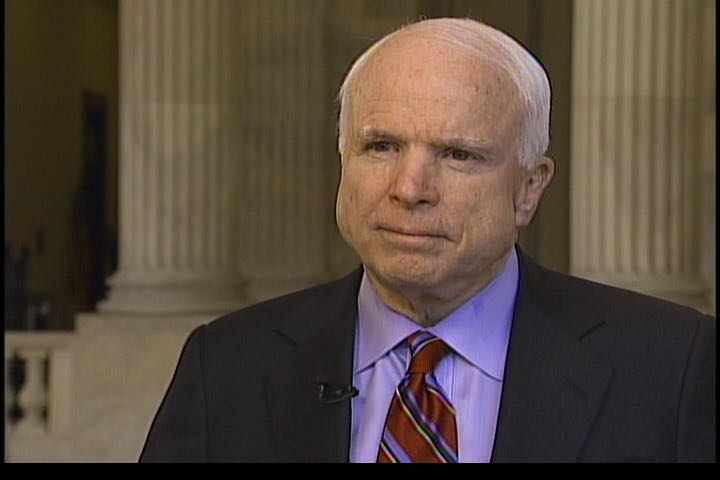
Sen. John McCain, R-Ariz., chairman of the Senate Armed Services Committee
UPDATED: With Thornberry Comment Supporting Reform
WASHINGTON: Sen. John McCain plans a long-term review of the law underpinning the modern American military, the Goldwater-Nichols legislation that created the current chain of command from president to defense secretary to combatant commanders.
“The Committee will be conducting a preliminary examination of the structure, roles, and missions of civilian and military organizations within the (Defense) Department. That will set the stage for a broader review of these issues starting after this year’s NDAA (National Defense Authorization Act) and extending into next year, many of which are tied directly to Goldwater-Nichols Act,” a congressional staff member wrote in an email after McCain spoke this morning at the Center for Strategic and International Studies.
The staffer responded to an email I sent after McCain hinted at the review during his speech.
Here’s what the chairman said at CSIS:
“At the same time, three decades later, there are real questions about how Goldwater-Nichols has been implemented and what unintended consequences may have resulted. For example:
(Continued at the link below)

Sunday, September 29, 2013

Commentary: Shut Down the US Combatant Commands Move Would Cut Redundancy, Aid Diplomacy

This should stir up some debate.
V/R
Dave

Commentary: Shut Down the US Combatant Commands

Move Would Cut Redundancy, Aid Diplomacy

Sep. 29, 2013 - 04:14PM   |  
By BENJAMIN H. FRIEDMAN and HARVEY M. SAPOLSKY   |   Comments

  • FILED UNDER
Defense News recently reported on a Pentagon plan to consolidate its six regional commands into four. The proposal would dissolve Africa Command and split it between European and Central Commands, and combine Southern Command and Northern Command. The action would shed thousands of civilian and military positions and help the Defense Department comply with the budget caps squeezing its topline. But consolidation isn’t enough. The Pentagon should close all of the commands.
Other Pentagon offices can accomplish the commands’ few important functions. The commands have become less accountable alternatives to embassies, predictable sources of threat inflation and insatiable consumers of military resources.
The 1986 Goldwater-Nichols Act, an effort to limit the military services’ independence, gave the regional commands control over deployed US forces. They plan and manage relations with foreign militaries, humanitarian assistance and war. Pacific Command deals with most of Asia. Central Command handles the Middle East and parts of South Asia, including Afghanistan and Pakistan. European Command is largely an offshoot of NATO’s headquarters. Africa, long split by Central and European Commands, got its own command in 2008 — though it still shares European Command’s headquarters. Northern Command was created in 2002 to manage the military’s homeland defense efforts, and Southern Command handles South America.
There are also functional commands dealing with strategic nuclear weapons, transportation and special operations forces, which we would keep.
There is plenty of room to trim. The regional commands collectively employ more than 15,000 military personnel, civilians and contractors. They are also flag officer magnets. Pacific Command alone has five four-star jobs, plus a full-up platoon of three-, two- and one-star generals and admirals. Each service also maintains subordinate commands to deal with the combatant commands — an additional bureaucratic layer.
(Continued at the link below)

Sunday, September 8, 2013

How Grenada reshaped the US military

A little history for students of joint operations.  Changed for THE good or changed for good?  Seems like we are returning to some inter-service (internecine) rivalry and conflict.

V/R
Dave

How Grenada reshaped the US military

Three decades ago, a tiny war changed the armed services for good.


By Phil Kukielski

 |   
  SEPTEMBER 08, 2013


American troops disembarked at the start of the invasion of Grenada on October 25, 1983.
PETER CARRETTE ARCHIVE/GETTY IMAGES
American troops disembarked at the start of the invasion of Grenada on October 25, 1983.
ON OCT. 25, 1983, the United States invaded the tiny Caribbean island republic of Grenada, a military mismatch analogous to a Goliath doing battle with a David—only with no sharp stones in the shepherd’s pouch.
Hostilities on the island were declared over within a week. The invasion is remembered today in America, if at all, as a brushfire war where the US military won a restorative victory in its first full-fledged combat since the ignominious end of the Vietnam War a decade earlier.
In subsequent years, the American military would march on to victory in Panama and in Kuwait, and then deploy for larger, much longer wars in Iraq and Afghanistan. But 30 years after the invasion of Grenada, hindsight suggests that this little war turned out in the long run to have a disproportionately large effect on the American military.
US Army medical personnel helped a wounded soldier to a helicopter at St George's University School of Medicine in Grenada.
UPI
US Army medical personnel helped a wounded soldier to a helicopter at St George's University School of Medicine in Grenada.
The victory took longer to achieve and was more costly in American casualties than it should have been because of serious flaws in how the four uniformed branches performed together in joint combat. And in key respects, how the Pentagon is structured today—how military combat commands are organized and led, how officers get to be admirals or generals, and how the military relates to the news media on the battlefield—is because of the embarrassing lessons it learned in Grenada.
A Marine officer later told an official military historian that he was more afraid of being shot at by the 82nd Airborne than he was of the Grenadian Army.
Quote Icon
Today the military has a new set of experiences under its belt. And with defense cuts looming again, it faces what many believe will be similar challenges to those of that time: how to adapt for new kinds of engagements, and ensure that all the military services, indeed all branches of government, work effectively together to plan and fight the inevitable next war. The example of Grenada suggests that productive change can, indeed, come to even a resistant, entrenched bureaucracy—but it also offers a vivid warning about what can happen when you wait to make these changes until after the shooting starts.
***
FOR MOST OF its modern history, Grenada’s principal claim to fame—besides wide, sandy beaches and a gentle climate—has been as a leading world exporter of spices, especially nutmeg. An island microstate located 100 miles off the coast of Venezuela, it has a population comparable to the city of Cambridge, Mass., and a land area equal to Philadelphia’s.
But after the nation gained its full independence from Great Britain in 1974, the tiny state played host to very volatile domestic politics. On Oct. 19, 1983, Grenadian Prime Minister Maurice Bishop, three of his cabinet ministers, and seven of his close supporters were executed by Grenadian soldiers on the orders of a hard-line faction within Bishop’s own Communist-style party. The killings plunged the country into governmental chaos, raising fears for the safety of about 1,000 Americans living on the island, including 600 US students attending St. George’s University School of Medicine.
Even before the killings, the Reagan administration had been concerned about the growing influence of Cuba and the Soviet Union on the island’s leftist government, especially the potential military uses of a new 9,000-foot commercial runway then nearing completion on Grenada by Cuban construction workers.
Asolider posed with students from the school after the invasion.
ASSOCIATED PRESS
A solider posed with students from the school after the invasion.
When the bloody coup occurred in 1983, a US Navy aircraft carrier group and a Marine amphibious unit happened to be in the Atlantic in route to the Mediterranean. The battle-ready force of 11 ships was diverted south to Grenada. A secret American-led invasion was hastily organized and launched.
An American force of more than 6,000 that included elite troops from all four uniform services was dispatched to the island. The resistance they faced was a poorly trained Grenadian Army of about 700 front-rank soldiers supported by 650 military-trained Cuban construction workers and 43 Cuban and Soviet military advisers.
In charge of the American force was Vice Admiral Joseph Metcalf III, a three-star admiral with the US Navy. H. Norman Schwarzkopf, then a two-star general in command of a Georgia-based Army division, was picked by the Pentagon to be the Army’s top liaison to Metcalf. In his autobiography, Schwarzkopf recalled feeling “about as welcome as a case of the mumps” when he reported for duty with the Navy. That feeling foretold a great deal.
(Continued at the link below)

Giving Tuesday Recommendations

  Dear Friends,  I do not normally do this (except I did this last year and for the last few years now, too) and I certainly do not mean to ...