Showing posts with label Colombia. Show all posts

Friday, July 11, 2014

(Linda Robinson Interview) Beyond Hollywood, 'Call Of Duty': Why Special Forces Are The Future Of The U.S. Military

I do have to take issue with these excerpts:

But, I want to get to this issue of the actual Special Operations themselves; you're most recent book talks about how Special Ops are the future of American warfare. And, we've been hearing this for some time that this really is the way in which we're going to be fighting our wars in the future. 

I think it is fair to say that Special Operations will make an important contribution to national security strategy but the fighting of US wars will always be done by the Army, Navy, Air Force, Marines and conventional and special operations forces.  Special operations as a way of war and special operations are certainly not war winners by themselves.  Special operations can play a role in helping others to help themselves in their wars but to say that special operations is the way of future American warfare does a disservice to both conventional and special operations forces and also imprints in the public mindset unrealistic, unsupportable, and unattainable expectations.  Small footprint with special operations working with indigenous and host nation forces is a nice concept and very useful in many cases but it and special operations are not a panacea or silver bullet and we need to be careful about implying it as such.  I know that is not what Linda Robinson means but it is obvious by the reporter's questions and the questions and comments of the press and pundits that they are implying that small footprint special operations are the answer to everything.  It should not be touted as the future of American warfare.  We do not need that kind of cheerleading for special operations.


And it pains me to read this:

So what I viewed, what was happening in Afghanistan was they were kind of recovering their roots, and going back to working with populations and also working with indigenous military forces.

This is actually counter to the discussions in this very article about Colombia, The Philippines, and East Africa where Special Forces continued since 9-11 and continue to this to operate in accordance with their "roots."


Beyond Hollywood, 'Call Of Duty': Why Special Forces Are The Future Of The U.S. Military


By  &  & TREVOR FORD
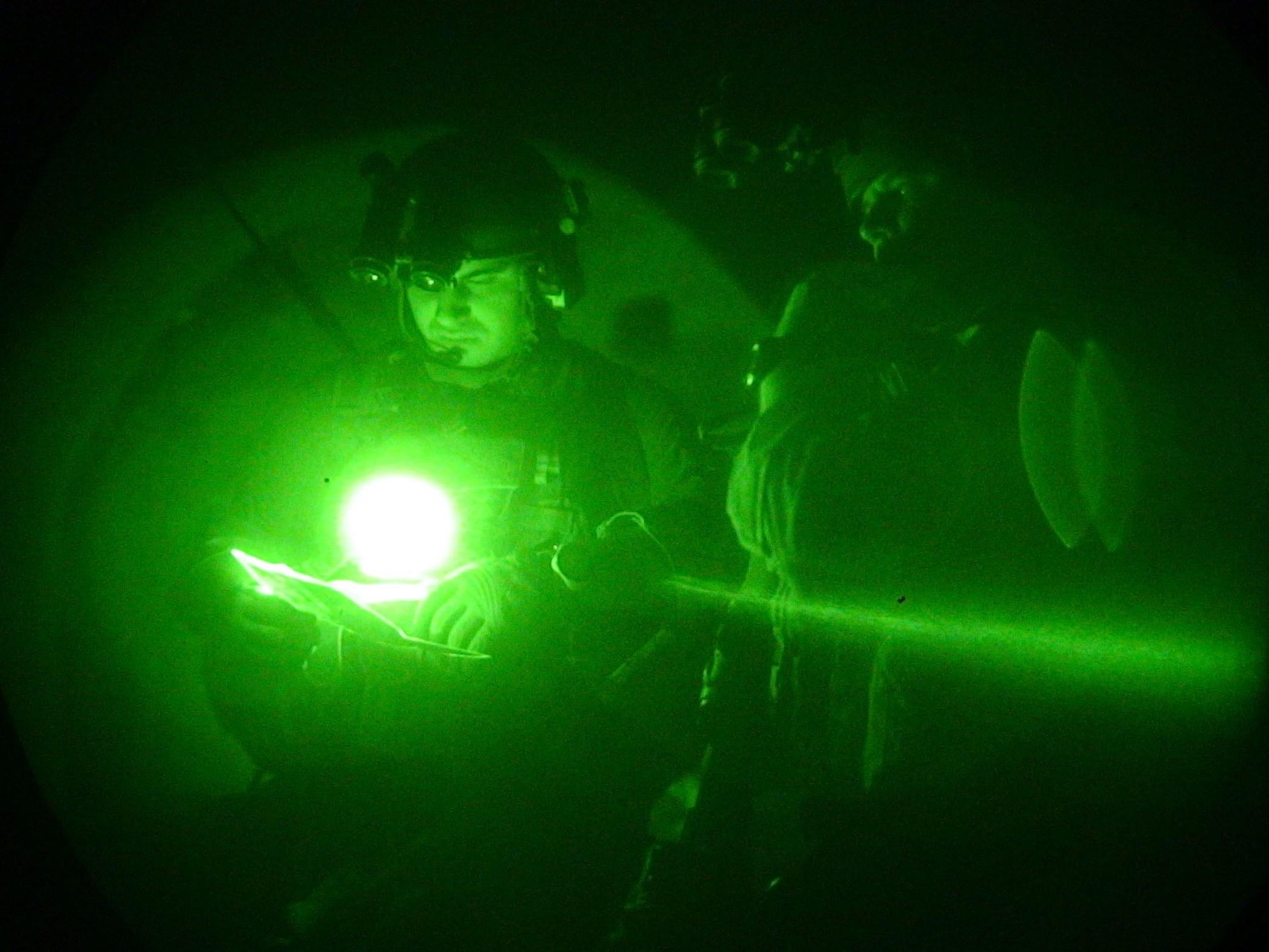
  • Soldiers from the U.S. Special Forces review map data while conducting an operation in Panjawi district, Kandahar province July 10, 2010.
    Sgt. David Russell U.S. Army
The so-called “light footprint strategy” has been a hallmark of President Obama’s military engagement strategy as he pulled U.S. troops out of Iraq and winds down the U.S. presence in Afghanistan. That drawdown of massive units of soldiers, sailors, airmen, Marines and civilian support staff means a stronger reliance on smaller, more elite military groups.
RAND Corporation senior international policy analyst Linda Robinson focuses on national security strategy and these types of units in her latest book One Hundred Victories: Special Ops and the Future of American Warfare. It covers the two years she spent embedded in Afghanistan.
14:41
Listen to Suzette Grillot's conversation with Linda Robinson.
Before the Middle East, she started her career focusing on insurgencies in Latin America. She studied and wrote about the role of U.S. Special Forces in a counter narcotics effort that eventually evolved into a true counterinsurgency against FARC rebels in Colombia.
“One officer had said, ‘Nothing has been written about us since Vietnam. Much of what was written in that era wasn’t good, so let’s take a chance on this reporter and see if she’s willing to give some in-depth research on us.’,” Robinson says.
According to Robinson, U.S. special operations have doubled in size since the September 11, 2001 attacks and the subsequent October invasion of Afghanistan. But they still operate in small numbers, and Robinson calls that the model of the future.
“About 12,000 people can be deployed around the world at any one time as a sustainable number,” Robinson says. “And some people may say, ‘Oh my gosh, that’s a lot.’ Well, if you consider it compared to 100,000-plus [the 2006 counterinsurgency] in Iraq, it’s not.”
In Afghanistan, these small units worked among indigenous populations by going into villages and seeing if residents wanted to form self-defense groups and a local government.
“They had done this in the Vietnam era, but they had gotten away from that in the years after 9/11,” Robinson says. “And that is a more long-term solution while recognizing they still do the direct action raids, but that is more of a temporary piece of the puzzle.”
FULL TRANSCRIPT
SUZETTE GRILLOT, HOST: Linda Robinson, welcome to World Views.
LINDA ROBINSON: Thank you Suzette, I'm delighted to be here.
GRILLOT: I have to start by asking what drew you to that topic, why focus on Special Forces and Special Operations?
ROBINSON: Well I did get that question a lot and I actually started my career focused on insurgencies down in Latin America. First in Central America but also in Peru, Colombia, Mexico, and elsewhere. And also the democratization issue was something I covered heavily there. But the insurgency, or small wars, issue led kind of naturally to the flip side which is counterinsurgency, what the people do when they're trying to combat an insurgency. Since that is one of the main missions for the Special Forces, I gained some entree, really first in Colombia, down in Latin America, where the Special Forces were ramping up a counterinsurgency support effort. So, the Colombians were in the lead, but US Special Forces were helping them and training them what had originally been a counter narcotics effort, morphed into a counterinsurgency effort because there were two very strong insurgencies. 40 years the FARC was the larger of the two groups in Colombia that had really grown in strength to control half of the country. So it was a good, real, first lesson for me in what Special Forces could do to help a country. And, right now, flash forward a decade or so later, Colombia is engaged in very serious peace talks with the remnants of the FARC and there is quite a strong expectation that they will be able to wrap up their war, with the negotiated accord. So, of course the Special Forces weren't solely responsible for that progress but it gave me a window into the various things that they do and I had to go through a lot of hoops to gain that access. So I spend a lot of time on doing research and attending exercises and briefings. They had really not let anyone inside to see what they do, and one officer had said, "Nothing has been written about us since Vietnam, much of what was written in that era wasn't good, so let's take a chance on this reporter and see if she's willing to really give some in depth research on us." 
GRILLOT: Well I want to get back to that issue of your access, and specifically what it is you did on the ground, you know, what that was like, spending time with the Special Forces. But, I want to get to this issue of the actual Special Operations themselves; you're most recent book talks about how Special Ops are the future of American warfare. And, we've been hearing this for some time that this really is the way in which we're going to be fighting our wars in the future. But you begin your story in this most recent book, at a time when you say that Special Forces were at a crossroads, that they were very unclear about their goals that they were unsure of their procedures and the effectiveness of those procedures. So, when was it, that it became more clear that Special Forces were going to be the way that we were going to fight wars, and what's the reason for that?
(Continued at the link below)

Sunday, June 1, 2014

Obama's counterterrorism doctrine: Let locals lead the fight

Excerpts:

But critics say America's past efforts to train local security forces have had mixed results. Washington has a poor track record of applying the long-term resources, funding and attention needed to carry out such efforts successfully.
In Libya, training by U.S. Special Forces soldiers was suspended after a local militia stole a cache of American-provided weapons. In Mali, American-trained military officers carried out a coup. And in Afghanistan, the United States failed to mount a major training effort until nine years after the fall of the Taliban.
...
Bruce Hoffman, an expert on terrorism and Georgetown University professor, said a cardinal failing of the American counterterrorism effort since 2001 has been its haphazard nature. Hoffman said the United States focused its effort on Afghanistan in 2001, shifted to Iraq in 2003, returned to Afghanistan in 2009. Now, Obama announced a shift from Afghanistan to Syria.
“It continues our pathology,” Hoffman said. “Our attention has shifted from one trouble spot to another with disastrous results.”
...
    Peter Bergen, a terrorism expert at the New America Foundation think tank, praised Obama’s address and approach. In the Philippines, he said, local commandos trained by American forces had severely weakened the Abu Sayyaf militant movement. Over the long term, training locals was far cheaper and more politically sustainable than deploying large numbers of American troops, he argued.
    "It’s pennies on the dollar,” he said. “It’s less than one percent of the defense budget.”
I find it quite amusing that Bergen cites the Philippines (and others will cite Colombia as well) because I doubt that he knows much about the Foreign Internal Defense mission conducted there.  But now it will be touted as the "model."  But people should remember that that mission started during the Bush administration (initial assessment conducted in October 2001 and campaign plan completed in November) and was built on relationships and operations from well before 9-11 and it has been conducted in accordance with basic Special Operations doctrine on to how advise and assist a friend, partner, or ally (in this case the US's longest standing treaty ally) with its internal defense and development programs to defend itself against lawlessness, subversion, insurgency, and terrorism.   All the current administration has done is allow it to continue (and it continued for such a long time with little visibility because everyone has been distracted with Afghanistan and Iraq and people like Bergen ignored it - which was a good thing for the mission).  The mission in the Philippines is nothing new and missions like it have been conducted around the world and well before 9-11.  But it is also not appropriate for every situation and the decision to conduct missions like it needs to be based on a strategy that supports US interests and requires a thorough (and continuous) assessment of the entire situation that leads to an integrated, synchronized campaign plan to support a strategy with balance and coherency among ends, ways, and means.

People like Bergen will contribute to the pathology that Bruce Hoffman outlines in which we will want to just try to apply this "model" (and the Colombian one) going from one trouble spot to another with no real strategy except to do more with less, with a small footprint and spend "pennies on the dollar" (which of course makes it sound attractive.)

The real lessons from the Philippines needs to be an understanding that the military (in particular special operations forces), the country team, to include State, Justice, the FBI, and USAID), and the IC all did their jobs in accordance with and their established roles and responsibilities and in the case of the military, its doctrine, and synchronized the actions of diplomacy, development and defense (and as an aside the so-called 3-D's was "coined" by an Ambassador, and not the military, well before it became a popular term of art).

That said the biggest and most important lesson from the Philippines (and Colombia) is the one in the title of the article: "let the locals fight."  What the Philippines and Colombia show is that we do have military forces and interagency elements that know how to operate with the host nation being in charge of their defense and not take over and dominate operations with US forces.  That is why the FID mission is the most appropriate and important mission for the future because it provides the joint and interagency framework to conduct these types of missions with the correct focus and from the right perspective; e..g., without the mission being dominated by a US presence.  Yes this is all new to people like Bergen and the administration but it is a traditional mission that has been used to good effective in history around the world (but it is not always been effective - it is NOT a silver bullet and the administration would do well not to think of it as one - but of course it is only natural to do so as that is the American way - we will always search for the silver bullet and holy grail rather than realize that such problems require synchronized and integrated campaigns to support effective strategy and presence, patience, and persistence).


Obama's counterterrorism doctrine: Let locals lead the fight
Sat, May 31 21:29 PM IST

image
By David Rhode
NEW YORK (Reuters) - In a foreign policy address this week, U.S. President Barack Obama gave his clearest outline yet of his counterterrorism strategy. Al Qaeda splinter groups remain the largest threat to the United States, he said, but Washington must respond to it in a new way: by training local security forces, not deploying American ground troops.

   “We have to develop a strategy that matches this diffuse threat - one that expands our reach without sending forces that stretch our military too thin, or stir up local resentments,” Obama said. “We need partners to fight terrorists alongside us.”

But critics say America's past efforts to train local security forces have had mixed results. Washington has a poor track record of applying the long-term resources, funding and attention needed to carry out such efforts successfully.

In Libya, training by U.S. Special Forces soldiers was suspended after a local militia stole a cache of American-provided weapons. In Mali, American-trained military officers carried out a coup. And in Afghanistan, the United States failed to mount a major training effort until nine years after the fall of the Taliban.

Finding the effective partners Obama described has proven challenging as well. For years, the United States has struggled to get Saudi Arabia, Qatar and Turkey to coordinate their support to Syria’s panoply of rebel factions. And the kidnapping of 200 Nigerian school girls in April exposed the inability of American officials to get the Nigerian government to address the endemic corruption that helps fuel the al Qaeda splinter group Boko Haram.

Bruce Hoffman, an expert on terrorism and Georgetown University professor, said a cardinal failing of the American counterterrorism effort since 2001 has been its haphazard nature. Hoffman said the United States focused its effort on Afghanistan in 2001, shifted to Iraq in 2003, returned to Afghanistan in 2009. Now, Obama announced a shift from Afghanistan to Syria.

“It continues our pathology,” Hoffman said. “Our attention has shifted from one trouble spot to another with disastrous results.”

In his address on Wednesday, Obama unveiled a $5 billion “Counterterrorism Partnerships Fund” to train local forces in the Middle East and Africa and voiced support for increasing American training and assistance to “moderate” Syrian rebels. "A strategy that involves invading every country that harbors terrorist networks is naïve and unsustainable," he said.

Obama said the new fund would allow the United States to expand training of security forces in Yemen fighting al Qaeda, support a multinational force trying to stabilize Somalia, and work with European allies training local forces in Libya and Mali. Citing the 2012 attack on the American consulate in Benghazi and last September's attack on a shopping mall in Nairobi, he said the United States faced a different type of threat.

“Today’s principal threat no longer comes from a centralized al Qaeda leadership,” he said. “Instead, it comes from decentralized al Qaeda affiliates and extremists, many with agendas focused in the countries where they operate.”

    Peter Bergen, a terrorism expert at the New America Foundation think tank, praised Obama’s address and approach. In the Philippines, he said, local commandos trained by American forces had severely weakened the Abu Sayyaf militant movement. Over the long term, training locals was far cheaper and more politically sustainable than deploying large numbers of American troops, he argued.

    "It’s pennies on the dollar,” he said. “It’s less than one percent of the defense budget.”

AFGHANISTAN AS AN EXAMPLE

In his speech, Obama cited the training of “hundreds of thousands” of Afghan soldiers and police officers as a success. Afghan forces secured the country’s recent presidential election, he said, and set the stage for the first peaceful transfer of power in the country’s history later this year.

   But Graeme Smith, an Afghanistan-based analyst for the International Crisis Group, said Obama’s pullout would destabilize the country. He said a planned cut in American and foreign military aid will result in a rapid reduction in the size of the Afghan security forces.
    “If they quickly implement the plan to reduce Afghan security forces from roughly 370,000 to 228,000, we will have a serious problem in this country,” Smith said in an email. “You can't axe the personnel roster that dramatically without destabilizing many districts.”

    At the same time, according to Smith, Taliban attacks are rising and the broad direction of the conflict is escalation.

    Obama said a critical focus of the new training effort would be moderate rebel groups in Syria. Reversing his past opposition to large-scale American arming and training of Syrian rebels, Obama said that strengthened moderate rebel groups could serve as a counterweight to radical Islamist groups.

    Analysts say the proposed effort is too small to have any serious impact. Noah Bonsey, the Syria analyst for the International Crisis Group, said that moderates – groups he defined as “largely non-ideological or mildly Islamist” – have gained strength recently but overall remain military weak.

    “We have seen in the last few months that increases in funding, weapons and training to certain non-ideological rebel groups have strengthened their relative power within the rebel spectrum,” Bonsey said in an email from Turkey. “Thus far however, the levels of support provided - and apparently under consideration within the US administration - are not sufficient to meaningfully shift the balance of power between the opposition and the regime.”
   
 Bergen was more optimistic about Obama’s approach. He said future presidents could increase American force levels in Afghanistan, if needed, and aiding Syria’s rebels was a step forward. He argued that training local forces was the only approach that was politically acceptable to Americans and foreigners alike.

    “You buy yourself influence without a large footprint,” Bergen said. “It’s the only sensible model on all sorts of levels.”

Hoffman agreed that ground invasions were a mistake, but he said the American counterterrorism effort must be more consistent. Otherwise, Washington appears to be a fickle ally to those it is asking to fight al Qaeda splinter groups.

(Editing by David Storey and Frances Kerry)

Tuesday, April 8, 2014

Lessons from the Post 9/11 Campaigns

With all due respect to the General I would have to push back on a few comments.

The first question when you are involved in any counterinsurgency is how do we marshal the right combination of our forces necessary to limit and shape the insurgency? 
...
So first is shape the insurgency, second is to move the host nation forces into the lead and the third is to build the kind of enduring capacities necessary within the institutions of the host state that permit, ultimately, for that nation to continue to deal with the insurgency and also to endure over the long term as a viable political entity. 

I would off the first task is to gain an understand of the situation before we think about marshaling the right combination forces.  As part of that detailed and thorough assessment we have to ask whether there is a viable political entity that can achieve a political solution.  We need to address all these issues before we think about committing forces.  In the General's defense he goes on to talk about Iraq and the Awakening and the importance of understanding the operational environment:

We had to understand the operational environment - the role of Al Qaeda, the relationships between the tribes and Al Qaeda, the inter-tribal relations, and the fact that Anbar in many respects was a closed Sunni environment that was distant from the Shia government in Baghdad. If we could understand the value systems of the tribes and how they related to Al Qaeda, then we would have the capacity to target weaknesses in those relationships

But I would offer another lesson to consider that offers a different perspective than this one:
 
 You cannot start the planning for capacity building as you are moving out of decisive operations into sustained operations. I think this is a major problem. In Afghanistan we knew we were going to purposefully destroy the Taliban government. That was our task. But I am not sure we fully understood just how little capacity there was in the human dimension of the Afghan society to create governance in the wake of the fall of the Taliban regime. Now, Colombia always had in essence an intact government. You may not agree necessary with the politics or the politics may have changed, but the government remained essentially intact. The same happened in other insurgency challenges, for example with El Salvador or the Philippines. So while we would have programmed assistance to help the Philippines government to improve itself, we didn’t have to build the Philippines government from the ground up. There was no need for national capacity building, but there was significant need to assist the Philippines government in internal defense operations and in training and advising its forces. The fundamental difference was that there was no phase three (decisive operations) to our operations. You’ve got to start thinking about and preparing for state-building during phase zero. We didn’t get much chance to have a phase zero in Afghanistan. Iraq was different. We had more time and we have to look very hard in retrospect why we didn’t do more to think what our post decisive operations activities should have been. All in all, there is a fundamental difference. El Salvador, Colombia, and Philippines governments remained intact. But there was no government left intact at the end of decisive operations in Iraq and Afghanistan, and that required a far different phase four.

I absolutely agree with the General that you cannot compare Colombia, El Salvador, and the Philippines with Iraq and Afghanistan. But what I would offer is that the mistakes we made in Iraq and Afghanistan are the result of policy decisions and assumptions (and emotions) that caused us to not look at things from a traditional perspective.  Of course we cannot prove a negative so I accept the coming criticism for this. We failed to do something that we have done in most other wars.  We failed to take the surrender of the defeated force or government in each case.  We decisively defeated both Afghanistan and Iraq but instead of taking a surrender as we do in traditional war we took on the mindset of not only did you break it you buy it, we also developed the mindset that would could create whole governments, security forces, and societies out of whole cloth.  An alternative approach might have been to find whomever was left to offer the surrender, we accept it, and then we say we are going to conduct conflict stability operations and the remaining leaders of the country are going to be responsible for re-establishing their government and security.  Yes it will be ugly and difficult for them but I would submit (and again we cannot prove a negative) that it would not have been any uglier than it has been for the last nearly 13 years.  Again our assumption is that they could not have done it themselves and we had to do it for them. But is that a valid assumption?  Again I know we would not have been able to handle the criticism that we would be responsible for internal violence and strife (and we have to follow the "do something now" doctrine) but the fact remains we were not able to fully prevent it through our actions anyway.  We should think real hard about how our actions as an occupying force, trying to create something in our image that was not in accordance with the countries' customs and traditions, contributed to the rise of insurgencies and violence.  Rather than hold back Iraq and and Afghanistan (and later "return" their sovereignty as if it was ours to give back) we should have assured they maintained their sovereignty from the time of surrender and allowed them to figure out how to re-establish their country in their own image and not in ours.  Again I fully accept the criticism that this is a should have or could have and is not based on the reality of the situation on the ground at the time.  I would only counter with one question: did we really understand the reality on the ground at that time?  I think probably not and that might be the root of our problems because instead of understanding the reality we made assumptions, applied our ideology, and made decisions based on emotion and not practical reality.
 

Last excerpt from the conclusion:

The outcome in a COIN campaign will not be determined by military operations, they’ll be determined by the political stability and economic development which will emerge over time from the security purchased by the foreign intervention and indigenous security forces. Understanding that success in these endeavors is a function of a comprehensive, whole of government approach is essential to success over the long term. The question of whether we should educate military officers to that end isn’t the question. The question should be is how do we prepare members of the interagency … the whole of government … for the reality of what comprehensive COIN demands.

I would offer that the success of a COIN campaign (that should only be conducted and led by the nation threatened with insurgency and not by foreign intervention forces) comes from either the host nation defeating the insurgent forces militarily or the government reaching a political 
 accommodation
 that either satisfies the insurgent demands (such as between the MNLF and MILF in the Philippines) or undercuts the insurgent legitimacy (such as the Huk Rebellion) or some combination of both (El Salvador).  


I think we should consider the idea that the only country that defeat an insurgency is the country that is faced with the insurgency.  We may be able to provide support and advise and assist (i.e. FID) but if we try to do it for them then we are going end up being an occupying power conducting a Pacification campaign (e.g., the US in the Philippines more the 100 years ago).  As long as we believe we can do it for someone else I think we are going to face tremendous military and strategic problems.


Lessons from the Post 9/11 Campaigns

by Octavian Manea

Journal Article | April 8, 2014 - 7:58am
Lessons from the Post 9/11 Campaigns: Small Wars Journal Discussion with General John R. Allen
Octavian Manea
General John R. Allen, U.S. Marine Corps (Ret.) is a distinguished fellow in the Foreign Policyprogram at Brookings, working within the Center on 21st Century Security and Intelligence. Prior to joining Brookings, Allen commanded the NATO International Security Assistance Force and United States Forces in Afghanistan from July 2011 to February 2013.
“The outcome in Afghanistan was not going to be decided by military operations alone. It was to create the security platform operating in the hard end of the hard-power spectrum that then permitted us to leverage those outcomes in governance, economic development and civil society, which was going to deliver the knockout blow to the Taliban.”
SWJ: In the past, the US military trained for high-end maneuver warfare and intensive firepower - historical key ingredients of the American way of war. Since 9/11 we’ve seen a totally different approach. What has changed, in your experience, in the nature and the character of war, in how you wage war? 
General John R. Allen: War is fundamentally a human endeavor; the character of war may change, but not its nature. Conflict may be characterized by high intensity firepower and maneuver dominated operations and campaigns or we may find that the character of war is dominated by counterinsurgency operations, or even cyber operations. But the nature of war still continues to remain the same, a human endeavor. What was unique about Iraq and Afghanistan was what we undertook after the decisive phase of the campaign, because both of them were seen as part of a paradigm that emphasized the traditional application of the American way of war. In the aftermath of those campaigns we ultimately undertook the kind of capacity building and nation-building that would be necessary for that state to endure. We wanted to make sure that what emerged after the destruction of both central governments is something that we could live with. That required and caused us fundamentally to change the manner in which we conduct operations in both theaters.
SWJ: What are the core questions a military commander needs to answer and guide his decisions in a counterinsurgency battlefield?
General John R. Allen: I think there are three very large questions.
The first question when you are involved in any counterinsurgency is how do we marshal the right combination of our forces necessary to limit and shape the insurgency? Being involved in a counterinsurgency campaign would seem to indicate that the host nation at its core has limited or no capacity ultimately to address fundamental issues. So the foreign intervention has to be one that shapes the insurgency while you are doing the next thing which is extraordinarily important, building the capabilities and capacities of the indigenous force to take over from the foreign expeditionary force. Frankly, recognizing when this moment has come and orchestrating the rebalancing of the foreign forces, with moving the indigenous forces into the lead to take over operations is critically important. The commander needs to recognize that moment and be prepared to reshape and rebalance the foreign force from an essentially conventional unit into a force with strong advisory and support capabilities. This is a very significant undertaking.
So first is shape the insurgency, second is to move the host nation forces into the lead and the third is to build the kind of enduring capacities necessary within the institutions of the host state that permit, ultimately, for that nation to continue to deal with the insurgency and also to endure over the long term as a viable political entity. All three of those things have to occur in a counterinsurgency campaign. How do I keep insurgency from winning, how do I get the indigenous security forces into the fight so they become a credible solution to the problem and how do we shape and build endurance in the national institutions so they can bring an end to the insurgency at the political and economic level supported by its own credible and capable security forces and has a hope of enduring beyond the departure of the foreign forces.
One of the challenges with foreign interventions and insurgencies, especially in the kind of interventions where we are investing a lot in capacity-building, is ensuring we are building or developing capacities that are culturally, socially, economically feasible to endure over the long term.  One of the things that I told to my staff, very early on when I have arrived in Afghanistan was that I didn’t want any more big ideas.  As I conveyed to my leadership, I wanted to stop trying remake Afghan institutions into Western institutions. Afghanistan, Iraq, El Salvador, Colombia each of those countries has a unique social environment, history, and faith - the combination of which over time shaped its institutions for governance and government. When we seek to create them in our own image we may well be creating a social dynamic that is unnatural. What I said to my staff was there would be no moratorium on good ideas. What I wanted was to have a good understanding of what works from the context of Afghan solutions. Stop trying to impose unique Western solutions to their unique Afghan problems and needs. Within their own capabilities, we needed to understand Afghan needs and requirements and invest in giving them the capacity to solve their problems or invest in their own capability to build capacities. But if we impose a Western solution and then provide insufficient or no sustainment we can’t expect anything other than collapse of those capabilities once we leave.
SWJ: Is it reasonable to expect military commanders to acquire enough grass-root understanding and insight to influence the local social fabric?
General John R. Allen: This is an important question. I felt very comfortable when I went into Iraq, that I understood the history of the tribes of the Euphrates River and the western desert. I understood, in essence, that if I was to accomplish anything it was going to require very close personal relationships with the sheiks, with the tribal leadership, and understanding how Iraq would govern itself at the civil level. I spent months studying to prepare myself to exist in this environment of an Arab, Muslim, tribal society. At the same time I understood Saddam Hussein, the emergence of modern Iraq. Unfortunately, I didn’t have anything like the same amount of time for my preparations to command in Afghanistan. The enormously complex cultural environment of Afghanistan was far more multifaceted than what I experienced in the Al Anbar Province of Iraq - the ethnicity, the religious and the tribal issues, the fact that the country had been at war non-stop for over 30 years and each phase or segment of that war was different. Each segment had its own unique effect on Afghanistan, the institutions of country, and the Afghan people themselves. These were the Communist uprising, the Soviet invasion, the post Soviet Afghan state against the mujahedin, the civil war, the rise of the Taliban and then the U.S. and Western invasion. Each of these stripes of conflict was different - each one shaped the Afghan society in a very different manner and each deserved to be understood.
(Continued at the link below)

Saturday, July 20, 2013

Colombia's FARC says holding U.S. soldier, willing to release

In my haste I should have noticed this important comment that a friend and colleague pointed out to me.  Great example of the Reuters reporter (and editors) succumbing to FARC propaganda and forgetting history (as I am now guilty of as well):

On a separate note: I noticed this interesting sentence at the end of this article: 
"In 2008, the FARC freed three U.S. military contractors which it had held in captivity for more than five years after shooting down their plane. They were released together with former Colombian presidential candidate Ingrid Betancourt." 
So nice of the FARC to free those four.  I think the Colombian Special Operations had something to do with this.

I should not have missed that (see below)!  

My original Comments:

If a Soldier was captured in Colombia on June 20th I would have thought we would have seen press reports on it.  I did a quick google search and the only reference to it is this article.  Perhaps he is a former Soldier or a reservist not on active duty and traveling in some other capacity in Central and South America.
V/R
Dave

Colombia's FARC says holding U.S. soldier, willing to release
2:34am EDT

BOGOTA (Reuters) - Colombia's FARC rebels said late on Friday they were holding a U.S. soldier captured on June 20, but were willing to release him to a humanitarian commission as they pursue peace talks with the government.

The FARC, or Revolutionary Armed Forces of Colombia, said on its website it had caught the soldier, identified as Kevin Scott Sutay, in a jungle region in the south of the country, describing him as a mine clearance expert from New York who has served in Afghanistan.

"Despite the right we have to hold Kevin Scott as a prisoner of war, we have taken the political decision to free him in the spirit of talks that are advancing in Havana with the Colombian government," the statement said.
It was referring to peace talks in the Cuban capital under way since last November aimed at ending five decades of conflict.

The United States, which considers the FARC a terrorist organization, has helped Colombia's government in a military offensive over the last decade that has driven the rebels back into remote regions and diminished their numbers.


The guerrilla group called for a commission to be formed to assist in the soldier's release, headed by former Colombian Senator Piedad Cordoba and representatives of the International Committee of the Red Cross and religious community Sant'Egidio.
(Continued at the link below)

Wednesday, February 13, 2013

Mac Thornberry: Congress Must Empower Special Operations - EXCLUSIVE


I would have to take some exception to this characterization by BG Irrizarry.  I actually think that you can make a case that the planners dealing with Colombia and the Philippines actually developed some pretty effective campaign plans.  I know that he is making the case for additional resources for the TSOCs and I agree that the TSOCs do need to be better and more effectively resource.  But I take exception to the idea that Colombia and the Philippines were not treated as "campaign quality" problems.  That may have been the view at Bragg and Tampa but I think those at SOCSOUTH and SOCPAC were (and still are) treating those as campaign quality problems.

So while Central Command has been well-staffed to orchestrate special operations since 9/11, other theaters have had to plan and organize on a relative shoestring. "We probably made a bit of a mistake by not treating Colombia, the Philippines, Yemen, Pakistan as 'campaign quality' problems that we ought to put the same quality of staff [planning and resources] against," said Brig. Gen. Ferdinand Irizarry, deputy commander of the Army's Special Warfare Center, at the NDIA conference. That's a level of attention now needed for Mali, he said.
V/R
Dave
Mac Thornberry: Congress Must Empower 
Special Operations - EXCLUSIVE

Published: February 13, 2013
Text Size


US and Polish special operators deploy from a Lithuanian helicopter in a NATO training exercise held in Germany.
WASHINGTON: Tomorrow morning, overshadowed bysequestration, the House Armed Services Committee will hold a rare full-committee hearing on a topic that would normally be high-profile, even explosive: whether to give the Defense Department, and especially its elite special operators, broader legal authority to work with foreign forces worldwide, from Colombia to Mali to the Philippines.
·  RECOMMENDED FOR YOU

To implement the administration's January 2012 strategy, with its emphasis on supporting foreign partners rather than committing large numbers of US troops, "we need to overhaul our authorities to provide assistance to other security forces," HASC vice-chairman Mac Thornberry told AOL Defense. And despite the bitter partisan divisions on most other issues, he said, "there is interest -- equal interest -- on both sides to examine existing authorities and see how they can be improved."

Since 9/11, the once-marginalized Special Operations Command has nearly doubled its personnel to over 60,000, quadrupled its budget to over $10 billion, and played a starring role in the movieZero Dark Thirty. But, except for a few top-priority missions like the raid that killed Bin Laden, the Special Operations Command doesn't actually run most special operations.

Instead, SOCOM lends out most of its special operations forces to theater commanders around the world, who manage the vast majority of missions. The problem is that -- outside of Central Command (CENTCOM), which oversees Iraq and Afghanistan -- those theater headquarters are short of both SOF units to conduct missions and SOF-trained staff officers to plan them. And to compound the problem, the rules under which special operators operate vary from theater to theater and even country to country.

"Too much of the time, we are asking people in the field to get their lawyers together and navigate through some legal morass in order to get the job done," Thornberry said in a recent speech to a special operations conference hosted by the National Defense Industrial Association. Sorting through the technicalities, he said, "your head can start to swim."

"The hearing this week is a beginning," Thornberry told AOL Defense in a follow-up interview. HASC staff aren't drafting any specific proposals yet. In fact, given how complexly the legal and organizational issues cross jurisdictional boundaries -- between the Pentagon and the State Department, between the military's global Special Operations Command and its geographical theater combatant commanders, and between different panels on the House Armed Services Committee itself -- "it may take two years," Thornberry said.

So before Congress is finished, some of the authorities authorizing SOCOM and other military missions may actually expire. As the military draws down in Afghanistan and seeks both to "pivot" to the Pacific and reengage around the world, critical funding lines and legal authorities are limited in space and time to the war against al-Qaeda. Many depend, ultimately, on the Sept. 18, 2011 "authorization of the use of military force... against those nations, organizations, or persons [which] planned, authorized, committed, or aided the terrorist attacks that occurred on September 11, 2001."

"There may come a time when the core al-Qaeda responsible for 9/11 doesn't really exist anymore," Thornberry told the NDIA conference, "[but] we have not yet been successful in updating the authorization for the use of military force."

Of course, civil libertarians, peace activists, and those anxious about what they call the militarization of American foreign policy would happily let these authorities expire. Thornberry, however, argues that assisting foreign partners around the planet would actually reduce the pressure for the US itself to play the world's policeman.

"I would prefer that it's not the US military that has to be everywhere," said Thornberry -- but, at the same time, "[that] we don't just wait until it hits us here at home like on 9/11." Instead of sending large US forces abroad, as in Afghanistan and Iraq, Thornberry would rather send small special forces teams to train friendly countries to secure their neighborhoods themselves.

That so-called "indirect approach" has become increasingly attractive to policymakers appalled by the human and fiscal costs of having large US forces in direct combat for a decade.

"We don't need to send tens of thousands of our sons and daughters abroad or occupy other nations," President Barack Obama said last night in his State of the Union address. "Instead, we'll need to help countries like Yemen, Libya, and Somalia provide for their own security and help allies who take the fight to terrorists, as we have in Mali. And, where necessary, through a range of capabilities, we will continue to take direct action against those terrorists who pose the gravest threat."
(Continued at the link below)

Tuesday, January 15, 2013

Empirical Studies of Conflict Project Web Site (ESOC)


Please see below the announcement from my good friend Joe Felter.  I think this resource will be very helpful to analysts, researchers, students and practitioners.  I have looked over the site and it contains a lot of very useful information and data that I think will continually evolve with collaboration with interested parties.  Note the 6 country pages below.


Dear Colleagues,

We are pleased to announce the launch of the Empirical Studies of Conflict Project (ESOC) website, which can be accessed at http://esoc.princeton.edu/ .

ESOC identifies, compiles, and analyzes micro-level conflict data and information on insurgency, civil war, and other sources of politically motivated violence worldwide. ESOC was established in 2008 by practitioners and scholars concerned by the significant barriers and upfront costs that challenge efforts to conduct careful sub-national research on conflict. The ESOC website is designed to help overcome these obstacles and to empower the quality of research needed to inform better policy and enhance security and good governance around the world.

The ESOC team includes about forty researchers (current and former) and is led by six members: Eli Berman, James D. Fearon, Joseph H. Felter, David Laitin, Jacob N. Shapiro, and Jeremy M. Weinstein.

The website is organized by countries and research themes. The six country pages are: Afghanistan, Colombia, Iraq, Pakistan, the Philippines, and Vietnam. The content is structured according to five themes: Demographic/Socioeconomic, Geography, Infrastructure, Public Opinion, and Violence. The website currently hosts about 45 ESOC data files, over 35 ESOC peer-reviewed publications (with replication data), and ten working papers. The ESOC team has also posted links to many external data repositories and external readings that have proven useful for analysis. The website will be regularly updated with new micro-level conflict data and contextual information, as it is compiled and submitted by ESOC researchers.

We are a new and evolving research network with limited staffing resources, so please accept our apologies if we’ve inadvertently overlooked key readings or acknowledgements. We welcome your suggestions on additional materials to host on the site.

Please contact us if you would like to contribute data relevant to ESOC. We are committed to archiving replication data and useful information on all the countries in which we work, and we anticipate expanding our coverage.   Also, please share this resource with your colleagues and others who may benefit from our website.

Analyses can only be as good as the data supporting it. We hope ESOC’s commitment to making more and better quality data widely available as a public good will help raise the bar in the quality of conflict research being conducted and the important policies it informs.
Best regards,

Joe Felter and Jake Shapiro (ESOC co-Directors)

Giving Tuesday Recommendations

  Dear Friends,  I do not normally do this (except I did this last year and for the last few years now, too) and I certainly do not mean to ...